When it comes to turning personal moments into printed products, Shutterfly remains one of the most recognizable platforms on the market. Designed primarily for everyday consumers, it makes it easy to upload photos, customize products, and place orders in just a few steps. From photo books and wall art to personalized gifts and event stationery, the platform is built around one core idea: helping users preserve and celebrate meaningful memories.
As the print-on-demand industry evolves, however, more sellers are starting to look beyond consumer-focused tools. Many are now exploring Shutterfly alternatives that better support business needs such as cost control, product expansion, and operational scalability. In this guide, we’ll break down some of the most relevant platforms to consider in 2026.
About Shutterfly
Founded in 1999 and headquartered in San Jose, California, Shutterfly operates at the intersection of eCommerce, digital photography, and personalized printing. It has built a strong reputation around photo-based products, especially for gifting and personal use.
The platform centers on simplicity. Users can upload images, apply pre-designed templates, and quickly turn them into finished products ready for printing and delivery.
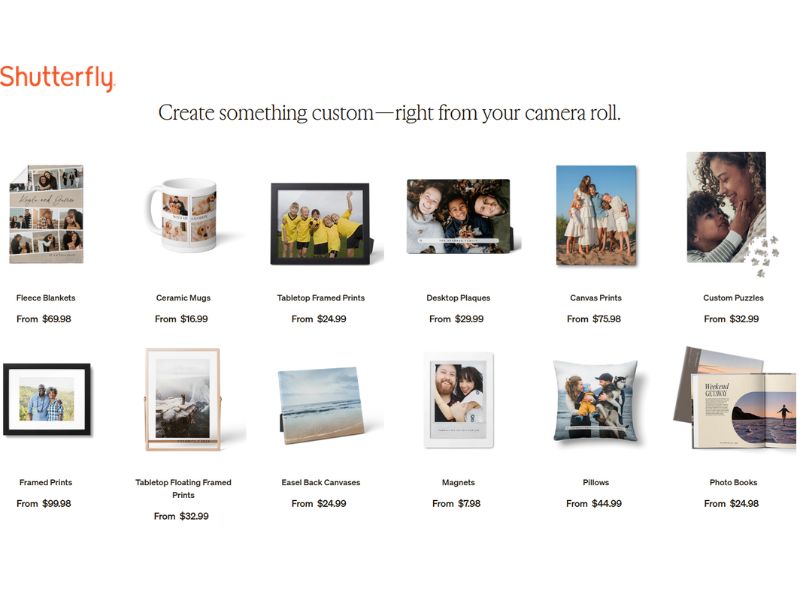
Today, Shutterfly offers more than 600 products across several key categories:
- Photo-based products: photo books, photo prints, framed prints, canvas, and metal prints
- Cards & stationery: greeting cards, wedding invitations, thank-you cards for special occasions
- Home decor: wall art, canvas prints, and photo-based decorations
- Personalized gifts: mugs, blankets, phone cases, puzzles, and other custom items
- Wedding services: end-to-end solutions from invitations to keepsake albums
In addition, Shutterfly provides several convenient features, including free address printing and address book storage, an automatic photo book design tool, and 1-hour print pickup through partners like CVS and Walgreens.
So why should you consider Shutterfly alternatives?
For personal use, Shutterfly does its job well. It’s convenient, beginner-friendly, and built for quick results.
For sellers, though, the limitations become more noticeable.
If you’re trying to build a brand or monetize your designs, here’s where the platform starts to fall short:
- Limited creative control: Most designs rely on fixed templates and basic editing tools, which can restrict branding and layout flexibility.
- No built-in selling features: There’s no way to create a storefront, set pricing, or sell directly to customers.
- Inconsistent print quality: With a wide product range, print quality may vary across different items. Professional creators often require better color accuracy and higher-quality materials.
- Costs can add up quickly: Although promotions are common, base prices and shipping fees can become expensive, especially for larger orders.
For these reasons, many creators and entrepreneurs begin looking for Shutterfly alternatives that are better aligned with long-term business growth.
10 potential Shutterfly alternatives for your brand in 2026
1. Mixbook
Among the top platforms for creating photo books, calendars, and high-quality printed products, Mixbook stands out for its advanced design control and premium output quality. While Shutterfly emphasizes convenience and a fast, user-friendly experience for mainstream users, Mixbook leans more toward creative flexibility.
Its design system allows users to customize nearly every element of a product. From photo books and cards to calendars and wall art, everything is built with modern templates and highly flexible editing capabilities at the page level.
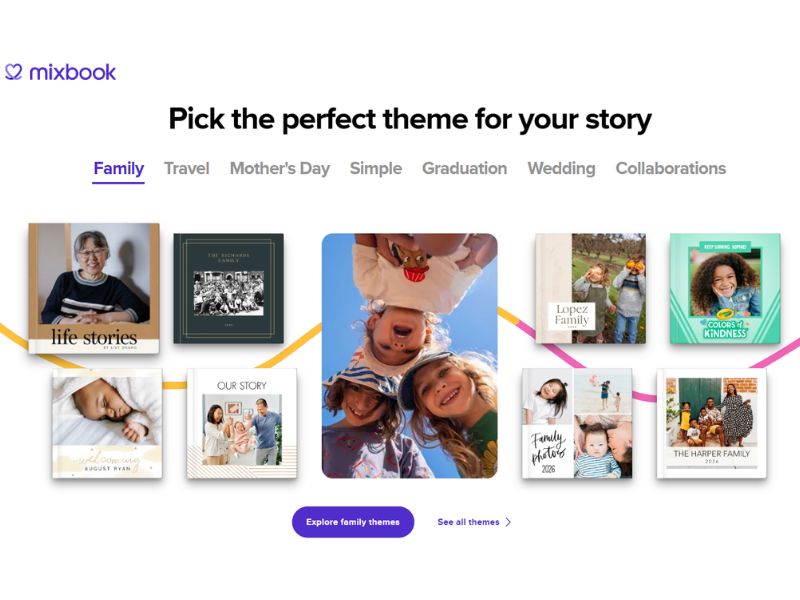
Compared to Shutterfly, Mixbook offers a higher level of creative freedom, particularly when it comes to layout control. Many reviews highlight its strong print quality, combined with deep customization capabilities that enable users to create more polished and personalized products.
The trade-off is that this level of flexibility requires more time and manual effort, especially when users need to arrange photos page by page. In addition, Mixbook is generally priced higher than mass-market alternatives, making it more suitable for important occasions such as weddings, anniversaries, or premium projects rather than everyday use.
Quick comparison: Mixbook vs Shutterfly
| Criteria |
Mixbook |
Shutterfly |
| Model |
Design-focused photo printing |
Photo printing (B2C) |
| Target users |
Users needing high design control |
General consumers |
| Main focus |
Premium photo books & storytelling |
Quick, convenient memory keeping |
| Customization |
Very high, full layout control |
Template-based |
| Print quality |
Premium |
Good, consistent |
| Design time |
Longer |
Faster |
| Pricing |
Higher |
More affordable |
If you only need to quickly create a photo book or a personalized gift, Shutterfly is a convenient choice. If you want to invest in a visually refined product with detailed layout control, then Mixbook is one of the best alternatives available.
2. Merchize
Built specifically for sellers, Merchize approaches print-on-demand from a completely different angle than Shutterfly. Instead of making personal photo gifts for family memories, Merchize is designed to help you build and grow a real business. While both platforms let you customize items, Merchize is all about commercial use and selling at scale.
One of its biggest strengths is production power. Merchize owns a massive factory in Vietnam and works with global fulfillment centers in the US, EU, UK, AU and China. This setup allows them to make over 100,000 items a day and start production from just 24 hours. For sellers, this means fast shipping and much lower base costs.
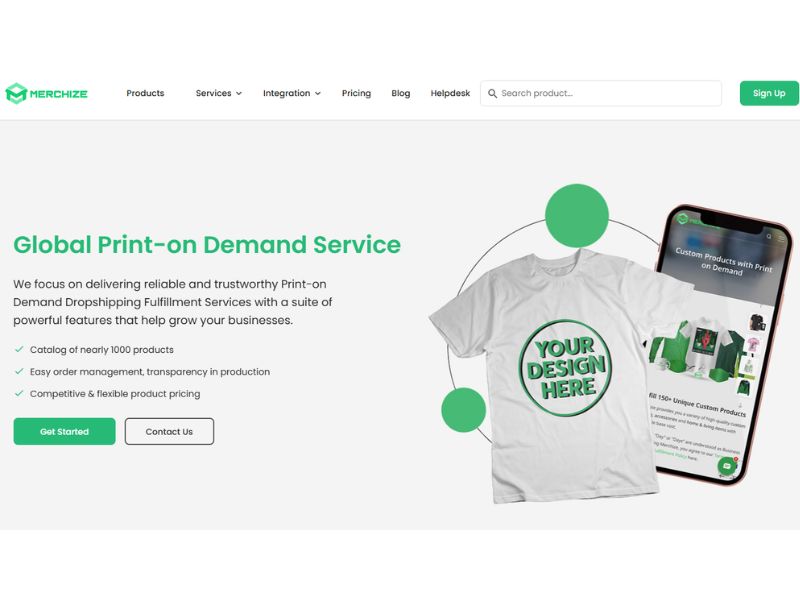
The product choice is also huge, with nearly 1,000 products available. You can sell standard things like t-shirts and home decor, or stand out with unique products like shaped window hangings and custom night lights. They also support many advanced printing methods from regular garment printing to laser cutting and embroidery giving you way more creative freedom than traditional photo websites.
One of Merchize’s biggest advantages is its production capability and quality control. With facilities in Vietnam and fulfillment centers across the US, EU, UK, Australia, and China, Merchize can maintain stable timelines while optimizing shipping costs. The platform is capable of producing over 100,000 items per day, with turnaround times starting from just one business day.
On the customization side, it supports a wide range of techniques including DTG, UV printing, embroidery, engraving, sublimation, and laser cutting. This opens up far more possibilities compared to traditional photo-printing platforms.
Beyond manufacturing, Merchize makes selling stress-free by connecting directly with major stores like Shopify, Etsy, Amazon, and TikTok Shop. They even offer extra services like building your own website, FBA support, and company gifts.
Quick comparison: Merchize vs Shutterfly
| Criteria |
Merchize |
Shutterfly |
| Model |
POD + in-house + global fulfillment |
Photo printing (B2C) |
| Target users |
Sellers / businesses |
Individual consumers |
| Main focus |
Building & scaling a business |
Memory keeping & gifting |
| Core products |
Diverse POD + niche items |
Photo books, wall art, gifts |
| Customization purpose |
For resale |
For personal use |
| Integrations |
Shopify, Etsy, Amazon… |
Not supported |
| Scalability |
High |
Limited |
If you are an individual looking to create photo books or meaningful personalized gifts, Shutterfly is an excellent choice. But if you’re building a business and need scalability, product diversity, and automation, Merchize is the more strategic option.
3. Snapfish
Snapfish is a cost-effective option for creating photo books, wall art, and personalized gifts, offering affordable pricing with a wide range of product choices. Designed with simplicity in mind, its user-friendly tools make it accessible for both beginners and experienced users. Frequent promotions and discounts further reinforce its appeal, especially for bulk orders such as photo cards or simple gifts.
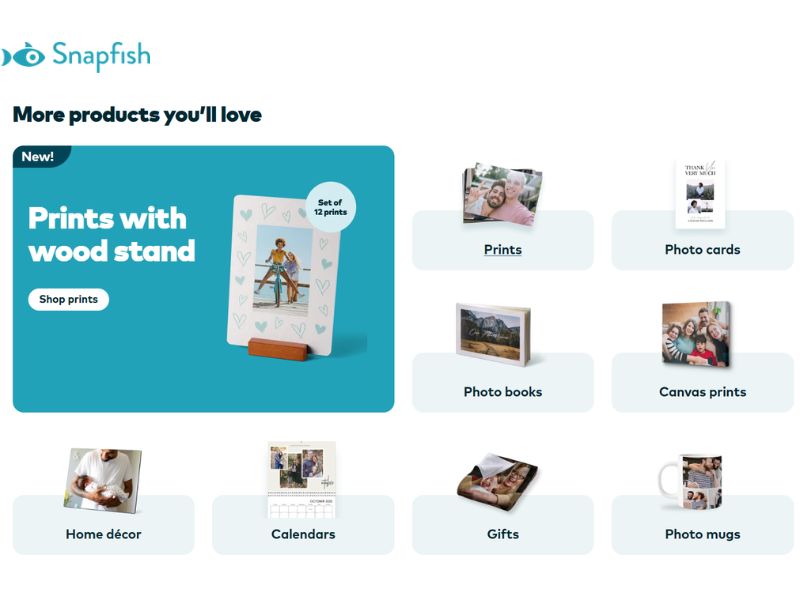
The platform offers a broad selection of products, including photo prints, home décor, and personalized gift items. Snapfish also focuses heavily on photo-based products and event-related items such as greeting cards, invitations, and stationery for occasions like birthdays, weddings, graduations, and holidays.
Despite its advantages in cost and simplicity, Snapfish comes with certain trade-offs. Print quality can be inconsistent across different product categories, with some items such as canvas prints, blankets, or puzzles receiving mixed feedback in terms of color accuracy and sharpness.
In addition, its design tools, while easy to use, are generally less advanced and somewhat outdated compared to more design-focused platforms. For most users, this trade-off is acceptable when cost savings matter more than premium output.
Quick comparison: Snapfish vs Shutterfly
| Criteria |
Snapfish |
Shutterfly |
| Model |
Photo printing (B2C) |
Photo printing (B2C) |
| Target users |
Budget-conscious consumers |
General consumers |
| Main focus |
Affordable photo products & cards |
Memory keeping & gifting |
| Customization |
Basic to moderate |
Moderate (template-based) |
| Print quality |
Varies |
More consistent |
| Pricing |
Lower |
Mid-range |
| Design tools |
Simple, slightly outdated |
More polished |
If your priority is saving costs, especially for bulk orders or simple designs, then Snapfish is a practical alternative worth considering.
4. Artifact Uprising
Known for its premium positioning, Artifact Uprising focuses on high-quality photo books, frames, and thoughtfully designed personalized gifts. Its strong emphasis on sustainability, including the use of eco-friendly materials like recycled paper, makes it stand out among Shutterfly alternatives.
The platform’s design language leans toward clean layouts, modern aesthetics, and premium materials, making it particularly appealing for wedding albums and high-end photography projects. This refined approach prioritizes visual consistency over flexibility, which may not suit users looking for more creative freedom.
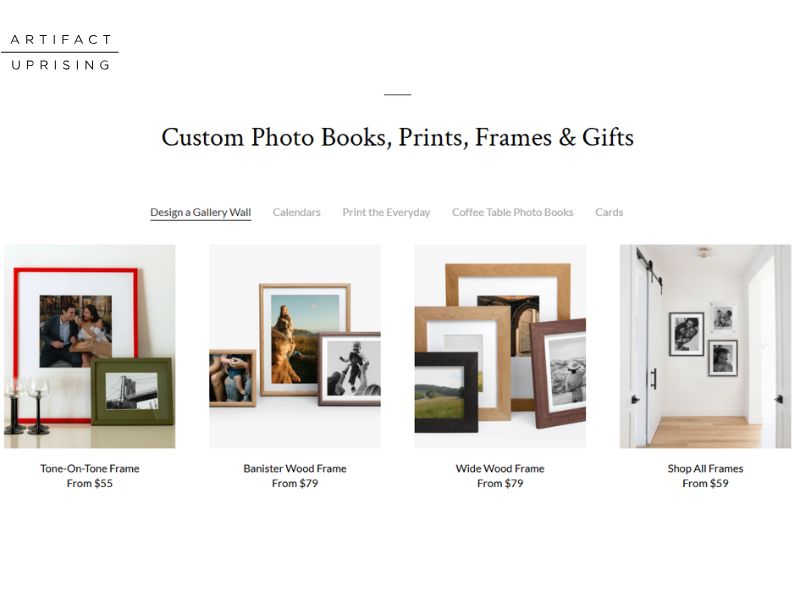
In contrast, its product range is more limited compared to broader photo printing platforms. While it excels in premium books and wall art, it does not offer as many product variations as other Shutterfly alternatives. The premium positioning also means that pricing is significantly higher, making it less suitable for everyday or large-volume printing needs.
Quick comparison: Artifact Uprising vs Shutterfly
| Criteria |
Artifact Uprising |
Shutterfly |
| Model |
Premium photo printing |
Photo printing (B2C) |
| Target users |
Premium / design-focused users |
General consumers |
| Main focus |
High-end photo books & gifts |
Memory keeping & gifting |
| Customization |
Limited but refined |
Moderate (template-based) |
| Print quality |
Premium, high-end finish |
Consistent mainstream quality |
| Pricing |
High |
Mid-range |
| Design style |
Minimalist, modern |
More flexible templates |
If you are looking for luxury-quality photo books with a minimalist, premium feel, Artifact Uprising is a strong choice.
5. Persnickety Prints
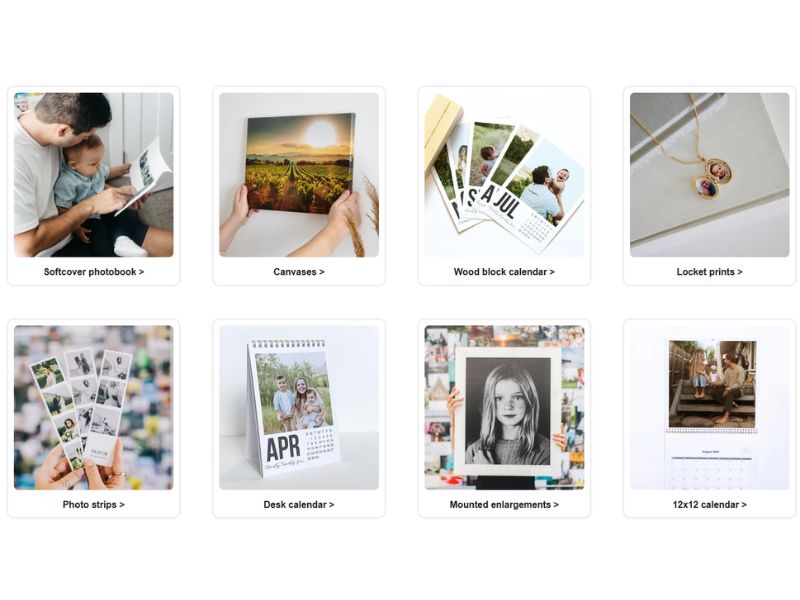
Persnickety Prints is a premium photo printing service designed for users who prioritize high archival quality and long-lasting print durability. With a strong focus on precision and color accuracy, it is especially favored by photographers and creatives who want to preserve images without degradation.
Built around precision, color accuracy, and professional-grade output, the platform is especially favored by photographers and creatives who want to preserve images over time without degradation.
The platform is commonly used for photo prints, wall art, photo books, and curated print collections. This also means it offers a more limited product range and fewer template-based tools, making it less suitable for users who prioritize speed and convenience.
Quick comparison: Persnickety Prints vs Shutterfly
| Criteria |
Persnickety Prints |
Shutterfly |
| Model |
Premium photo printing |
Photo printing (B2C) |
| Target users |
Photographers & quality-focused users |
General consumers |
| Main focus |
Archival-quality prints & color accuracy |
Memory keeping & gifting |
| Customization |
Limited, quality-focused |
Moderate (template-based) |
| Print quality |
Very high, archival-grade |
Good, consistent |
| Product variety |
Limited |
Broad ecosystem |
| Ease of use |
Moderate |
Easy |
If your priority is museum-level print quality, color accuracy, and long-term durability, Persnickety Prints is a strong alternative.
6. Blurb
For users working on professional or publishing-focused projects, Blurb serves as a strong alternative to Shutterfly. Equipped with advanced design tools, it is particularly well-suited for those who require detailed layout control and high-end output.
Its biggest strength lies in its ability to handle complex and highly customized designs. Therefore, it is a preferred choice for photographers, designers, and creators building portfolios or self-published books.
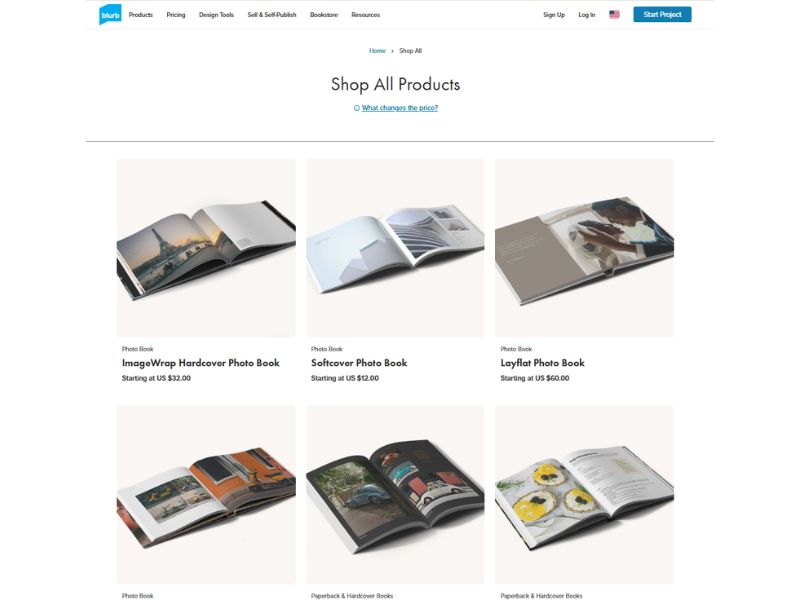
Blurb does require a steeper learning curve, and pricing can be relatively high for smaller orders. Despite this, it remains a reliable choice for users who prioritize print quality, design control, and professional-grade output.
Quick comparison: Blurb vs Shutterfly
| Criteria |
Blurb |
Shutterfly |
| Model |
Professional publishing platform |
Photo printing (B2C) |
| Target users |
Photographers, designers, publishers |
General consumers |
| Main focus |
Photo books, magazines, portfolios |
Memory keeping & gifting |
| Customization |
Very high (advanced layout control) |
Moderate (template-based) |
| Print quality |
Professional-grade |
Consistent mainstream quality |
| Pricing |
Higher |
Mid-range |
| Ease of use |
Complex |
Easy |
If you need professional-level control for photo books, portfolios, or publishing projects, Blurb is a strong option.
7. PhotoBox
Popular in the UK market, PhotoBox is recognized for combining affordability with fast delivery and simple customization tools. It positions itself as a practical option for users who need quick and accessible photo products.
It offers a wide range of products including canvas prints, photo books, calendars, and personalized home décor items. The platform is particularly popular for gifting purposes, thanks to its fast turnaround time, which makes it a convenient choice when users need personalized gifts.
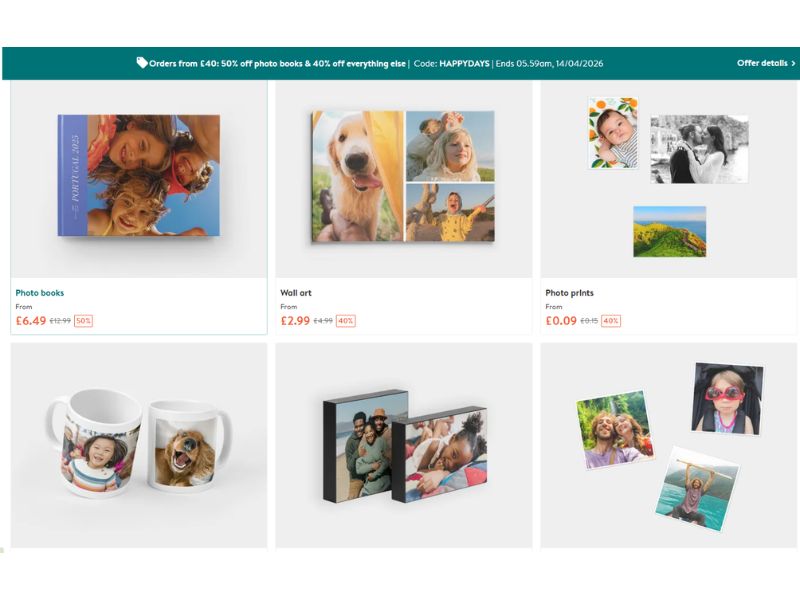
Compared to more platforms, its customization options are more limited, especially for users who want advanced layout control or highly detailed design work.
Quick comparison: PhotoBox vs Shutterfly
| Criteria |
PhotoBox |
Shutterfly |
| Model |
Photo printing (B2C) |
Photo printing (B2C) |
| Target users |
Budget & convenience-focused users |
General consumers |
| Main focus |
Affordable photo gifts & fast delivery |
Memory keeping & personalized gifts |
| Customization |
Basic |
Moderate (template-based) |
| Print quality |
Good for the price |
More consistent overall |
| Speed |
Fast |
Standard |
| Design tools |
Simple |
More structured |
Overall, while PhotoBox may not be the best choice for professional or highly customized projects, it remains a practical solution for anyone who wants a quick, affordable way.
8. VistaPrint
Built with small businesses in mind, VistaPrint focuses on helping users create professional marketing materials, branded merchandise, and printed products at scale. Its ecosystem is centered around brand consistency, offering solutions that range from business cards and flyers to packaging and custom merchandise, all designed to support cohesive branding.
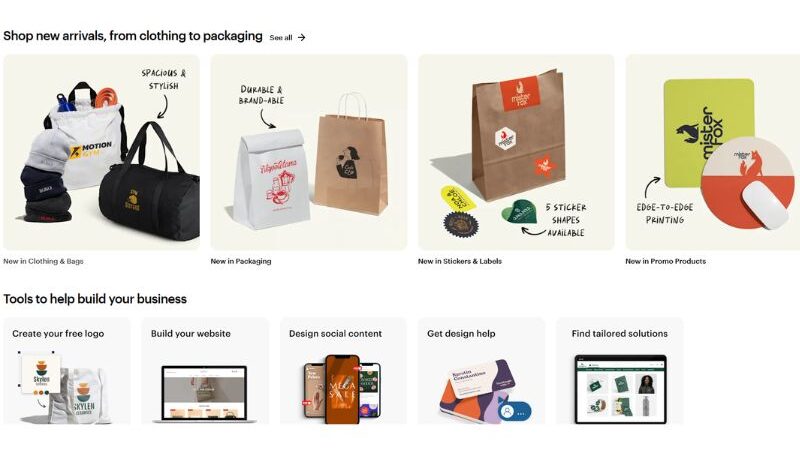
VistaPrint is ideal for small businesses, startups, and organizations that need consistent quality across large orders. Its user-friendly design tools and reliable customer support also make it accessible for beginners.
However, VistaPrint is not optimized for advanced photo editing; its focus is more on structured design templates for business use. Still, its affordability makes it an alternative when the goal is business branding rather than personal keepsakes.
Quick comparison: VistaPrint vs Shutterfly
| Criteria |
VistaPrint |
Shutterfly |
| Model |
Business printing & branding |
Photo printing (B2C) |
| Target users |
Small businesses & brands |
General consumers |
| Main focus |
Branding materials & marketing assets |
Memory keeping & gifts |
| Product range |
Business cards, flyers, merch, limited photo items |
Photo books, wall art, gifts |
| Customization |
Template-based, brand-focused |
Template-based, photo-focused |
| Bulk orders |
Strong advantage |
Moderate |
| Use case |
Brand consistency & marketing |
Personal memories & gifting |
More: Best 15 Vistaprint Alternatives Worth Trying in 2026
9. Zazzle
Operating as a large-scale print-on-demand marketplace, Zazzle enables users to create highly unique and customizable designs across thousands of products. It connects customers with independent designers from around the world.
Through its marketplace model, designers can upload artwork and templates that customers can personalize, turning each product into a customized item. Beyond customization, the platform also offers monetization opportunities through royalties and storefronts, giving designers a way to monetize their work while reaching a broader global audience. For sellers, this creates opportunities, but also requires more effort to stand out in a highly competitive marketplace.
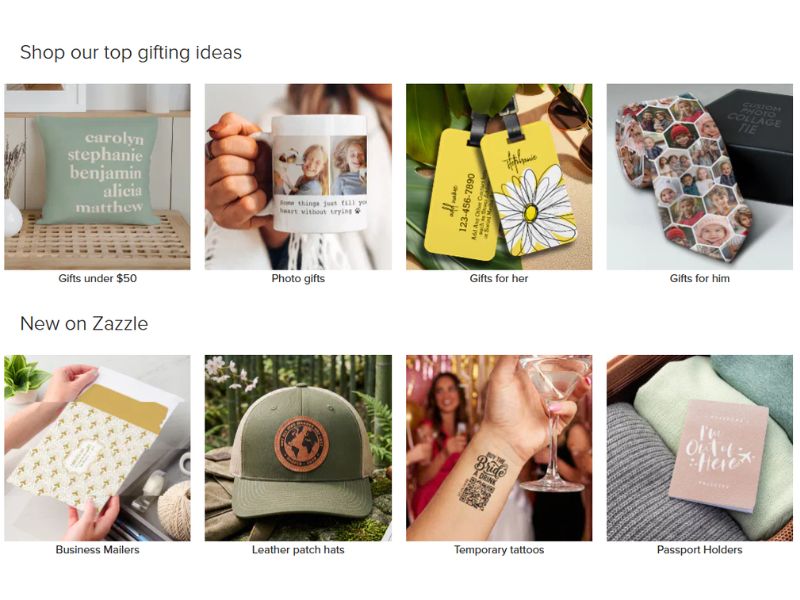
The downside becomes more noticeable when product quality varies across categories, and the marketplace interface can feel overwhelming for new users. Additionally, Zazzle is less focused on premium photo books or archival-quality printing, and more oriented toward everyday personalized gifts and event-based products.
Quick comparison: Zazzle vs Shutterfly
| Criteria |
Zazzle |
Shutterfly |
| Model |
Print-on-demand marketplace |
Photo printing (B2C) |
| Target users |
Creators, niche buyers, gift shoppers |
General consumers |
| Main focus |
Creative customization & unique designs |
Photo memory products & gifting |
| Product variety |
Extremely wide (multi-category) |
Focused on photo-based products |
| Customization |
Very high (design + personalization) |
Moderate (template-based) |
| Print consistency |
Varies by product |
More consistent overall |
| User experience |
More complex |
More structured & simple |
10. Picaboo
Picaboo is a user-friendly platform designed for creating simple and personalized photo projects, especially photo books, calendars, and greeting cards. Its templates are organized by occasions such as travel, weddings, babies, and family events, making it easy to start a project without designing from scratch.
One of Picaboo’s key advantages is its transparent and straightforward pricing model. Compared to some competitors, it avoids heavy upselling and provides a more predictable cost structure, which is appreciated by users who want clarity in their purchasing process. Print quality is generally solid, and options like hardcover and softcover photo books make it suitable for personal keepsakes.
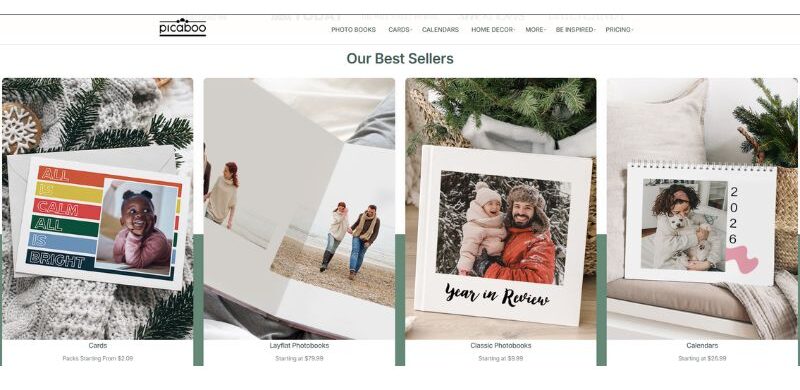
However, Picaboo is more focused on personal projects rather than professional-grade design work. It offers fewer advanced customization tools compared to more design-heavy platforms, and its user base is smaller, which means less ecosystem variety compared to larger competitors like Shutterfly or Snapfish.
Quick comparison: Picaboo vs Shutterfly
| Criteria |
Picaboo |
Shutterfly |
| Model |
Photo book & gift printing |
Photo printing (B2C) |
| Target users |
Casual users & personal projects |
General consumers |
| Main focus |
Simple photo books & gifts |
Memory keeping & personalized products |
| Customization |
Basic–moderate |
Moderate |
| Pricing |
Transparent, predictable |
More upsell-driven |
| Design tools |
Simple, clean editor |
More structured templates |
| Product variety |
Limited |
Broader range |
Shutterfly competitors comparison chart
1. Printing options
| Platform |
Photo books |
Wall art |
Apparel |
Business products |
POD marketplace |
| Shutterfly |
Y |
Y |
|
|
|
| Merchize |
Y |
Y |
Y |
Y |
Y |
| Mixbook |
Y |
Y |
|
|
|
| Snapfish |
Y |
Y |
|
|
|
| Artifact Uprising |
Y |
Y |
|
|
|
| Persnickety Prints |
Y |
Y |
|
|
|
| Blurb |
Y |
|
|
Y |
|
| PhotoBox |
Y |
Y |
|
|
|
| VistaPrint |
|
|
Y |
Y |
|
| Zazzle |
Y |
Y |
Y |
Y |
Y |
| Picaboo |
Y |
Y |
|
|
|
2. Facilities (Production locations)
| Platform |
Facilities |
| Shutterfly |
USA |
| Merchize |
Vietnam, USA, China, EU, UK, Australia |
| Mixbook |
USA, Europe |
| Snapfish |
USA, EU |
| Artifact Uprising |
USA |
| Persnickety Prints |
USA |
| Blurb |
USA, EU |
| PhotoBox |
UK, EU |
| VistaPrint |
USA, EU, Asia |
| Zazzle |
USA |
| Picaboo |
USA |
3. Integrations
| Platform |
Shopify |
Etsy |
WooCommerce |
Amazon |
eBay |
API |
| Shutterfly |
|
|
|
|
|
|
| Merchize |
Y |
Y |
Y |
Y |
Y |
Y |
| Mixbook |
|
|
|
|
|
|
| Snapfish |
|
Y |
|
|
|
|
| Artifact Uprising |
|
|
|
|
|
|
| Persnickety Prints |
|
Y |
|
|
|
|
| Blurb |
|
Y |
|
|
|
|
| PhotoBox |
|
|
|
|
|
|
| VistaPrint |
Y |
Y |
|
|
|
Y |
| Zazzle |
|
Y |
|
|
|
Y |
| Picaboo |
|
|
|
|
|
|
4. Branding options
| Platform |
White-label packaging |
Labels |
Custom branding |
| Shutterfly |
|
|
|
| Merchize |
Y |
Y |
Full branding support |
| Mixbook |
|
|
|
| Snapfish |
|
|
|
| Artifact Uprising |
|
|
|
| Persnickety Prints |
|
|
|
| Blurb |
|
|
Limited |
| PhotoBox |
|
|
|
| VistaPrint |
Y |
Y |
Strong branding focus |
| Zazzle |
|
|
Designer storefronts |
| Picaboo |
|
|
|
Factors to consider when choosing a Shutterfly alternative
When evaluating alternatives to Shutterfly, the key is understanding how each platform fits your actual workflow. The right choice depends on how much control, convenience, and cost efficiency you need.
Photo import flexibility – Check whether the platform supports importing images from cloud services, social media accounts, or if it relies only on manual uploads. This becomes especially important when your photo library is spread across multiple devices and platforms.
Workflow simplicity – Evaluate how much effort is required to complete a project from start to finish. Some tools automate layout creation, while others require users to manually arrange every element, which can significantly affect speed and convenience.
Print output and product formats – Look into material options such as paper finish (gloss or matte), binding styles (hardcover or softcover), and available sizing. These choices directly impact the final look and overall feel of the printed product.
Pricing clarity – Many platforms use discount-heavy pricing models that can make base prices misleading. Prioritize services with straightforward and transparent pricing structures to better control overall costs.
Creative control level – Consider whether you prefer full design freedom with manual adjustments, or a guided experience where layouts and designs are automatically generated with minimal effort required.
The right platform ultimately comes down to how well it aligns with your goals and where you want your business to go next. While Shutterfly can be a good entry point, it isn’t always the most flexible solution as your needs evolve. Looking into different Shutterfly alternatives can open up better opportunities in terms of cost efficiency, consistent quality, and brand control.