
Contents
- Key Takeaways
- Common T-shirt size chart measurements
- Understand common t-shirt fits to advise based on customer needs
- Reference women’s t-shirt size chart
- Reference men’s t-shirt size chart
- Men’s & women’s size conversion guide
- How POD sellers can build a clear t-shirt size chart to optimize conversion rates
Choosing the right T-shirt size can be challenging for online buyers, especially when sizing varies by supplier and fit. For sellers, a clear size chart helps customers compare measurements, choose the right fit, and shop with greater confidence. This guide covers men’s and women’s T-shirt size charts, common fit types, size conversion tips, and practical ways to display sizing information in your store.
Key Takeaways
- Use your supplier’s exact size chart for each T-shirt style to prevent sizing errors and customer complaints.
- Keep garment measurements and body measurements clearly labeled so buyers know which numbers to compare.
- Match each fit type to your target audience, from Standard Fit for everyday wear to oversized fit for streetwear niches.
- Show both inches and centimeters, with clear measuring guides to help international buyers choose the right size.
- Place the size chart near the size selector and Add to Cart button to help customers make faster purchase decisions.
- Keep sizing information consistent across product pages, mockups, and marketplaces to reduce returns and build buyer trust.
Common T-shirt size chart measurements
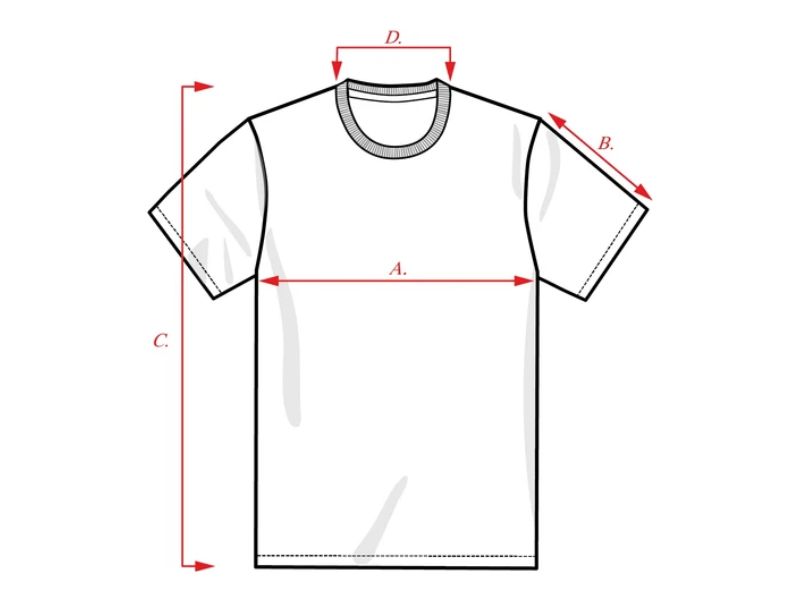
Depending on the supplier or shirt fit, a t-shirt size chart usually uses a combination of the measurements below. Understanding the meaning and measuring method for each parameter will help you advise accurately and minimize return risks.
- Chest width: Place the shirt flat on a surface, measure horizontally from the underarm point on one side to the underarm point on the other side. You need to check the supplier’s measurement diagram to accurately identify the measurement position.
- Shirt length (Length/ Body length): Measure straight down from the highest point of the shoulder (next to the collar) to the bottom hem.
- Body bust: Measure around the fullest part of the chest. This parameter helps customers compare their body size with the recommended size range.
- Sleeve length: The measuring method may vary depending on the product. The starting point can be at the shoulder seam or another position according to the supplier’s instructions.
- Shoulder width: Measure horizontally from the left shoulder seam edge to the right shoulder seam edge across the upper back.
- Waist: Measure around the natural waist of the body. This parameter may appear in fitted women’s shirt size charts, but not every t-shirt size chart needs to use it.
Note: You need to check the above definitions against the actual measurement diagram of each product. Do not assume all suppliers apply the same measuring method.
Understand common t-shirt fits to advise based on customer needs
Each t-shirt fit brings a completely different style and wearing experience. Understanding each fit helps sellers design accurate size charts while catching the right shopping needs of each target customer group.
-
Regular fit (Standard fit)
This is a classic style with a slightly straight cut, fitting naturally from chest to hip without being too tight or too loose. This fit is suitable for people looking for safety, prioritizing versatility and comfort for daily wear, school, or work. This is a best-selling fit because it is easy to wear and suitable for the majority of body shapes.
-
Relaxed fit (Comfortable fit)
Relaxed fit is slightly wider than the standard fit, creating extra room at the chest and waist while still maintaining a neat shape without swallowing the figure. This style usually targets customers who like comfort, freedom of movement, or people who want to hide body flaws around the belly and waist. This is an ideal choice for loungewear, outdoor, or summer fashion collections.
-
Oversized fit (Trendy loose fit)
Unlike simply sizing up, the oversized fit is intentionally designed with dropped shoulders, a wider body, and a longer hem to create a relaxed shape. Oversize strongly attracts young customers, people who love streetwear style, unisex, or like layering outfits.
See more: Oversized Clothing Trend & How to Build a Best-Selling Line
Reference women’s t-shirt size chart
Women’s t-shirt fits have unique features in their cuts to highlight the wearer’s figure. Therefore, you need to clearly understand this to accurately advise shirt sizes for customers, minimizing returns due to improper fitting.
- Collar: Usually wider (wide round neck or deep v-neck).
- Shoulder line: Narrower width to suit the female bone structure.
- Sleeves: Designed shorter and slightly fitted around the biceps.
- Body: Lightly tapered at the waist and gradually expanding down to the hips to highlight body curves.
When listing women’s t-shirts, sellers should use individual product measurements instead of assuming all women’s shirt styles follow the same size standard.
Women’s standard t-shirt size chart
| Size | USA | AUS/NZ/UK | Bust | Waist | Hips |
| XS | 0–2 | 8 | 32–34" (83–87 cm) | 24.5–26.5" (63–67 cm) | 35.5–37.5" (91–95 cm) |
| S | 4–6 | 10 | 34–36" (88–92 cm) | 26.5–28.5" (68–72 cm) | 37.5–39.5" (96–100 cm) |
| M | 8 | 12 | 36–38" (93–97 cm) | 28.5–30.5" (73–77 cm) | 39.5–41.5" (101–105 cm) |
| L | 10 | 14 | 38–40" (98–102 cm) | 30.5–32.5" (78–82 cm) | 41.5–43.5" (106–110 cm) |
| XL | 12 | 16 | 40–42" (103–107 cm) | 32.5–34.5" (83–87 cm) | 43.5–45.5" (111–115 cm) |
| XXL | 14 | 18 | 42–44" (108–112 cm) | 34.5–36.5" (88–92 cm) | 45.5–47.5" (116–120 cm) |
The table below provides reference female body measurements to compare with clothing sizes. Size labels and measurement ranges may vary depending on the brand or supplier. Sellers should use this table for initial reference and prioritize official product specs when listing. If you are a POD seller, you can refer to some t-shirt size charts from Merchize:
-
2D women’s t-shirt: Standard fit line (Regular Fit), extremely easy to sell.
| US SIZE | LENGTH (Inch) | LENGTH (Cm) | WIDTH (Inch) | WIDTH (Cm) | SLEEVE (Inch) | SLEEVE (Cm) |
| XS | 24.0 | 61.0 | 16.0 | 40.6 | 5.0 | 12.7 |
| S | 26 | 66 | 18.0 | 45.7 | 5.5 | 14.0 |
| M | 26.5 | 67.3 | 19.0 | 48.3 | 6 | 15.2 |
| L | 28 | 71.1 | 20.5 | 52.1 | 6.3 | 16.0 |
| XL | 28.5 | 72.4 | 22.5 | 57.2 | 6.7 | 17.0 |
| 2XL | 30.5 | 77.5 | 24.5 | 62.2 | 6.9 | 17.5 |
| 3XL | 30.5 | 77.5 | 26.5 | 67.3 | 7 | 17.8 |
-
Women’s t-shirt Gildan 5000L (Made in US): Shirt line specifically designed according to women’s fit standards in the US market (US Fit), slightly flattering at the waist and chest. The product is very suitable for women’s fashion niches sold in the North American market.
| Size | Length (Inch) | Length (Cm) | Width (Laid Flat) (Inch) | Width (Laid Flat) (Cm) | Sleeve Centre Back (Inch) | Sleeve Centre Back (Cm) |
| S | 25.5 | 64.8 | 17.25 | 43.8 | 13.25 | 33.6 |
| M | 26 | 66.0 | 19.25 | 48.9 | 14 | 35.6 |
| L | 27 | 68.6 | 21.25 | 54 | 14.75 | 37.5 |
| XL | 28 | 71.1 | 23.25 | 59 | 15.75 | 40 |
| 2XL | 28.5 | 72.3 | 25.25 | 64.1 | 16.75 | 42.52 |
| 3XL | 29 | 73.6 | 27.25 | 69.2 | 17.5 | 44.45 |
-
Women’s t-shirt Gildan 6400L (Made in EU): Women’s t-shirt manufactured and printed directly in the EU. The size chart for this line follows EU standards (usually slightly slimmer than US sizes), making it an optimal choice if your store focuses on the European market.
| EU SIZE | Width (Inch) | Width (Cm) | Length (Inch) | Length (Cm) | Sleeve Center Back (Inch) | Sleeve Center Back (Cm) |
| S | ||||||
| M | ||||||
| L | ||||||
| XL | ||||||
| 2XL |
Reference men’s t-shirt size chart
Men’s t-shirts usually focus on cuts that highlight shoulder and chest structure while providing maximum comfort during movement.
- Shoulder & chest: Wider shoulder seams, expanded chest area to create comfort for the upper body frame.
- Body: Straight design from underarm to hem (no waist tapering like women’s shirts), creating a strong, masculine look.
- Sleeves: Roomier sleeves, length usually reaches the middle of the bicep.
- Length: Men’s shirt bodies are usually longer than women’s to maintain a proper fit even during active movement or tucking in.
Men’s body measurement size chart
| Size | Chest Circumference (cm) | Chest Circumference (in) | Waist (cm) | Waist (in) |
| XXS | 72–80 | 28–31 | 57–65 | 22–25 |
| XS | 80–88 | 31–34 | 65–73 | 25–28 |
| S | 88–96 | 34–38 | 73–81 | 28–32 |
| M | 96–104 | 38–41 | 81–89 | 32–35 |
| L | 104–112 | 41–44 | 89–97 | 35–38 |
| XL | 112–124 | 44–49 | 97–109 | 38–43 |
| 2XL | 124–136 | 49–53 | 109–121 | 43–48 |
| 3XL | 136–148 | 53–58 | 121–133 | 48–52 |
| 4XL | 148–160 | 58–63 | 133–145 | 52–57 |
Men’s garment size chart
| Size | Chest Width (in) | Chest Width (cm) | Body Length (in) | Body Length (cm) |
| XXS | 17–18 | 43–46 | 26–27 | 66–68 |
| XS | 18–19 | 46–48 | 27–28 | 68–71 |
| S | 19 | 48 | 28 | 71 |
| M | 20 | 51 | 29 | 74 |
| L | 22 | 56 | 30 | 76 |
| XL | 24 | 61 | 31 | 79 |
| 2XL | 25–26 | 63–66 | 32–33 | 81–84 |
| 3XL | 26–27 | 66–68 | 33 | 84 |
| 4XL | 27–28 | 68–71 | 34 | 86 |
This size chart is for reference only. Different suppliers will have slight variations.
Tips for advising men’s t-shirt sizing
- Advise based on height & weight: Male customers are often hesitant to measure themselves with a tape measure. If possible, sellers should include a reference height/weight conversion chart to help customers order faster.
- Customer is between 2 sizes: Guide the customer to compare actual shirt measurements with a shirt that currently fits them well. If they prefer a loose fit, customers can consider a larger size after checking the size chart and product width. For cotton shirts, refer to care instructions and shrinkage information provided by the supplier before offering advice.
- Always prioritize actual size charts from suppliers: Each print factory/supplier has its own technical specifications chart. Sellers should use the official size chart from the supplier they are using.
Men’s & women’s size conversion guide
When selling cross-border or offering unisex products, sellers very often receive questions from female customers who want to buy men’s fit shirts (or vice versa). Providing a quick conversion rule will help customers choose sizes more easily, thereby effectively increasing conversion rates.
Note: All conversion tables below are for REFERENCE only. Actual female fit varies greatly between brands. The best way to avoid complaints is still guiding customers to measure shirt chest width (Armpit-to-Armpit) and compare directly with the supplier’s size chart.
General conversion rules
- From female size to unisex/ male: Male/unisex shirts usually have a straight cut, roomier at the shoulders and chest. Female customers who want a tailored fit should decrease by 1 size compared to the male size. If they want an even tighter fit, they can decrease by 2 sizes.
- From male size to female: Female shirts have a fitted cut, shorter body, and waist tapering. Therefore, the general rule when converting from male size to female size is to increase by 1 size (for example: male size L is equivalent to female size XL).
Reference conversion table from female size to unisex size
| Women’s Size | Unisex Size |
| XS | XS |
| S | XS |
| M | S |
| L | M |
| XL | L |
| 2XL | XL |
Reference conversion table from unisex size to female size
| Unisex Size | Women’s Size |
| XS | S |
| S | M |
| M | L |
| L | XL |
| XL | 2XL |
| 2XL | 2XL |
Reference conversion table from male size to female size
| Men’s Size | Women’s Size |
| XS | S |
| S | M |
| M | L |
| L | XL |
| XL | 2XL |
| 2XL | 2XL |
How POD sellers can build a clear t-shirt size chart to optimize conversion rates
- Use exact supplier specifications: Use the official size chart for each specific product. Do not apply a single general chart to standard shirts, fitted shirts, oversized shirts, and unisex shirts unless confirmed by the supplier.
- Clearly state measurement types: Distinguish body measurements from finished garment measurements. Explain how to measure chest width, body length, and sleeve length so customers understand the parameters correctly.
- Display both inches & centimeters: Provide both units of measurement to serve customers across different markets. Ensure conversion figures remain consistent across size charts, product images, and descriptions.
- Place size charts near the size selection area: Help customers easily view information when selecting sizes and shirt colors. A direct link or pop-up right on the product page helps them check measurements faster.
- Synchronize size information: Double check measurements across product descriptions, images, size chart generators, and e-commerce marketplace listings. Update all locations whenever the supplier changes parameters.
- Consider size recommendation tools: If using Shopify, sellers can consider size recommendation apps based on customer inputs. Before integrating, test compatibility, setup requirements, and how the tool generates recommendations.
Building an intuitive & accurate T-shirt size chart for men and women plays an extremely important role in building trust with international shoppers. When size specs are displayed transparently, customers can easily compare and make quick purchasing decisions. Always double check official specs for each product before publishing to achieve sustainable growth.