Contents
There is no denying that Custom Ink is a giant with reliable printing services for group and business orders. However, as the printing and e-commerce markets become highly specialized, a one-size-fits-all solution sometimes cannot meet every deep customization need.
Actively looking for Custom Ink alternatives is a way to expand your perspective and reach partners who have a product catalog that better fits your project. Keep reading to get more.
About Custom Ink
Custom Ink has long been one of the famous names in the custom printing and design industry for organizations, groups, and businesses. This success is well-deserved: the platform is easy to use, offers reasonable prices for bulk orders, and handles everything from design to shipping.
Starting as a small startup in 2000 in Virginia (USA), Custom Ink has had an impressive 25-year journey of development. Currently, the company has expanded its scale to more than 1,600 employees worldwide, while acquiring two major platforms, Swag.com and Swag Pro (Printfection), to optimize services for corporate clients and the B2B segment.
Custom Ink’s product ecosystem is extremely rich with more than 10,000 different options. Besides the core product line of apparel (T-shirts, jackets, hoodies, protective gear), this platform also provides a wide variety of other premium items such as tech accessories, water bottles, office supplies, bags, and event merchandise. Notably, Custom Ink also partners with famous brands like Nike, Patagonia, The North Face, or Yeti to bring the best quality blank products to users.
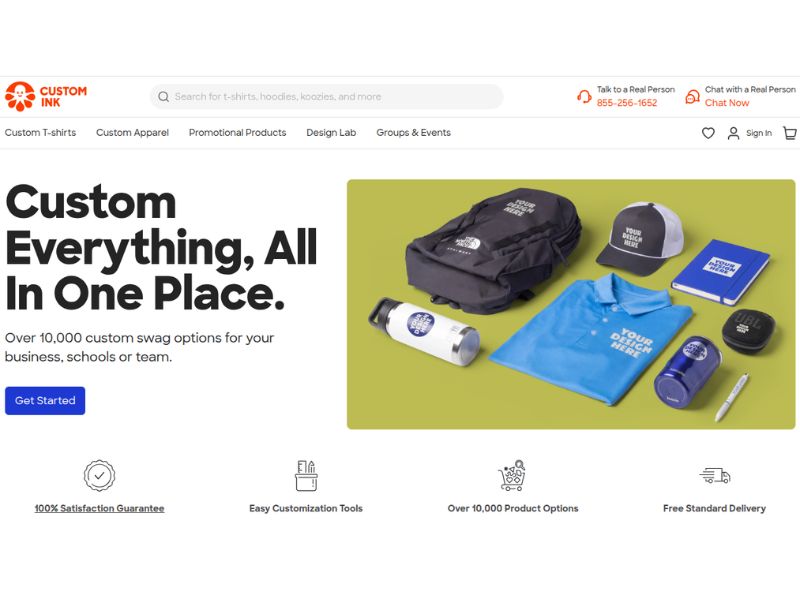
Custom Ink’s outstanding strength lies in its intuitive online design tool (Design Lab), which allows customers to easily upload or create designs right on the website. Custom Ink also focuses on improving the experience with dedicated design support from a team of experts, aiming for a 100% satisfaction guarantee and free standard shipping.
So, is it necessary to consider Custom Ink alternatives?
While it is undeniable that Custom Ink is very user-friendly and has many outstanding advantages, this platform still has certain limitations.
Because it does not operate entirely on a Print-on-Demand model for individual small customers, Custom Ink usually requires a minimum order quantity for many product lines. If you buy in small quantities, the cost will be quite high.
In addition, Custom Ink is not an ideal place for artists who want to upload designs to earn passive income, because Custom Ink will not automatically handle the retail selling and shipping process for each of your customers. You will have to order in bulk, manage the inventory, and ship to customers yourself.
Furthermore, their shipping network is currently only optimized for the North American market and is not yet truly flexible worldwide.
Therefore, looking into Custom Ink alternatives is completely a good strategy if you are looking for a model that helps optimize costs, avoids inventory worries, and allows you to sell flexibly to the world.
Top potential Custom Ink alternatives in 2026
1. Printify
Printify operates on a Print-on-Demand (POD) model, connecting sellers with a network of partner printing factories in many countries. Instead of printing by themselves, Printify acts as an intermediary, allowing you to compare prices, choose suppliers, and route orders to the factory closest to the customer’s location to save shipping time.
This platform focuses heavily on dropshipping businesses thanks to its ability to integrate directly with popular e-commerce platforms like Shopify or Etsy. When a customer places an order, the system automatically syncs and transfers the information to the printing factory for production, then ships it directly to the buyer. This process helps sellers run a business without spending capital on inventory or managing warehouses.
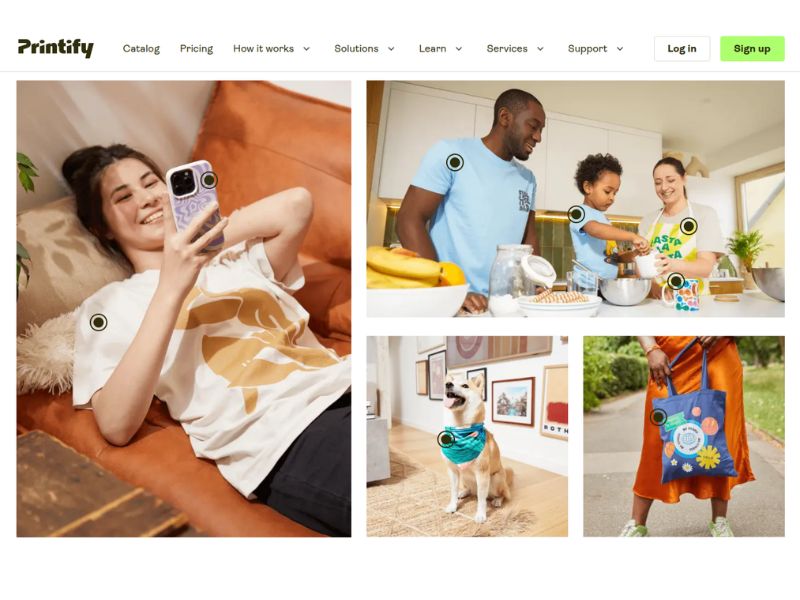
In terms of products, Printify has a catalog of more than 1,300 items, including basic apparel (T-shirts, hoodies, hats) and other common items (mugs, bags, phone cases, wall art). The difference compared to traditional printing factories is that they do not require a minimum order quantity, meaning the system still processes even a single order. In addition, sellers can add logos to labels or customize packaging to increase brand recognition.
Relying entirely on third parties makes it difficult for Printify to control quality. Finished products from different printing factories will have differences in color and fabric quality. Therefore, sellers must spend money to order samples to check by themselves before deciding to sell long-term.
Quick comparison: Printify vs Custom Ink
| Criteria | Printify | Custom Ink |
| Model | POD/Dropshipping | Bulk printing (Serving groups/Businesses) |
| Product quantity | Diverse catalog with over 1,300 items | Over 10,000 options (Strong in uniforms, protective gear, gifts) |
| Minimum quantity | From 1 product | Minimum order quantity applies |
| Target audience | Individual online sellers, MMO players | Companies, schools, event organizers |
Read more: Printify Alternatives: 11 Powerful Options for Sellers in 2026
2. Printful
Instead of distributing through third parties, Printful directly operates its own in-house production facilities in many regions around the world. This self-managed model helps them shorten local delivery times and solve the problem of maintaining stable product quality.
This platform focuses heavily on professional branding solutions for sellers. You can fully customize everything from embroidered logos and printed labels inside the collar to the packaging. Notably, this system has updated its features to support bulk printing for warehousing, while also providing pre-designed packaging templates and eco-friendly reusable packaging options.
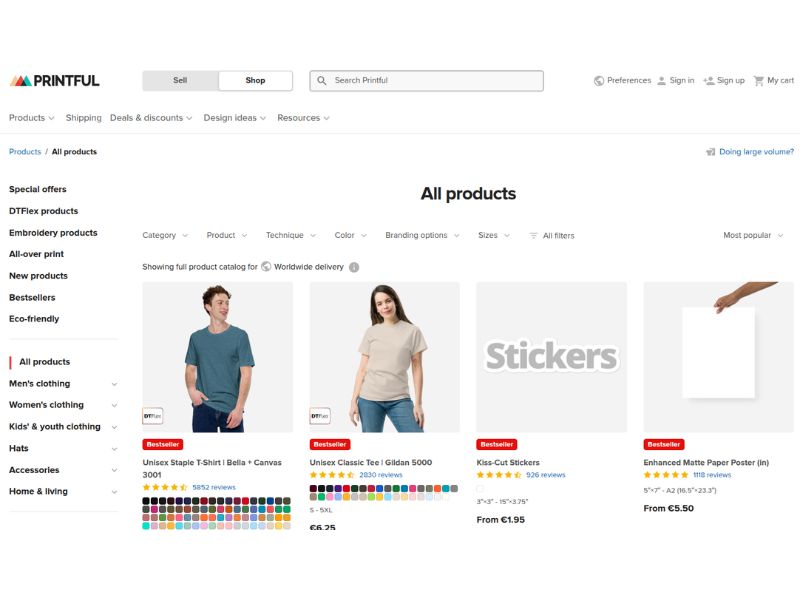
In terms of catalog, Printful’s products focus on popular categories such as fashion apparel, hats, wall art, and home decor with sharp and intuitive product mockup images. However, the number of products here is somewhat limited with 505 items and fewer specialized goods compared to some other custom printing partners on the market.
Quick comparison: Printful vs Custom Ink
| Criteria | Printful | Custom Ink |
| Model | In-house production POD | In-house bulk printing |
| Quality control | Consistent and stable | Premium, carefully inspected |
| Product catalog | Less diverse with 505 products | Over 10,000 options |
| Minimum quantity | From 1 product | Minimum order quantity applies |
| Target audience | Independent fashion brands, online sellers | Companies, schools, event organizers |
Read more: 12 Cheap Printful Alternatives to Maximize Your Profits in 2026
3. Merchize
When your goal goes far beyond the usual POD model and looks toward building a large-scale e-commerce business, Merchize is a comprehensive solution well worth considering.
Not an intermediary, Merchize directly owns the production process through an in-house factory of over 70,000 sq.ft (in Vietnam) combined with a strategic distribution warehouse system in the US, EU, UK, Australia, and China. This control over the supply chain helps significantly optimize base costs and ensures consistent product quality when exporting to more than 118 countries.
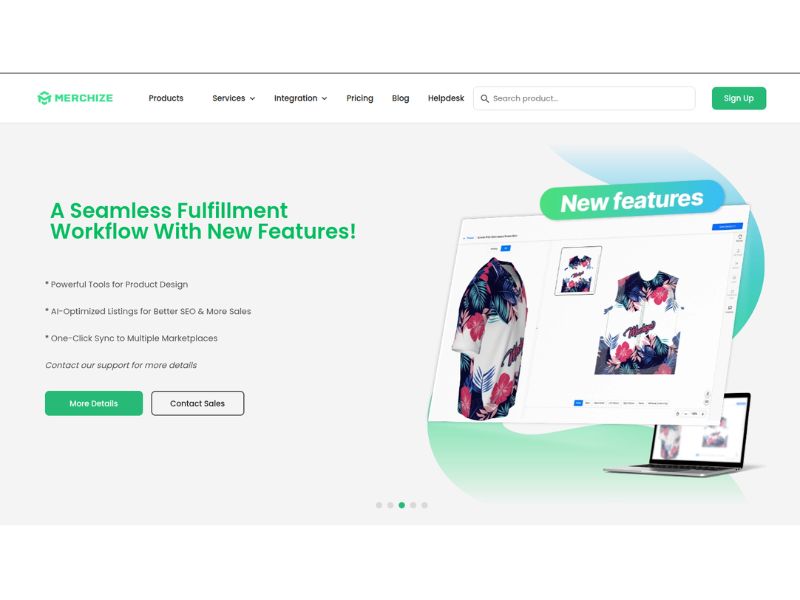
Merchize’s core strength lies in its high technical customization capability with a diverse catalog of nearly 1,000 products (especially strong in All-Over Print (AOP) fashion apparel and event/holiday decor). This platform applies multiple advanced processing technologies on the market at the same time:
-
Sharp Direct-to-Garment (DTG) and Sublimation printing.
-
High-durability computer embroidery.
-
UV printing on hard materials, precise laser cutting & engraving.
The biggest difference that makes Merchize a complete ecosystem for long-term business expansion is its accompanying value-added services. They do not just stop at printing, but also provide storefront solutions, branding services, matching packaging, warehousing support, and specialized order fulfillment for Amazon FBA as well as corporate gifts (SWAG).
Quick comparison: Merchize vs Custom Ink
| Criteria | Merchize | Custom Ink |
| Core model | POD + in-house production | In-house bulk printing |
| Quantity requirement | No requirement | Must order a minimum quantity in batches |
| Tech solutions | Diverse (All-Over Print, UV printing, laser engraving, computer embroidery). | Focused on screen printing, standard digital printing, and logo embroidery. |
| Extended services | Storefront, branding packaging services, Amazon FBA, etc. | None |
| Logistics | Multi-national fulfillment network (US, EU, Australia, China, Vietnam). | Focused on processing and optimizing delivery best in the North American market. |
4. Gooten
Stepping away from the traditional path of only printing apparel, Gooten aims directly at sellers who want to tap into deeper niche markets.
The biggest selling point lies in the diversity of its product processing techniques. Instead of being limited to familiar digital printing methods, the system deeply integrates complex methods like computer embroidery, foil printing, laser engraving, and weaving, helping to bring unique ideas to life on challenging materials.
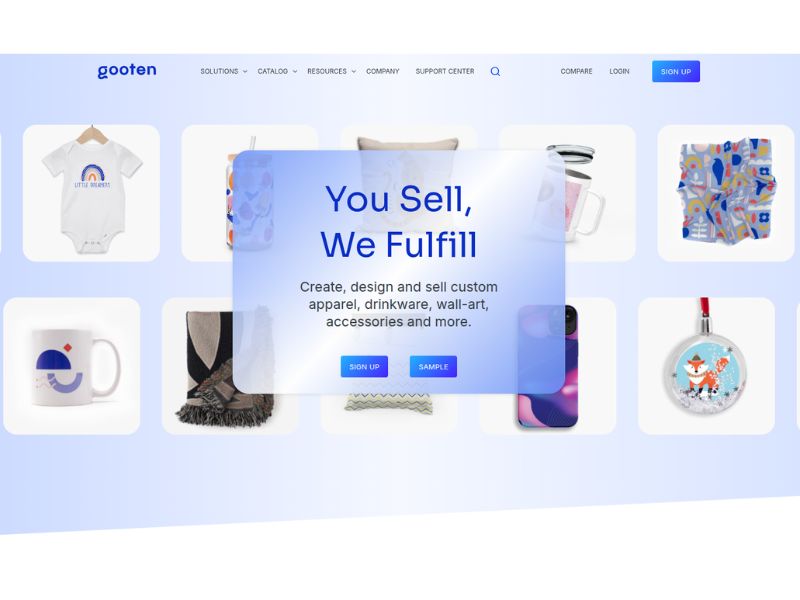
Regarding its operating method, Gooten chooses to optimize the supply chain by connecting with a large network of manufacturing partners in the US, UK, Spain, Canada, and Australia. Sellers only need to focus on uploading designs and setting prices; all technical processing, packaging, and logistics steps behind the scenes are fully automated.
Gooten’s catalog offers around 525 different product lines, ranging from basic apparel to specialized home decor items. Notably, this system allows direct pairing with Customily – a powerful tool for the personalized niche business trend. Thanks to this, buyers can freely customize the design by inserting names, editing patterns, or using artificial intelligence to automatically remove backgrounds right on the store interface.
Because it relies on third parties to process orders, the consistency of product quality between different manufacturing facilities may sometimes have certain variances. In addition, the system does not yet support direct syncing to major e-commerce marketplaces like Amazon or eBay, and the Customily personalization tool currently only works best on Shopify or Etsy.
Quick comparison: Gooten vs Custom Ink
| Criteria | Gooten | Custom Ink |
| Model | POD | Bulk direct manufacturer and supplier |
| Production tech | Diverse segments (Foil printing, weaving, laser engraving, embroidery, digital printing). | Focused on traditional screen printing, standard digital printing, and logo embroidery. |
| Buyer experience | Retail customers can manually edit and personalize products before buying. | Choosing templates and approving designs is fixed based on available blanks. |
| Minimum quantity | No | Yes |
| System sync | Automatically connects with online stores (Shopify, Etsy). | Manual ordering or using shared order links within a group. |
5. Zazzle
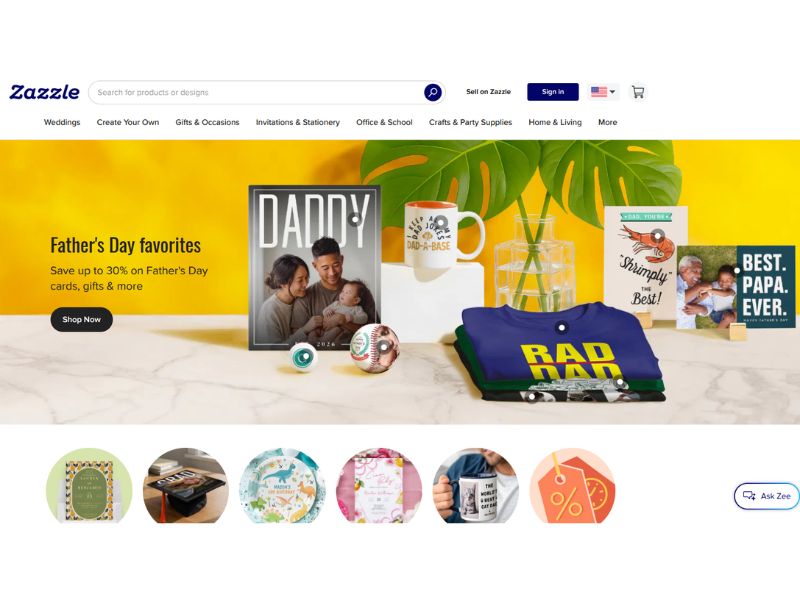
Turning in a completely different direction compared to independent selling solutions, Zazzle operates as an e-commerce marketplace combined with print-on-demand. Creators only need to focus on uploading their artwork to the system, setting their desired commission, and letting Zazzle handle everything from reaching millions of existing customers, production, and shipping to customer service without any upfront investment.
The signature competitive advantage of this system lies in the feature that allows end buyers to directly customize the design before clicking the order button — for example, changing names, dates, or editing text to their liking. Although owning a huge inventory of products ranging from clothing and sportswear to furniture, Zazzle positions its brand very strongly in paper products and stationery such as wedding invitations, greeting cards, wrapping paper, and life-event decorations (birthdays, baby showers…).
Zazzle’s profit-sharing mechanism is based on a flexible royalty model decided by you:
-
Freely set profit margins from 5% to 50% for physical items.
-
Can push the profit rate up to 99% for digital product groups.
-
The retail price shown on the website will be automatically calculated using the formula: Base Blank Price + % Royalty chosen by you.
Because everyone does business on the same Zazzle interface, building and positioning an independent brand with its own identity becomes highly challenging. You will face direct competition from thousands of other designers right on the same website, which unintentionally pushes real profit margins lower unless you have truly breakthrough designs.
Quick comparison: Zazzle vs Custom Ink
| Criteria | Zazzle | Custom Ink |
| Operating nature | POD e-commerce marketplace | Bulk direct manufacturer and supplier |
| Key catalog | Strongest in paper products, cards, and event stationery. | Mainly focused on uniform apparel, protective gear, and corporate swag. |
| Design flexibility | Allows buyers to edit fonts and image details directly on the platform. | Approving a fixed design template applied to the entire bulk order. |
| Minimum quantity | No | Yes |
6. Redbubble
Redbubble chooses the path of a traditional e-commerce marketplace. This model aims directly at designers and artists who want to use the platform’s available traffic to reach buyers without investing money in marketing campaigns or building their own websites.
The operating process here is simplified as much as possible for creators: you only need to upload your design file, and the system will automatically display it on more than 70 different types of products. When an order is placed, Redbubble transfers the technical work to third-party printing partners closest to the customer’s location for production and direct shipping. The seller is completely hands-off from this logistics step.
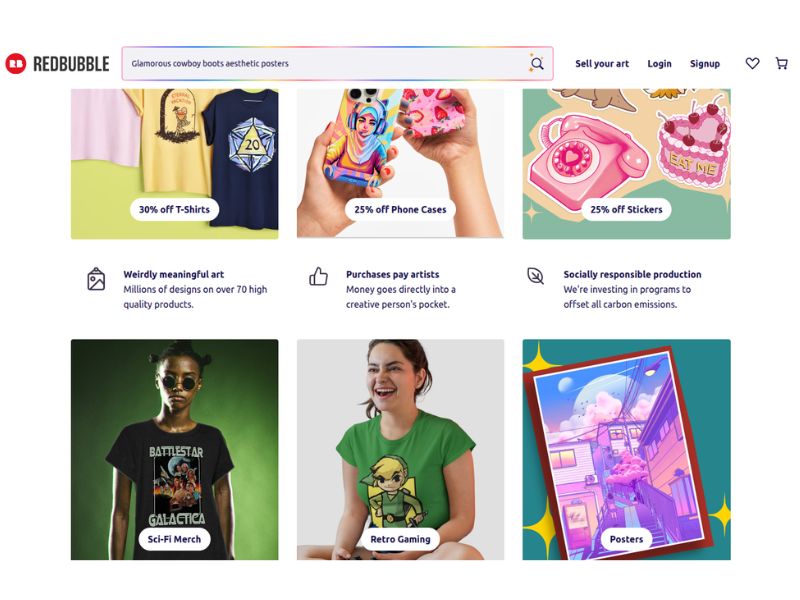
In the platform’s product ecosystem, besides common categories like apparel (T-shirts, hoodies, leggings) or phone accessories, stickers are the product line with the most dominant sales thanks to their low price and a very large young customer base.
However, selling together on the same marketplace makes the profit margin on each product relatively thin, and you have almost no control over personal branding. In addition, due to the open review mechanism, Redbubble always faces the painful problem of idea copying and copyright infringement from spam accounts, forcing serious content creators to always actively protect their own work.
Quick comparison: Redbubble vs Custom Ink
| Criteria | Redbubble | Custom Ink |
| Operating nature | POD e-commerce marketplace | Bulk direct manufacturer and supplier |
| Product catalog | Around 70 types, strongest in stickers | Over 10,000 options, strong in uniform apparel and corporate gifts |
| Marketing | The platform helps drive traffic; artists only need to focus on designing files. | Buyers are responsible for finding their own buyers or using internally. |
Read more: Redbubble Alternatives: Which You Should Switch to in 2026?
7. Vistaprint
If your needs look toward a physical brand identity system, VistaPrint is a name well worth considering. As one of the pioneers in digitizing the traditional printing industry, this brand focuses on solving the core problem for small businesses, startups, and household businesses: designing and producing all marketing materials in one place.
VistaPrint’s strength lies in its large-scale manufacturing factories located in Canada, the Netherlands, and Australia, helping to optimize global delivery speeds with consistent print quality. Instead of focusing deeply on fashion, their ecosystem holds an absolute advantage in promotional items and stationery, including premium business cards (matte finish, embossed, recycled paper), flyers, menus, banners, standees, labels, and packaging.
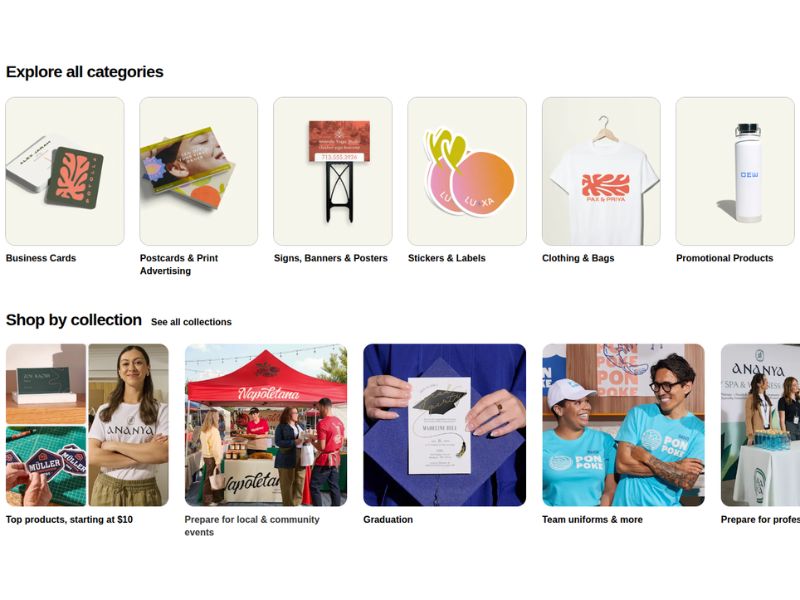
In addition, VistaPrint invests heavily in simplifying the preparation process for non-professional users by integrating a variety of supporting tools:
-
AI Logomaker.
-
VistaCreate online design tool (operating similarly to Canva) with a rich library of available templates.
-
Design support services from experts and a partnership with Wix to help businesses make websites and buy domains.
Although bringing a very good all-in-one solution for small and medium enterprises, VistaPrint shows a weakness in lacking API ports to integrate deeply with popular e-commerce platforms. In addition, when comparing the apparel segment alone, the blank clothing catalog and branding customization features (like inner neck labels or custom packaging) here are relatively limited and not as flexible as specialized POD platforms.
Quick comparison: Vistaprint vs Custom Ink
| Criteria | VistaPrint | Custom Ink |
| Model nature | All-in-one commercial printing and marketing material solution for businesses. | Bulk uniform apparel and event gift factory. |
| Key catalog | Business cards, flyers, brochures, standees, packaging, and office stationery. | T-shirts, hoodies, jackets, protective workwear, and event merchandise. |
| Tech ecosystem | Very strong (AI logomaker, Canva-like design tool, website creation support). | Focused on the Design Lab tool that previews images on blank clothes. |
| POD capability | Limited | Not optimized |
| Best suited for | Small businesses needing to sync all office stationery and direct marketing materials. | Groups, schools, and companies needing uniforms or swag in large quantities. |
Read more: Best 15 Vistaprint Alternatives Worth Trying in 2026
8. Apliiq
While most POD partners today target the mass market, Apliiq chooses a niche path: positioning itself as a clothing and printing factory exclusively for streetwear brands and premium labels.
Apliiq runs every step in-house. What makes their name famous is their ability to provide deep customizations that are ready for retail standards:
-
Private Label: Completely replace the original manufacturer’s label with your own woven or satin label.
-
Cut and sew on demand: Design upgraded details such as T-shirts with patterned fabric pockets or artistic linings for hoodie caps.
-
Diverse clothing techniques: Allows ordering high-quality embroidered logos, digital printing (DTG/DTF), bulk screen printing, or sewing patches onto clothes and hats.
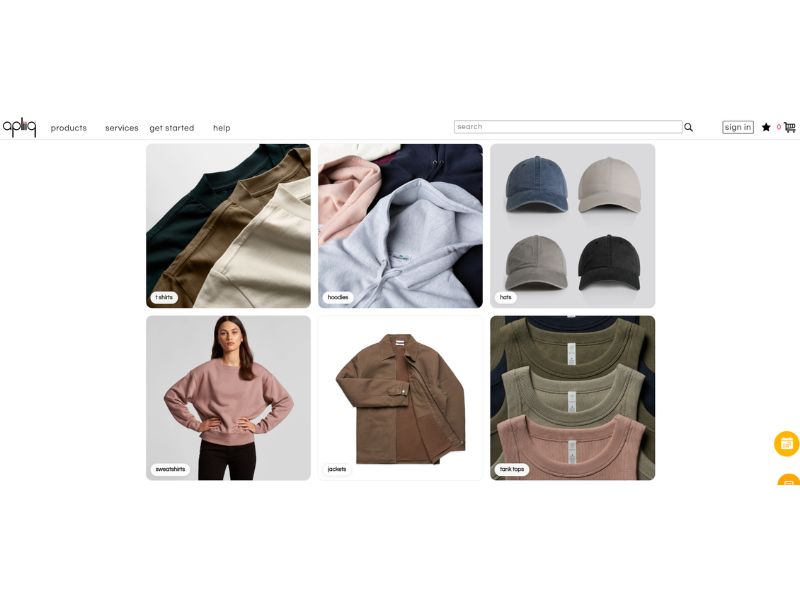
Apliiq’s catalog owns more than 1,200 styles of premium blank apparel from famous blank brands like Bella + Canvas, Comfort Colors, or even Nike and Adidas. Notably, they provide a flexible model conversion solution: you can start with POD with no minimum order quantity to test the market, then switch to bulk ordering (VIP plan saves 20%) and use warehousing services so the system automatically packs and ships goods within 24–48 hours. This platform also has available apps to sync smoothly with Shopify, WooCommerce, Etsy, and Wix.
However, premium positioning means that the cost of blanks and processing fees at Apliiq are more expensive than the market average. In addition, the product ecosystem here only focuses solely on fashion and fabric accessories (T-shirts, hoodies, hats, joggers, tote bags); there are absolutely no item groups like mugs, phone cases, or wall art.
Quick comparison: Apliiq vs Custom Ink
| Criteria | Apliiq | Custom Ink |
| Operating nature | POD and warehousing factory specialized in the premium fashion segment. | Bulk uniform apparel and event gift factory. |
| Customization capability | Very deep (Changing woven neck labels, computer embroidery, sewing patches, lining hoodie caps). | Basic (Screen printing, digital printing, and logo embroidery on available blanks). |
| Product catalog | Limited (Only focuses on clothes, hats, fabric bags). | Very large (Over 10,000 options including tech items, office supplies, water bottles). |
| Automation | Integrated apps to automatically process orders with Shopify, WooCommerce, Etsy, Wix. | Manual ordering or using internal group order links. |
9. RushOrderTees
RushOrderTees chooses a path focused maximally on optimizing order processing speed. This business is currently the official printing partner of the Philadelphia 76ers NBA basketball team and has served more than 1 million customers thanks to a synchronized production process and short-haul delivery network.
The model of RushOrderTees is suitable for schools, businesses, or non-profit organizations that need large quantities of uniform apparel and promotional items for events that arise in a short time. A convenient point when experiencing this platform is that the system allows users to see an instant estimated price based on the order quantity and the chosen blank line.
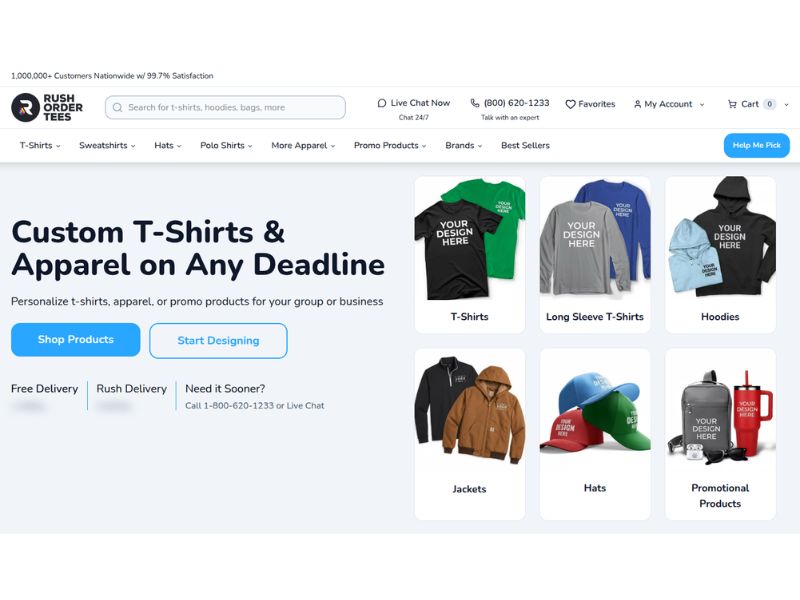
Although its traditional strength lies in bulk screen printing and computer embroidery, RushOrderTees has updated many flexible features:
-
No Minimums policy: The system has expanded its capability to print individual items from 1 product for core T-shirt and sweatshirt lines.
-
Special ink options: Provides unique effects to make designs stand out, such as metallic ink, bright reflective colors, or glow-in-the-dark ink.
-
Diverse blank ecosystem: The blank product catalog gathers many popular sports and protective workwear brands like Nike, Adidas, Under Armour, Champion, Carhartt, and Stanley water bottles.
-
AI design support: In addition to the basic online studio, the platform integrates an AI Logomaker to help simplify the brainstorming process for non-professional users.
Due to its orientation toward serving the internal needs of businesses and events, RushOrderTees does not design API ports to automatically connect with e-commerce platforms like Shopify or Etsy. Although the product catalog has expanded to the gift segment (water bottles, bags, tech items), it generally still leans heavily toward basic apparel.
Quick comparison: RushOrderTees vs Custom Ink
| Criteria | RushOrderTees | Custom Ink |
| Core positioning | Focused on optimizing processes and production time for event orders. | Focused on the online design experience and comprehensive customer service. |
| Quantity requirement (MOQ) | No | Yes |
| Printing effects | Extra choices like metallic ink and glow-in-the-dark ink. | Focused on traditional screen printing, digital inkjet printing, and standard embroidery. |
| E-commerce features | Does not support API connection ports for dropshipping. | Has a Group Order feature to share individual payment links internally. |
10. Bonfire
Bonfire shapes a completely different path by combining print-on-demand with a crowdfunding model. This means the platform provides free tools to help non-profit organizations, schools, artists, or social campaigns raise funds from the community through selling souvenirs.
The way Bonfire works is based on time-limited sales campaigns. The campaign creator only needs to design the product, set a goal, and share the link within their community. All payment processing, production, doorstep delivery, and customer service behind the scenes are handled by Bonfire.
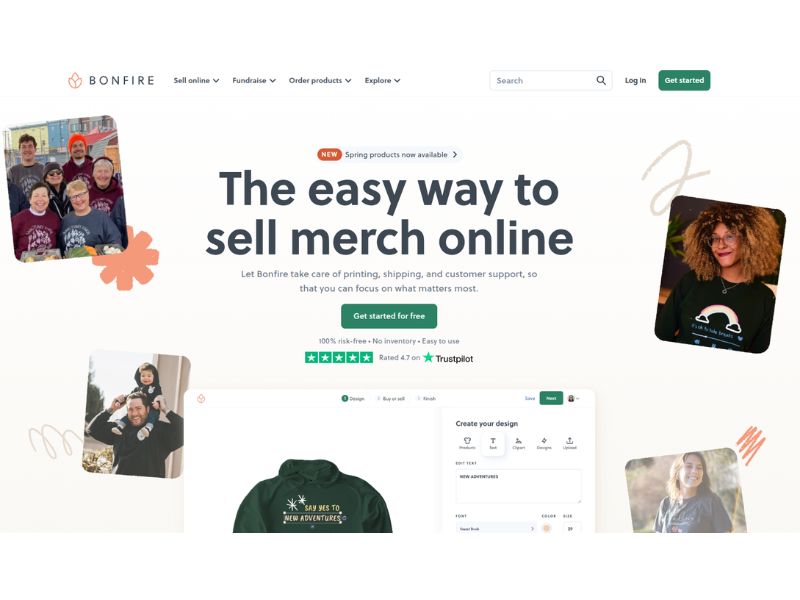
The product ecosystem here focuses heavily on items that easily reach the community, typically classic T-shirts, hoodies, sweatshirts, children’s clothes, tote bags, printed hats, mugs, and premium, eco-friendly blanks (such as Comfort Colors, Eco-friendly). Bonfire supports both forms: selling through online fundraising campaigns or allowing users to place bulk orders at base prices (with no minimum order quantity) for internal use.
Because it is specially designed for community connection and short-term fundraising, Bonfire is quite limited for those who want to build a long-term fashion brand. The system does not provide deep label customization solutions like woven or neck labels, the niche product catalog is still thin, and it lacks automatic API integration ports with Shopify or WooCommerce.
Quick comparison: Bonfire vs Custom Ink
| Criteria | Bonfire | Custom Ink |
| Model | Campaign-based selling / Crowdfunding | Bulk production and supply |
| Ordering method | Customers visit the campaign page to buy retail | A representative gathers orders and places them directly |
| Minimum quantity | No limit (Printed as orders come in) | Limited (Applies to each bulk batch) |
| Supporting tools | Online fundraising and donation features | Design Lab toolset, group ordering |
| Shipping | Automatic retail shipping to each buyer | Bulk shipping to a designated address |
| Catalog | T-shirts, hoodies, tote bags, hats, mugs | Over 10,000 multi-industry products |
11. Fourthwall
Fourthwall positions itself as an e-commerce platform specially run for content creators. The main difference is the ability to gather all of a creator’s revenue sources into one place: you can sell print-on-demand clothes (with a catalog of over 200 items), distribute digital products (digital files), and manage paid membership packages (membership/subscription) all on the same independent website.
Fourthwall solves the conversion problem very well thanks to its deep integration features. Your merchandise can be displayed directly in the ‘Merch Shelf’ section under YouTube videos, on Twitch live streams (including exclusive gifting features), TikTok Shop, or Discord. For the Signature collection product lines, they apply MAX ink printing technology with high color saturation, helping prints come out brighter and last longer compared to the usual standards of the POD segment.
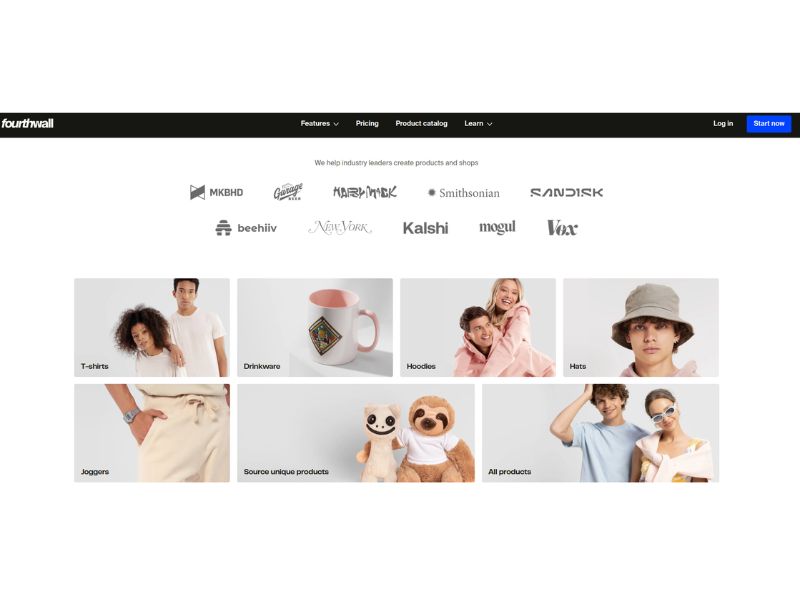
Financially, Fourthwall operates on a no-maintenance-fee mechanism (for the Free plan, the system only charges a 5% fee on digital product and membership revenue) or an advanced Pro plan ($19/month). Notably, Fourthwall will act as the ‘Merchant of Record’ – automatically handling all complex steps related to international sales tax, payment gateways, and customer support.
Fourthwall completely lacks natural organic traffic. Its nature is just a supporting tool, meaning you must have a stable existing fan base (audience) or actively drive traffic to your store yourself.
Quick comparison: Fourthwall vs Custom Ink
| Criteria | Fourthwall | Custom Ink |
| Core model | All-in-one e-commerce store for content creators. | Bulk apparel manufacturer and contractor for groups. |
| Product type | Multi-method (Physical POD goods, digital files, monthly membership packages). | Purely physical (Uniform apparel, corporate gifts). |
| Social media sync | Direct connection to display products on YouTube, Twitch, TikTok, Discord. | Manual ordering or using internal group order links. |
| Tax & Logistics | Fully automated international tax filing and customer service. | Customers handle distribution themselves or receive goods in bulk cardboard boxes. |
| Minimum quantity | No limit (Retail production for each single order). | Minimum quantity applies based on each machine run. |
| Customer reach | Depends entirely on the channel owner’s available audience. | Buyers use internally or look for external buyer groups themselves. |
12. Teelaunch
While most POD companies race in terms of clothing blank quantities, Teelaunch chooses its own path by focusing on unique product categories to help sellers stand out. This platform currently operates as an intermediary model connecting with specialized manufacturing factories in the US, UK, Australia, and the Czech Republic.
What is the difference here? Besides basic apparel, you can find items that are very rare elsewhere, such as electronics (Bluetooth speakers), laser-engraved wooden cutting boards, journals, and home decor items. The system flexibly applies multiple advanced processing technologies from DTG digital printing, sublimation printing, and UV printing to precise laser engraving.
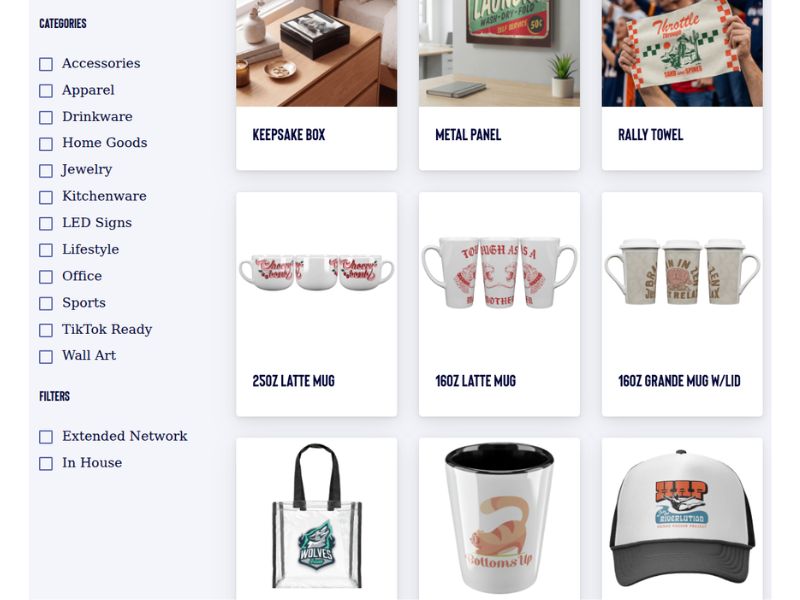
In terms of operation, Teelaunch is completely free to join and only charges for blanks when actual orders come in. Their dashboard integrates smoothly with Shopify, Etsy, WooCommerce, and TikTok Shop, while also providing a real-time production status tracking feature so sellers can stay on top of order progress.
The nature of outsourcing production through third parties causes finished product quality and packaging times to fluctuate depending on the specific item and the assigned partner factory. The design and mockup tools here remain basic, the interface is not yet truly optimized for users, and the customer service system sometimes records slow responses from users.
Quick comparison: Teelaunch vs Custom Ink
| Criteria | Teelaunch | Custom Ink |
| Model | Dropshipping / Print-on-Demand (POD) | Bulk production and supply |
| Strength | Electronics, home goods, and niche gifts | Group uniforms and corporate gifts |
| Minimum quantity | No limit (Printed from 1 product) | Limited (Applies to each bulk batch) |
| Sales integration | Automatically syncs with Shopify, Etsy, TikTok | Manual ordering or group ordering |
Custom Ink competitors comparison chart
| Competitor | Core Model | Minimum Quantity (MOQ) | Product Count | Printing Methods | Key Product Strengths |
| Custom Ink | Bulk Production | Yes | 10,000+ options | Screen printing, standard digital printing, logo embroidery | Corporate Swag, Uniforms, Protective Gear |
| Printify | POD / Dropshipping | No | 1,300+ items | DTG, sublimation, embroidery | Basic Apparel, Mugs, Bags, Phone Cases |
| Printful | In-house POD | No | 505 items | DTG, embroidery, all-over printing | Fashion Apparel, Hats, Home Decor, Wall Art |
| Merchize | POD + In-house Factory | No | 1,000+ items | DTG, Sublimation, UV printing, Computer embroidery, Laser cutting & engraving | All-Over Print (AOP), Decor, Custom SWAG |
| Gooten | POD Network | No | 525 lines | Computer embroidery, Foil printing, Laser engraving, Weaving, DTG | Specialized Home Goods, Foil Printing, Weaving |
| Zazzle | POD Marketplace | No | Huge inventory | DTG, specialized paper printing, laser engraving | Paper Products, Invitations, Event Stationery |
| Redbubble | POD Marketplace | No | ~70 types | DTG, sticker vinyl printing | Stickers, Graphic T-shirts, Phone Cases |
| VistaPrint | Bulk Commercial Printing | No | Huge commercial catalog | Commercial offset printing, digital text printing, embossing, matte coating | Business Cards, Flyers, Banners, Office Stationery |
| Apliiq | Premium Fashion POD | Flexible | 1,200+ styles | DTG/DTF, Bulk screen printing, embroidery, Sewing patches | Streetwear, Private Label, Woven Patches & Labels |
| RushOrderTees | Fast Bulk Printing | No | Large athletic catalog | Bulk screen printing, computer embroidery, Metallic ink, Glow-in-the-dark ink, Reflective printing | Quick Event Apparel, Sportswear, Team Uniforms |
| Bonfire | Crowdfunding POD | No | Focused community items | DTG, screen printing | Fundraising T-shirts, Hoodies, Community Tote Bags |
| Fourthwall | Creator e-Commerce | No | 200+ items | High-saturation MAX ink printing, digital printing, embroidery | Physical Merch, Digital Files, Memberships |
| Teelaunch | Niche POD | No | Unique curated list | DTG, Sublimation, UV printing, Laser engraving | Electronics, Engraved Wooden Boards, Notebooks |
Which Custom Ink alternatives should you choose?
You cannot just pick a random name based on its popularity. Instead, you must answer the question: ‘Does this platform fit your business model?’ Specifically:
-
Core product catalog: Do not choose a platform that is too generic if you already have a clear direction. If you want to do premium fashion, look to Apliiq. If you focus on All-Over-Print (AOP) items or decorations with competitive base costs, systems like Merchize will be a better launchpad.
-
Pricing and cash flow mechanisms: The way you make money determines your profit margins. Some platforms only pay a fixed royalty percentage, others allow you to set your own price markup, and wholesale factories offer deep discounts based on batch quantities. Choose a model that optimizes your cash flow according to your current scale.
-
Depth of branding solutions: If you are serious about branding, elements like white-labeling, inner neck printing, or inserting custom packing slips are a must. These small details determine whether customers will remember your personal brand or just the name of the printing platform.
-
System operating experience: When your number of designs grows to dozens or hundreds, a clunky interface will waste a lot of your time. Prioritize partners with a clean dashboard, intuitive order management, and features that allow quick bulk price adjustments.
-
Integration and scalability: This is the deciding factor for the long run. An open platform that integrates smoothly with Shopify, Etsy, WooCommerce, or TikTok Shop gives you the freedom to sell multi-channel and own your customer data. Conversely, if you choose closed marketplace models, you must accept playing completely by their rules.
Conclusion
Exploring Custom Ink alternatives is not about finding just another place to sell, but about finding a model that better fits your goals. There is no ‘best’ platform for everyone. Think carefully to find the piece that best fits your goals, operating capability, and current customer base.