Contents
Are you looking for a fresh product angle for your print-on-demand store or gift shop while saturated markets like T-shirts and mugs keep getting more competitive? It might be time to focus on an underrated product with strong versatility and solid profit potential: custom flag.
Understanding how to make custom flags not only helps you create personalized designs for events, sports fans, or brand identity, but also opens up an opportunity to get into real commercial products. In this article, we’ll walk you through the process so you can get started easily.
Why should you focus on custom flags?
When people think about flags, they often see them as simple decorative items, right? But let’s think bigger – custom flags are actually a highly promising product category in the POD market with strong revenue potential.
For sellers, the demand for personalized flags opens up many commercially valuable use cases: birthdays, anniversaries, family gatherings, and home decoration. These are all strong “entry points” that are easy to convert when your designs match the right emotions and usage context.
At the community level, groups such as schools, clubs, teams, or fanbases often have a strong need for custom flags to express identity and strengthen connection during events. This is a customer segment that tends to buy in bulk or seasonally, making it easier for sellers to scale revenue.
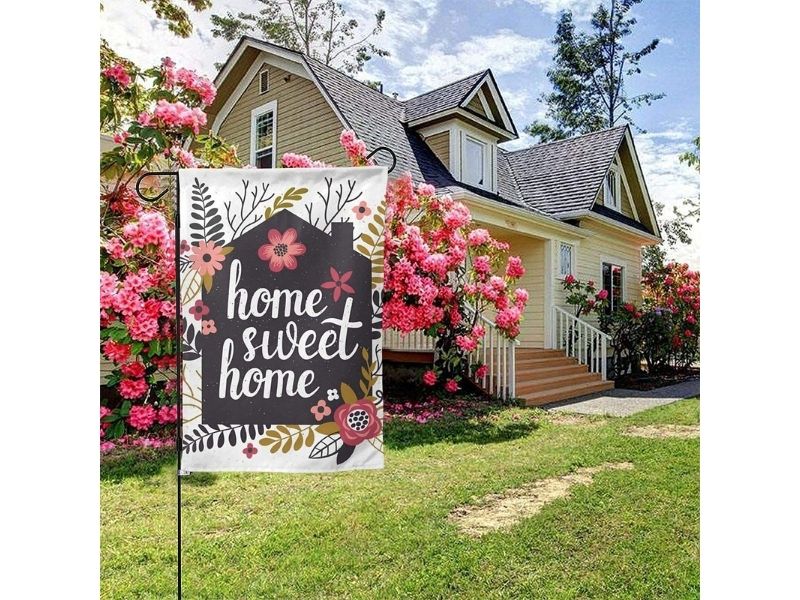
For the business segment, custom flags are a highly cost-effective branding tool. Companies often use them at trade shows, events, pop-up stores, or retail spaces to increase brand visibility, resulting in higher-value orders compared to individual customers.
Additionally, this coming July, the US will see a surge in demand due to two major events: the United States Semiquincentennial (250th Anniversary) and the FIFA World Cup 2026. These occasions typically drive a strong spike in demand for flags, banners, and nation- or team-related merchandise, creating a huge opportunity for sellers to launch trend-based and country-specific designs.
Because of all this, custom flags are a product line that sellers can easily scale across multiple customer segments and use cases. The next important step is identifying the right niche and optimizing your designs to maximize conversion and order value.
3 ways to create your own custom flags
There are currently three main approaches sellers can choose from: DIY (do-it-yourself), local production, or print-on-demand (POD). Each model fits different business goals and strategies.
DIY
DIY (stands for Do It Yourself) means you design and physically create the flag yourself. People who choose this approach usually have skills in sewing, painting, or combining different craft materials.
The biggest advantage is near-total customization from materials to every small design detail. This makes DIY ideal for product prototypes, testing ideas, or creating limited handmade editions. However, it requires time, skill, and specialized tools such as reinforced edges, grommets, or flag mounting accessories.
Because it is fully manual, DIY is best suited for single orders and is not practical for scaling or selling in large quantities.
Local production
You will work directly with local print shops or manufacturers in your area. You don’t need to handle production yourself, but you can still control output quality by communicating directly about materials, colors, or printing techniques. In some cases, you can also optimize costs when ordering in bulk.
However, product quality depends heavily on each supplier, and the workflow can lack flexibility if you want to expand into multiple designs or markets. Production time and logistics can also become bottlenecks when scaling.
Print on demand (POD)
POD has long been known for its advantages and is currently one of the most popular models for custom flag sellers.
For example, with platforms like Merchize, you don’t need to do much at all. You simply create an account in one minute, upload your design, and the system automatically handles everything from printing to fulfillment when an order comes in. This gives you more time to focus on niche research, design optimization, and marketing.
The main advantage of POD is no inventory and no minimum order quantity. You can test multiple ideas at low cost and validate the market quickly.
Additionally, POD solves the problem of not having access to local print shops or needing to diversify products (different sizes, materials, design styles) without heavy production effort.
However, you should pay attention to production and shipping times since each product is made per order. This requires proper planning, especially for seasonal sales or major events.
Quick comparison
| Criteria | DIY | Local Printing | POD |
|---|---|---|---|
| Initial cost | Low–medium (tools & materials) | Depends on supplier | Very low (~$2.5 via Merchize) |
| Quality | Depends on personal skill | Good but inconsistent | Stable with the right provider |
| Production time | Slow, manual | 1–3 days | 1–3 days (system-dependent) |
| Scalability | Very low | Medium | High, easy to scale catalog |
| Customization | Very high | Medium | High (digital-first) |
| Best for | Idea testing, handmade niche | Local orders, small B2B | POD sellers, eCommerce, dropshipping |
How to make custom flags: 5 simple steps
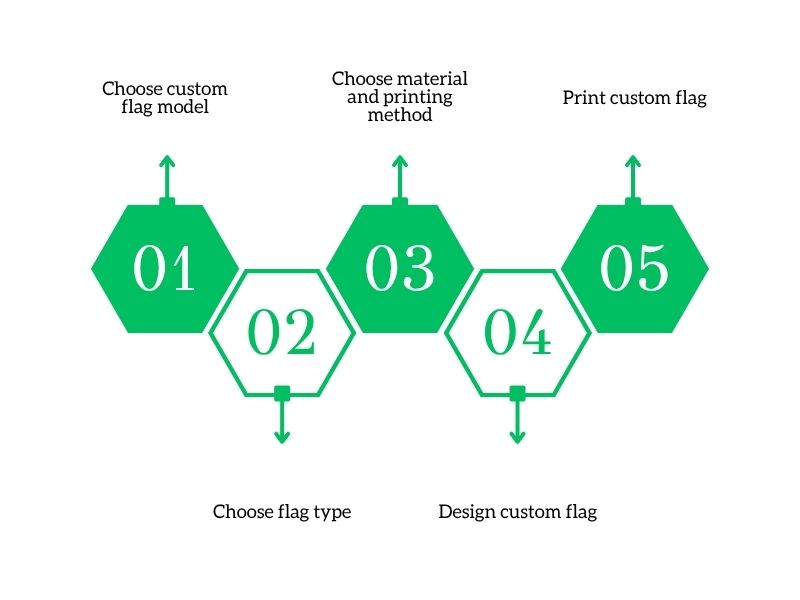
Step 1: Choose the right custom flag model
As mentioned above, there are 3 main ways to create custom flags. From our experience, POD is currently the most optimal option. You only need to focus on research, design, and listing products while printing and fulfillment are fully handled by the POD system.
Which platform should you choose to maximize profit? Merchize offers competitive base costs, allowing you to price your products higher and improve your profit margin more easily.
Step 2: Choose the right flag type for your sales goal
Not all flag types fit every use case. Before launching, you need to choose the right product type because it directly impacts conversion rate and customer experience.
First, define the purpose:
- Personal decoration / gifts → focus on aesthetic design and medium size
- Events, sports, communities → high visibility, easy setup, eye-catching from a distance
- Branding / business → consistency, clear logo display, strong message visibility
Next is usage context:
- Indoor → smaller, lighter flags focused on detail
- Outdoor → more durable, highly visible, weather-resistant
For formats, you can build your catalog around common flag types such as:
- Rectangle flags (most popular, easy to scale designs)
- Garden flags (ideal for home decor niches)
- Fence / wall flags (strong for visual branding)
- Hand flags (events, fanbase, sports use cases)
You can also explore Merchize product lines to quickly expand your catalog.
- House Flag (Made in US)
- Garden Flag (Made in US)
- Semicircle Fence Flag (Lightweight)
- Rectangle Fence Flag (Lightweight)
- Wall Flag
- Hand Flag
- Garden Flag
- House Flag
Step 3: Choose the right material and printing method
This step directly affects customer experience, product durability, and return rates.
Materials
Each fabric serves different use cases:
- Nylon: Lightweight, flies well in light wind, quick-drying, UV-resistant. Good for basic outdoor flags like house flags.
- Polyester: Durable, holds shape in strong wind, wear-resistant. Most popular option for sellers due to its balance of cost and durability.
- Cotton / Canvas: Premium, vintage feel but less weather-resistant. Best for indoor décor or aesthetic-focused niches.
- Terylene: Lightweight and foldable, suitable for short-term events or portable products.
For POD sellers, polyester is usually the safest starting point due to its flexibility and consistency.
Printing methods
Not every design fits every printing technique:
- Sublimation printing: Best for full-color, gradient, or complex artwork. Long-lasting colors, no peeling—ideal for POD.
- Screen printing: Great for simple, low-color designs like logos or slogans. Cost-effective for bulk production but less flexible for testing.
- Inkjet printing: Good detail quality but durability depends on ink and material—more suitable for indoor use.
- Embroidery / fabric applique: Premium and durable but expensive and not scalable for complex designs.
Most POD platforms including Merchize, use sublimation printing for flags to ensure consistent quality for online sales.
One-sided vs Two-sided printing?
One-sided printing helps reduce cost, keeps the flag lighter, and works well for wall or fence placement where only one side is visible. Two-sided printing provides visibility from all angles, looks more professional, and fits event, branding, or premium products.
If you target higher-end customers or business clients, two-sided flags can significantly increase perceived value.
Step 4: Design your custom flag
This is the step where many sellers tend to fall short. A visually “beautiful” design doesn’t always sell but a design optimized for buyer behavior converts much better.
- Clarity: Text must be easy to read, logos should be recognizable, and details should not be lost when the flag moves or folds.
- Balance: Avoid using too many colors or overly complex elements. Place key elements in the center or distribute them evenly to keep the overall composition harmonious.
- Recognizability: Prioritize a strong focal image or symbol, high contrast, and a simple layout that remains visible from a distance.
Use professional design tools
Professional tools like Adobe Photoshop or Adobe Illustrator allow full control over layout, color, and typography. These are ideal if you need precision, especially for logos or complex artwork.
If you prefer speed and simplicity, Canva or Adobe Express are more than enough for most designs. These platforms support drag-and-drop editing, ready-made templates, and fast iteration—perfect for testing multiple ideas quickly.
Alternatively, if you don’t have time or struggle with design tools, you can also hire a designer.
For POD sellers, you can streamline the process by designing directly on platforms like Merchize. You can upload your artwork, adjust layouts, and preview real product mockups instantly. This helps you move from idea → product much faster without switching between multiple tools.
Step 5: Print your custom flag
Pre-print checklist
- High-resolution design file
- Colors properly set to avoid print mismatches
- Important elements (logos, text) not too close to edges
- Final proofread to avoid spelling mistakes
If you are doing DIY or local printing, always request a sample if possible and confirm key details such as:
- Flag pole sleeve or grommets
- Actual finished size
- Material and finishing quality
After receiving the product, carefully check print quality, stitching, and overall appearance. For double-sided flags, ensure both sides are aligned and evenly printed. If you plan to produce in bulk, always test with a sample first to reduce scaling risks.
If you use POD, the process becomes much simpler. You only need to:
- Choose the flag type
- Upload your design
- Review the mockup
- Publish the product
Merchize will automatically handle the rest. However, to ensure quality and customer experience, you should still:
- Order a sample before selling
- Make sure mockups accurately reflect the real product
- Connect your store to the POD system for automated fulfillment
Start selling custom flags with Merchize today
If you’re still unsure where to start, the easiest way is to use a ready-made infrastructure like Merchize. You just select a product, upload your design, and connect your sales channel—the rest is automatically handled when orders come in.
Merchize directly manages the production process instead of relying entirely on third parties. This helps ensure more consistent quality as you scale. In addition, global shipping capabilities make it easier to reach multiple markets without setting up your own logistics system.
And timing matters—demand is about to surge. Major events such as the United States Semiquincentennial (250th Anniversary) and FIFA World Cup 2026 are approaching, driving massive demand for symbolic, country-themed, and community-based merchandise.
Start early. Sometimes, speed to market is your biggest competitive advantage as a seller.