Contents
Choosing between Printful and Printify isn’t just about picking a supplier. It’s about deciding how your entire print-on-demand business will scale. For many POD sellers, this decision directly impacts profit margins, shipping speed, and ability to test designs vs build a brand.
Besides, some sellers struggle with high costs but stable quality. Others prefer lower prices but deal with inconsistent fulfillment. And if you pick the wrong platform early, it can slow down your growth significantly. So the real question is not: “Which platform is better?” but: “Which platform is better for YOUR business model?”
In this guide, we’ll break down what Printful and Printify actually offer, the key differences that matter for POD sellers. And most importantly, which one you should choose based on your goals.
Let’s take a look at the whole blog post to get more details!
What is Printful?
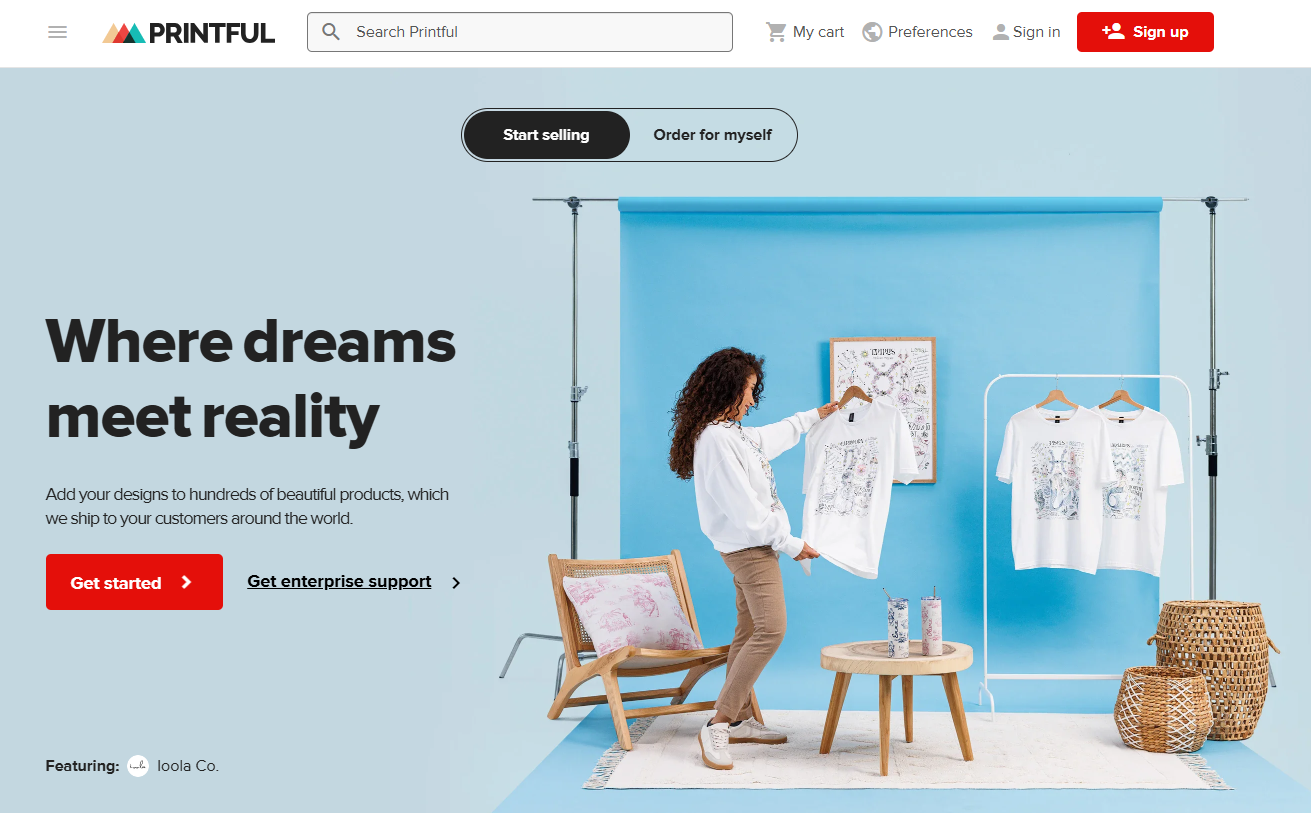
Printful is one of the most established print-on-demand platforms in the market, known for its in-house production model and strong focus on quality and branding.
Unlike marketplace-style POD providers, Printful owns and operates its own fulfillment centers across regions like the U.S. and Europe. This allows them to maintain tight control over product quality, printing consistency, and shipping processes.
Key Features of Printful:
- In-house fulfillment: More consistent quality and fewer production errors
- Premium branding options: Custom labels, pack-ins, branded packaging
- Wide product catalog: Apparel, accessories, home decor, and more
- Strong integrations: Seamless connection with Shopify, Etsy, Amazon, and others
- Global fulfillment network: Faster shipping for international customers
Pros of Printful:
- High and consistent print quality
- Reliable shipping and fulfillment times
- Best-in-class branding capabilities
- Ideal for building a long-term brand
Cons of Printful:
- Higher base costs compared to competitors
- Lower profit margins if you compete on price
- Less flexibility in choosing different print providers
What is Printify?
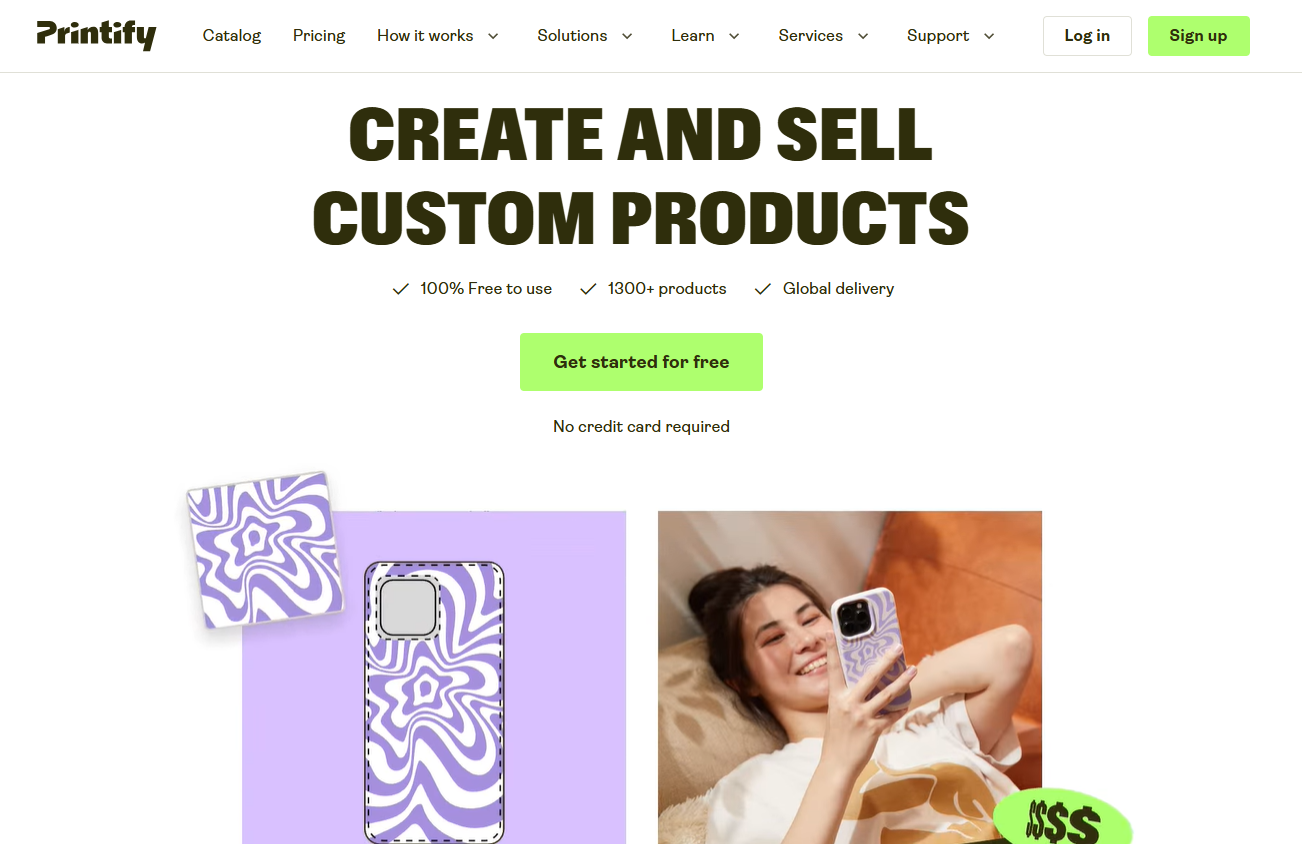
Printify is a print-on-demand platform that operates on a model of connecting print providers globally, rather than producing its own products like Printful. This means that when you sell a product through Printify, the order is sent to a third-party supplier within their network for production and shipping. This model makes Printify stand out with its competitive pricing and flexible scalability, especially suitable for sellers who want to quickly test many products.
Printify’s key features:
- Global printing network: Over 80+ print providers in multiple countries
- Lower costs: Choose the cheapest printer to maximize profits
- Diverse product catalog: More options in each product line (t-shirts, mugs, decor, etc.)
- Supplier options: Actively select suppliers based on price, location, and rating
- Premium plan: Further reduce product costs when scaling up
Advantages of Printify:
- Low cost leading to higher profit margins
- Suitable for quick design testing and product scaling
- Flexible in choosing providers according to needs
- Ability to optimize for each market (US, EU, UK, etc.)
Disadvantages of Printify:
- Inconsistent quality (varies depending on the printing company)
- Production and shipping times may be inconsistent
- Difficult to control customer experience on a large scale
- More limited branding compared to Printful
Key Differences Between Printful and Printify
When comparing Printful and Printify side by side, the difference isn’t just in price but in how you run your POD business. Here’s a quick comparison of the most important factors:
| Factor | Printful | Printify |
| Fulfillment model | In-house production and fulfillment | Third-party print provider network |
| Pricing | Free, $24.99 per month for Growth | Free, from $29 per month for Premium |
| Product range | 498 | 1.300+ |
| Fulfillment location | USA, EU (Spain, Latvia), UK, Australia, Japan, Canada, Mexico, and Brazil | USA, EU (Spain, Latvia, Germany, Netherlands, Poland, Czech Republic, Slovenia), UK, Australia, Canada, and China |
| Base cost | Lower | Higher (based on suppliers) |
| Intergrations | Shopify, Woocommerce, Wix, Squarespace, Square, Ecwid, BigCommerce, Prestashop, Big Cartel, Weebly, Adobe Commerce, Nuvemshop, ShipStation, Shift4shop, Launch Cart,
Etsy, Amazon, eBay, Storenvy, TikTok Shop, and an API |
Shopify, WooCommerce, Wix, Squarespace, BigCommerce, PrestaShop, Etsy, Amazon, eBay, TikTok Shop (only available in the US), and an API |
| Print quality | Stable, well-controlled | Supplier dependent |
| Shipping | 97% shipping within 5 business days | Varies by provider, though most orders ship within 2-7 business days |
| Branding | Strong (label, packaging…) | Limited |
| Customer support | Email, Live chat | Starts with a virtual chatbot and via email |
Printful vs Printify: Detailed Comparison
After a quick look at the comparison table, it’s time to delve into each factor that truly impacts your profitability, customer experience, and scalability.
Pricing & Profit Margins
Cost is always the first factor that POD sellers consider when choosing a suitable supplier. In this regard, Printful usually has a higher base cost because they handle the entire production and shipping process. Conversely, Printify allows you to choose your printing company, resulting in more flexible and often cheaper pricing. This results in Printful having lower but more stable profit margins, while Printify offers higher margins if you choose the right supplier.
In short, if you’re running ads and need high profit margins, Printify has an advantage. However, if you need to build a personal brand, Printful is still a good option.
Product Range
Printful and Printify offer a diverse range of products, from clothing to home decor and accessories. Specifically:
- Printful offers over 450 products in categories including women’s and men’s clothing, children’s and teen clothing, hats, accessories, home, and lifestyle items.
- Printify offers over 1300 products in many categories, including men’s clothing, women’s clothing, children’s and teen clothing, accessories, home decor, footwear, packaged consumer goods, pet supplies, and swimwear.
Both providers offer hundreds of customizable products. While Printify boasts a broader product catalog with multiple printing service providers, Printful excels in in-house production capabilities and product quality. Both platforms offer eco-friendly options and various printing methods, giving sellers many ways to showcase their brand.
Print Quality
When it comes to print quality, Printful is often highly regarded for its ability to control the entire production process at its in-house facilities. Because it directly manages the factory and operations, Printful can maintain consistent quality standards across all products and orders. This gives sellers greater peace of mind regarding color consistency, design sharpness, and overall finish quality. Whether a customer orders one or hundreds of products, the experience is usually quite consistent.
In addition, Printify operates on a model that connects with many different printing suppliers, so product quality can vary depending on the partner you choose. Some suppliers in Printify’s network offer very good quality and impressive results, but there may also be instances where quality is not entirely consistent between orders or products. Printify provides standards and guidelines for its production partners; however, the final experience ultimately depends heavily on each print provider. Therefore, sellers often need to spend time testing samples and selecting suitable suppliers to ensure consistent quality for their store.
Shipping & Fulfillment
Printify operates on a marketplace model, allowing you to select suppliers for each product based on price, location, and production time. If a supplier runs out of stock or is overloaded, the system can automatically transfer the order to another provider to ensure the order is still processed. With a network of over 140 production facilities, Printify helps you easily optimize costs and delivery times and provides a wide range of options for each product line.
Meanwhile, Printful primarily manufactures its own products in the US, Canada, Mexico, the UK, Spain, and Latvia. Every order undergoes multiple quality control checks before packaging. Production time is typically 2–5 business days, with relatively fast delivery in the US and Canada. Additionally, Printful handles customs duties in some markets, eliminating additional fees for buyers upon receipt of goods. This model allows for centralized management of the entire production and fulfillment process, rather than working with numerous different suppliers.
Integrations
Printify and Printful support integration with many popular e-commerce platforms, making it easy for sellers to synchronize products, orders, and fulfillment processes.
Printify integrates with major platforms such as Shopify, Etsy, Walmart, eBay, WooCommerce, and TikTok Shop (currently primarily supported in the US market). Additionally, the platform offers an open API, allowing developers to build custom integrations with other systems or platforms. This provides flexibility for businesses that want to expand or automate their operations.
Meanwhile, Printful also boasts a robust integration ecosystem with Shopify, Etsy, Wix, BigCommerce, eBay, and WooCommerce. A key highlight of Printful is its integration with Amazon, which gives sellers access to a massive customer base on the marketplace. Furthermore, Printful provides a fully documented API to support advanced development and customization needs.
Overall, both platforms adequately meet the needs for connecting with popular sales channels today. However, if Amazon is a crucial part of your business expansion strategy, Printful may be a more attractive option.
Branding Options
In terms of branding capabilities, Printful offers more comprehensive and professional options compared to Printify.
For product branding, both platforms support DTG printing in various locations, such as the front, back, inside/outside labels, and sleeves. However, Printful has an advantage in supporting more embroidery locations, such as the left chest, center chest, large embroidery, and both sleeves, giving sellers more options to upgrade designs and enhance the premium feel of their products.
For packaging branding, Printful supports white-label packaging, custom packing slips, branded order tracking pages, order inserts, and paid custom packaging. Meanwhile, Printify only supports a limited number of branding features through a few specific providers, such as paid pack-ins or complimentary messages.
Additionally, Printful supports custom order tracking pages, meaning customers can track their orders on a dedicated, branded page for the store, instead of switching to a third-party interface. This is a major advantage for businesses looking to build a professional and consistent shopping experience. Printify currently does not support this feature.
Ease of Use
In terms of ease of use, both Printify and Printful are designed to be quite user-friendly for beginners in the POD business. They offer intuitive interfaces, simple product creation processes, and numerous tutorials to support sellers in setting up their stores.
Printify stands out for its simple and easy-to-learn operation. Users can quickly create products, select suppliers, and synchronize with other sales platforms without complex operations. Printify’s design tools focus on practicality and ease of use, suitable for sellers who want to get started quickly and optimize their operations from the beginning.
Meanwhile, Printful also offers a very accessible experience, but invests more in design support tools. This platform provides a Design Maker with many intuitive features, allowing users to create or edit designs directly within the system without needing to use many external software programs. In addition, Printful has a library of resources, guides, and detailed setup procedures to help beginners easily get acquainted with the POD model.
In short, both platforms are suitable for beginners. However, if you prioritize a simple, easy-to-use process and want to quickly launch your store, Printify might be more accessible. If you want additional tools to support design and branding from the start, Printful is a worthwhile option.
Customer Support
Printify supports customers via email, live chat, and a knowledge base with numerous tutorials, FAQs, and helpful documentation. Users can find information related to order processing, product setup, or platform usage directly in the support center. Response times may vary depending on the volume of requests, but the platform still provides all the necessary support channels for sellers.
About Printful, they also offer a similar support system with email, live chat, and a comprehensive Help Center. Printful’s strength lies in its detailed documentation system, including step-by-step guides, troubleshooting guides, and in-depth support content for beginners. Their support team is also highly regarded for its quick response times and focus on resolving issues related to orders, products, and store operations.
Printful vs Printify: Which One Should You Choose?
Choosing between Printful and Printify will depend on your business goals, budget, and how you want to operate your POD store. Both platforms are powerful, but each suits a different type of seller.
Choose Printify if you prioritize flexibility and cost optimization.
Printify is suitable for sellers who want multiple supplier options and proactive control over production costs. Instead of manufacturing in-house, the platform connects with a global network of printers, allowing you to choose partners based on price, location, or order fulfillment time. This is a significant advantage if you want to optimize profits or experiment with different product lines.
Additionally, Printify’s Order Routing feature automatically redirects orders to other suppliers when a facility is overloaded or out of stock, especially useful during peak seasons. For beginners or small stores, Printify’s free plan is sufficient to operate and sell without requiring a large initial investment.
However, since product quality varies depending on the supplier, you may need to spend time testing samples and selecting suitable partners to ensure a consistent customer experience.
Choose Printful if you prioritize quality and brand building.
If your goal is to build a professional POD brand with a consistent customer experience, Printful is a superior choice. Most of Printful’s products are manufactured in-house in the US, Canada, and Europe, giving them better quality control and reducing the risk of errors during fulfillment.
Printful also has a significant advantage in branding. You can add custom labels, embroidered logos, personalized packing slips, branded packaging, or order inserts without working with multiple suppliers. This is especially suitable for sellers who want to develop a long-term brand rather than just focusing on bulk sales.
Furthermore, this platform supports seamless integration with Etsy, Shopify, TikTok Shop, and many other sales channels. Even in the free plan, Printful still provides high-quality mockup creation tools and basic order management. Upgrading to the Pro plan gives you additional design and marketing features such as background removal and product promotion tools.
Short conclusion
There is no single “best" platform for everyone.
- If you want to optimize costs, have more provider options, and operational flexibility, Printify will be a more suitable choice.
- If you prioritize consistent quality, professional branding, and a consistent customer experience, Printful will be a more worthwhile investment.
For many POD sellers, starting with Printify to test the market and then switching to Printful when they want to build a more structured brand is also a fairly common strategy.
Printful vs Printify in 2024-2025: What’s Changed?
2024 marked a major turning point for the print-on-demand industry when Printful and Printify officially announced their merger to expand their fulfillment networks, optimize operations, and increase their ability to serve sellers globally. However, at present, both platforms still operate relatively independently with separate dashboards, fulfillment systems, and pricing. This means that sellers will still clearly perceive the differences between the two platforms:
- Printful continues to focus on consistent quality, branding, and its in-house production model.
- Printify remains strong in competitive pricing, flexibility, and its extensive supplier network.
While this merger opens up expectations of faster shipping, a more diverse catalog, and better fulfillment during peak seasons, many sellers also worry that the POD market will become more concentrated as the two biggest players in the industry merge into one ecosystem.
However, for most POD sellers in 2025, the most important factor will still not be mergers, but which platform is a better fit for their business model: prioritizing brand and customer experience or maximizing margin and scaling quickly.
Why Consider Merchize as an Alternative
While Printful excels in quality and branding, and Printify is strong in pricing and flexibility, many POD sellers are now seeking a more balanced solution between cost, quality, and scalability. This is why more and more sellers are considering Merchize as a noteworthy alternative in 2026.
Unlike marketplace supplier models such as Printify, Merchize operates with a more centralized fulfillment control approach to ensure consistent quality and optimize the seller experience. At the same time, we maintain competitive pricing to help sellers maintain better profitability when expanding their stores or running ads.
One of Merchize’s biggest advantages is its diverse product range of over 730 items. Besides basic apparel products, Merchize focuses heavily on personalized gifts, home decor, and all-over prints – niches that typically have higher profit margins and less competition on platforms like Etsy, Shopify, or TikTok Shop. Additionally, Merchize also supports many branding features to help sellers build their personal brand effectively.
Of course, no platform is right for everyone. If you prioritize a large ecosystem and many supplier options, Printify remains a strong choice. If you focus on building a premium brand, Printful might be more suitable. But if your goal is to optimize margin, sell differentiated products, scale seasonal niches, and find a more flexible POD partner, then Merchize is definitely a worthwhile option to consider in 2026.
FAQs
1. Is Printify better than Printful?
This depends on your business goals. If you prioritize low costs, a wide range of suppliers, and want to maximize profits, Printify is often the better choice. This platform allows sellers to select from many different printing partners based on price, location, and production time.
Meanwhile, Printful is suitable for those who prioritize consistent quality, stable operations, and a professional brand experience. Printful manages most of its production process itself, so quality is usually more tightly controlled.
2. Is Printify cheaper than Printful?
Yes, in many cases, Printify offers lower product prices than Printful. This is because Printify operates on a marketplace model with many vendors competing on price.
For example, for the same t-shirt design, the base cost on Printify is often a few dollars lower than on Printful. This allows POD sellers to easily expand their profit margins or run more effective ads.
However, lower prices sometimes come with differences in print quality, fulfillment speed, or packaging experience between vendors. Therefore, sellers should test samples before scaling up.
3. Who ship faster, Printful or Printify?
Printful generally has more consistent order processing speeds because they own and operate their own fulfillment system directly. This results in less variability in production and delivery times.
With Printify, delivery speed depends on the print provider you choose. Some providers may ship very quickly, but others may experience slower processing times during peak seasons.
If customer experience and operational stability are prioritized, many sellers rate Printful as slightly better in terms of speed and consistency.
4. Which platform is best for print-on-demand?
There isn’t one “best" platform for everyone. The right choice will depend on your budget, target market, and business strategy.
- Printful: suitable for brands wanting to build a professional image, focusing on quality and branding.
- Printify: suitable for sellers wanting to optimize costs and quickly test multiple niches.
Merchize: a worthwhile option if you want competitive pricing, diverse products, and fulfillment advantages in both the US and Asia, especially suitable for international POD sellers looking to scale profits better.
Many sellers now even combine multiple platforms simultaneously to leverage the unique advantages of each.
5. Is Printful now Printify?
No. Although Printful and Printify merged in 2024, their business models remain independent.