
Contents
Every perfect sales plan needs a solid manufacturing foundation behind it to become reality. However, the journey to holding a finished product in hand often leaves many sellers confused due to a lack of information and experience working with factories. Finding a trustworthy manufacturing partner will help you completely solve quality and supply timeline issues. To accompany you in this important phase, the guide on “How to find a manufacturer or supplier for your product idea" below will help you quickly choose your right “partner."
Key Takeaways
- Choose a supplier based on your business model, product, and capital to avoid wrong investments right from the start
- Prepare product specifications, design images, and expected output before contacting factories to receive realistic price quotes
- Compare at least 3 suppliers regarding quality, order processing time, shipping costs, and support capabilities before deciding to partner
- Always check product samples before mass production. For POD sellers, test print quality, product durability, and fulfillment time
- Calculate total cost instead of only looking at product price to avoid extra expenses eating into profits
- Maintain backup suppliers and evaluate performance periodically to reduce order disruptions when sales grow or peak season comes
Categorizing current manufacturers/ Suppliers
Before starting your search, you need to clearly define which type of partner suits your business model. Basically, every manufacturer is a supplier, but not every supplier is a manufacturer. “Supplier" is a general term for any unit that supplies goods to you, including manufacturers, wholesalers, and distributors.
Based on actual needs, supply sources in the market today are divided into clear segments:
1. Direct Manufacturing Group
If you own exclusive designs or want to realize a completely new product idea, working directly with a manufacturer is the optimal path. This group includes large-scale factories specializing in custom manufacturing or independent artisans possessing unique handmade items.
Partnering with a manufacturer helps you get the best factory price and control the entire product creation process. However, the biggest barrier here is that minimum order quantities are usually very high, requiring large working capital and professional warehouse management capacity.
2. Distribution Intermediary Group
For sellers trading items already available on the market who want to diversify their product catalog without manufacturing themselves, distributors, wholesalers, or trading companies are suitable choices.
They stand out to import large quantities from many different manufacturers and then divide them to resell to retailers. Although unit product cost will be higher than working directly with factories, in return you can place small orders from different brands, save shipping costs, and significantly shorten delivery time.
3. Operation Optimization and Testing Group
For sellers who want to optimize cash flow, minimize inventory risk, or specialize in personalized items, the two models below offer outstanding competitive advantages:
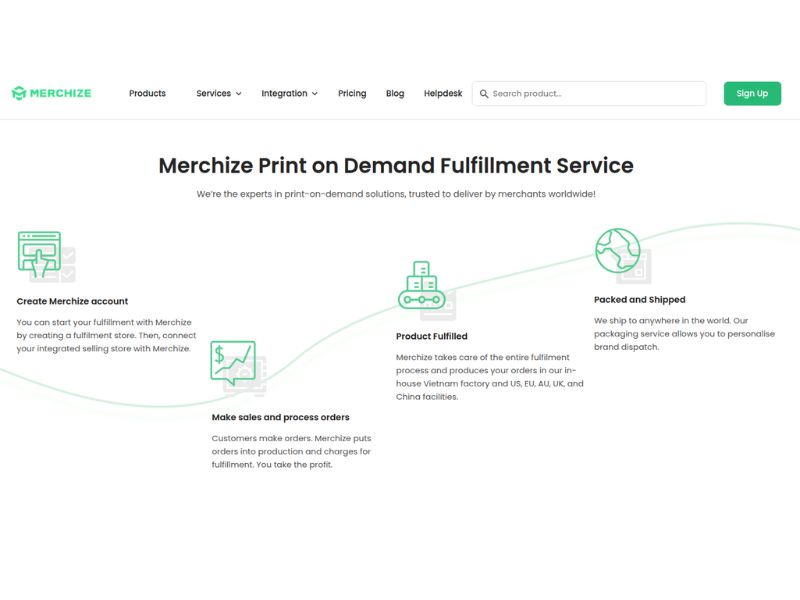
- Print-on-Demand (POD) Suppliers: This is an on-demand manufacturing model ideal for sellers who want to test new designs or products without worrying about inventory. With POD, products are only produced after a customer places an actual order. The strength of POD suppliers (like Merchize) is providing an MOQ of 1, while handling the entire process from manufacturing, packaging to delivery (to the end buyer). Sellers only need to focus completely on design creation and marketing.
- Dropshipping Suppliers: Similar to POD in operations, dropshipping suppliers handle the entire warehousing and fulfillment process for you. The difference is they provide ready-finished products from partner brands or factories, connecting directly to your store through automation apps.
4. Sourcing Support Group
If you have shaped your product line but face language, geographic, or experience barriers in working with overseas factories, sourcing agents will act as a bridge. They are local individuals or organizations that help you represent negotiations, search for factories with suitable capacity, supervise the manufacturing process, and inspect batch quality before dispatch.
How to find a manufacturer or supplier for your product idea
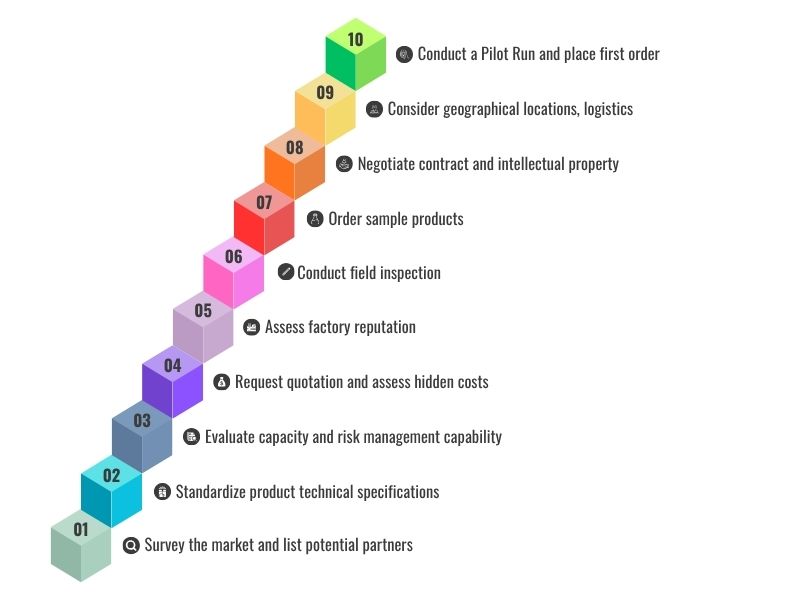
1. Survey the market and build a shortlist of potential partners
The journey begins by gathering information and filtering down to a shortlist of promising candidates. Use advanced search syntax on Google combined with niche keywords covering materials, processing technologies, or manufacturing certifications.
Beside Google, reputable business directories, major B2B platforms, or specialized trade shows are valuable information goldmines you shouldn’t overlook. In parallel, leveraging your personal network or joining active seller communities will help you gather objective reviews and valuable advice from experienced predecessors.
Example: If you want to develop an eco-friendly houseware product line, choose factories that possess existing certifications for recycled material origins or green manufacturing credentials. Similarly, if you choose the Print-on-demand niche with product lines like T-shirts or home decor, proactively look for partners with integrated printing infrastructure, high-quality blank items, and automated fulfillment systems for sellers, such as Merchize.
2. Standardize product technical specifications
The biggest barrier that causes manufacturers to reject inquiries or provide inaccurate quotes often stems from sellers providing overly vague information. Clarify every small detail in your product requirement document, including: main materials, precise dimensions, compatibility standards, colors (Pantone codes), printing/embroidery methods, packaging standards, and estimated minimum order quantity (MOQ). The more detailed and visual information you provide through sample mockups or technical drawings, the faster and more accurate subsequent communication will be.
3. Deeply evaluate factory capacity and risk management capability
Once you have your factory list and standardized specifications, the most critical step is verifying each partner’s actual capability. You need to thoroughly examine their quality control procedures, experience with similar product lines, and monthly production capacity. Pay special attention to 2 factors: sample-making capabilities and initial setup costs.
A reputable manufacturer is usually willing to support making samples or running a small test batch so you can evaluate real-world quality before committing funds to mass production. If your product requires complex structures or excessively high tooling costs, partnering with a supplier that already has technical infrastructure and an interconnected supply chain will help you minimize tied-up capital risks and shorten time-to-market.
4. Send Requests for Quotation and assess hidden costs
Contact at least 3 to 5 top candidates to send formal Requests for Quotation (RFQ). To receive quick responses, your first email should be concise, clearly demonstrate the stance of a serious seller, and provide complete product specifications alongside estimated annual volume.
When comparing proposals, do not look solely at the unit price. The actual production cost equation always conceals extra expenses such as initial tooling/setup fees, third-party quality control inspection fees, exchange rate fluctuations, import duties, and international shipping rates. Clarifying these hidden costs from the beginning helps you accurately calculate your net profit margin.
If you produce handcrafted goods or premium leather products, choosing a factory specializing in that specific material is mandatory. However, if you run a POD business with fashion items or personalized housewares, the pricing criteria you need to clarify with fulfillment partners include blank item prices, printing fees, custom packaging costs, and region-specific shipping rate cards.
5. Assess factory reputation
Before proceeding deeper, conduct a background check on the supplier’s operating history. A reputable manufacturing factory usually has 5+ years of industry experience, holds quality management certifications (such as ISO), and maintains transparent records on national corporate portals (or Verified/Trade Assurance badges on B2B platforms).
Proactively search for negative reviews, legal disputes, or ask partners to provide a list of reference clients they have manufactured for. Prioritizing direct partnerships with manufacturing factories rather than going through middle trading companies saves 10-20% in costs while minimizing communication distortion when conveying technical requirements.
6. Conduct field inspection
If budget and conditions permit, arrange a direct factory visit or hire a local sourcing agency to represent you during inspection. Observing the actual workforce, machinery scale, cleanliness, and occupational safety compliance on-site will give you the most accurate answer regarding the factory’s operational capacity.
In cases where geographical distance is an issue (such as working with overseas factories), request a virtual tour. Over a video call, ask factory representatives to show live production lines, quality inspection areas, and raw material warehouses to verify what they commit on paper.
7. Order sample products for quality testing
Never sign a mass production contract without holding a sample product in your hand. A sample is the sole tangible proof to evaluate material finishing, stitching quality, print color accuracy, and alignment with design drawings.
The sampling process often goes through multiple iteration rounds. Once you receive a sample that meets 100% of your requirements, sign and date that sample, and retain at least 1-2 copies as control samples. This serves as your legal benchmark to compare quality when the main shipment arrives later; if mass production exhibits defects or incorrect colors, the signed control sample is your sole basis to request compensation or remanufacturing.
Note for POD Sellers: In the Print-on-Demand model, placing a test sample helps you verify real ink quality, wash durability, production lead time, and the customer unboxing experience.

8. Negotiating contract terms and protecting intellectual property
Contract negotiation is not a battle of wits to squeeze factory prices down to the lowest level, but rather creating a win-win agreement for both parties. Key terms that need to be firmly settled include:
- Payment terms: Try to negotiate a flexible payment structure, most commonly a 30-50% deposit before production and the remaining 50-70% paid only after goods pass QC inspection and are ready for dispatch.
- MOQ: MOV/MOQ is always negotiable. If you are a new brand, propose a lower MOQ for the first order to test the market, in exchange for accepting a slightly higher unit price.
- Design protection and exclusivity rights: If you pay to create custom tooling, the contract must include a clause forbidding the factory from arbitrarily using that mold to manufacture similar products for competitors.
- Defective goods policy: Clearly specify the allowable defect rate (for example, below 1.5%) and financial compensation responsibilities, as well as return shipping costs if the shipment fails to meet control sample standards.
9. Selecting geographical locations, logistics
A supplier’s geographical distance directly impacts capital turnover time and delivery speed to buyers.
- Overseas manufacturing: Offers superior advantages in raw material and cheap labor costs, suitable for large-volume orders. However, you face language barriers, extended ocean shipping times (3-6 weeks), and supply chain disruption risks.
- Domestic manufacturing: Has higher unit costs but offers extremely short delivery times, easy quality control, and inventory optimization in return.
If you sell in international markets like the US/EU but want to optimize operations, hybrid models or POD fulfillment providers with factory networks placed in strategic locations will help you optimize input production costs while ensuring last-mile delivery times of just a few days.
Read more: Print on Demand in EU: Top POD Companies To Help You Grow a Profitable Europe-Focused Store
10. Conducting a Pilot Run and placing the first order
Once the contract is signed and the sample is approved, start with a small-volume test production run. This trial batch will reveal all technical errors arising on the mass production line, packaging loopholes, or shipping delays that producing 1-2 individual samples earlier could not detect.
Only after the test batch passes final inspections and receives positive feedback from initial customers should you officially place a large order. Throughout your long-term partnership, always maintain supplier evaluations using 4 core metrics: On-time delivery rate, quality consistency between batches, incident handling capacity, and support team communication attitude.
Core factors when evaluating and selecting supply partners
A common mistake among growing sellers is focusing excessively on a single factor: price.
Although input costs directly affect profit margins, a good partner is not merely a party that sends invoices for payment. Actual costs when working with suppliers include risks arising when orders are delayed, products are defective, or customer service is poor. If you continuously push prices down too low or delay payments, the factory may lower priority for your orders when overloaded.
To choose a long-term supplier that creates mutual value, evaluate them based on the 5 critical pillars below:
(1) Supplier Reliability and Stability
Reliability is reflected in the supplier delivering correct quantities, meeting quality standards, and honoring committed deadlines. This stability is usually seen in entities operating long-term in the industry, possessing a established business model, and maintaining committed management teams. Large-scale factories usually possess systematic management platforms and good backup resources to handle issues.
However, small and medium suppliers also offer undeniable advantages: if you are a seller providing good cash flow to them, you will receive priority attention and far more flexible service than being a small buyer at mega factories. A smart strategy for sellers is splitting orders between 2 suitable partners to create a supply chain backup plan while optimizing costs.
(2) Technical Capabilities, Technology, and Flexibility
An ideal supplier needs to possess actual production capacity sufficient to meet your order scale without becoming overloaded. They should continuously update the latest manufacturing technologies, materials, and techniques, employ well-trained personnel, and demonstrate a receptive attitude, ready to collaborate to improve your products.
For sellers operating in Print-on-Demand (POD) or personalized goods models, the technical capability of a fulfillment partner is also reflected in Order Management System (OMS) accuracy, automated API integration with e-commerce platforms, print/embroidery ink quality, and order processing speed during peak sales seasons (Q4).
(3) Geographical Location, Logistics Optimization, and Shipping Policies
Geographical distance directly affects shipping time and freight costs. Goods ordered from factories too far away can take weeks to reach warehouses, reducing agility when you need urgent restocking.
Proactively learn your partner’s shipping policies, such as order threshold values for free shipping, or the ability to consolidate multiple small orders into a single large shipment to save costs. If your target market is in the US or Europe, choosing suppliers with existing global fulfillment networks or last-mile warehouses will help shorten buyer delivery times to just a few days.
(4) Communication Ability and Risk Management
Long-term partnerships always rely on transparency. Observe response speed, problem-solving attitude, and how suppliers explain technical issues right from initial interactions. A professional supplier will have ready risk management scenarios (such as raw material price volatility, shipping disruptions) and proactively notify you instead of staying silent until delivery dates pass.
(5) Financial Terms and Cost Optimization
Besides product cost, examine the payment terms offered by suppliers. Volume discounts, flexible credit terms (such as Net-30 or Net-60 in long-term partnerships), or tooling cost support policies are all factors helping you optimize operational cash flow.
Renegotiating: Optimizing relationships with current suppliers
To secure better price or service agreements, you do not always need to waste time seeking new suppliers. Instead, renegotiating with your current partner often yields higher efficiency because both sides already possess shared understanding and existing workflows.
If your business volume has grown compared to initial stages, use those actual sales figures as leverage to propose better discount prices or request service upgrades (such as prioritized production time or free custom packaging support). Approach negotiations constructively while sharing your brand’s long-term growth roadmap; when suppliers recognize your growth potential, they will willingly offer favorable terms to retain a reputable partner.
Finding a reputable partner is a crucial stepping stone to help you realize your ideas and build a sustainable competitive advantage in the market. Hopefully, this detailed guide on “How to find a manufacturer or supplier for your product idea" has provided sellers with a clear roadmap. Apply these criteria to your project immediately to quickly bring quality products to your customers.