Contents
Teespring has long confirmed its position as a solid launching pad for millions of POD designs around the world. However, the e-commerce market is constantly moving, and as your business mindset grows day by day, diversifying your income sources and trying out new playgrounds is completely reasonable. Below are the most potential Teespring alternatives names at the moment.
Who is Teespring?
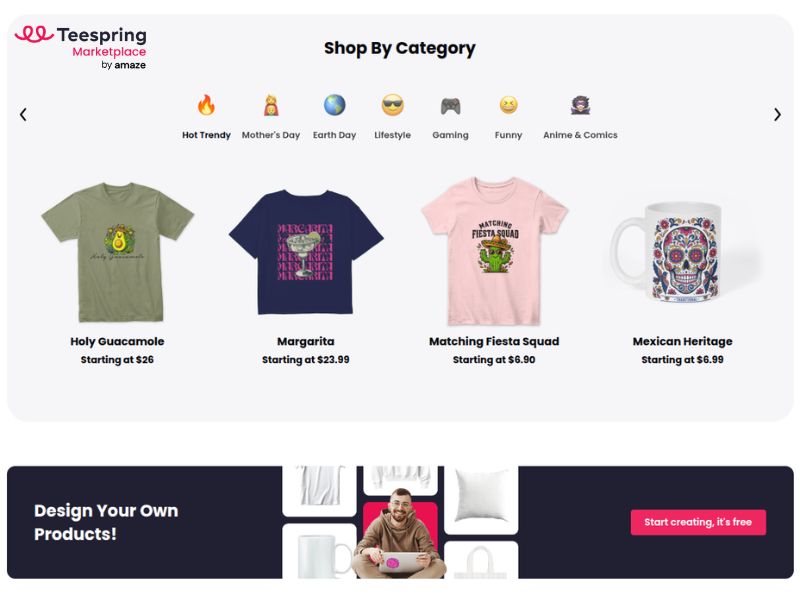
If you used to know Teespring as just a simple T-shirt selling tool in its early days, Teespring has now transformed into a complete commerce ecosystem – Spring designed specifically for content creators and modern sellers. No longer limited to physical products, Spring allows you to sell everything from T-shirts and home decor to digital products, design files, and even memberships or event tickets all on the same storefront.
The biggest competitive advantage of Teespring is its powerful social commerce capability. The platform integrates directly with YouTube, TikTok, Instagram, and Twitch, allowing your products to appear right below your videos or livestreams. Thanks to this, sellers can close deals instantly while viewers are engaged, without spending money to build and maintain a separate website.
For sellers, Spring optimizes the business process into a lean and risk-free model. You only need to focus on the two most important tasks: creating designs and marketing to drive traffic. The entire complex logistics behind the scenes is fully and automatically handled by Teespring from A to Z.
So, is it necessary to consider Teespring alternatives?
It is undeniable that Spring has many outstanding advantages. However, as your business grows larger, this platform will start to show certain limitations.
First, regarding the product catalog, the range of choices is still quite limited compared to the diverse needs of the market, while the printing techniques are not yet varied enough to handle highly complex designs. In addition, the ability to control and position brand on Teespring is only at a basic level, making it very difficult for you to create a unique personal identity for your customers.
Another issue is cost. The base price is often higher than some rival platforms, which accidentally squeezes your profit margin on each order. Finally, Teespring has absolutely no built-in organic traffic like Amazon or Etsy. If you do not already have a loyal audience from social media channels, you will almost have to start from zero and spend your own money and effort to drive every single visit to your store.
These are reason why looking for better Teespring alternatives is a strategic step.
Top potential Teespring alternatives in 2026
1. Printify
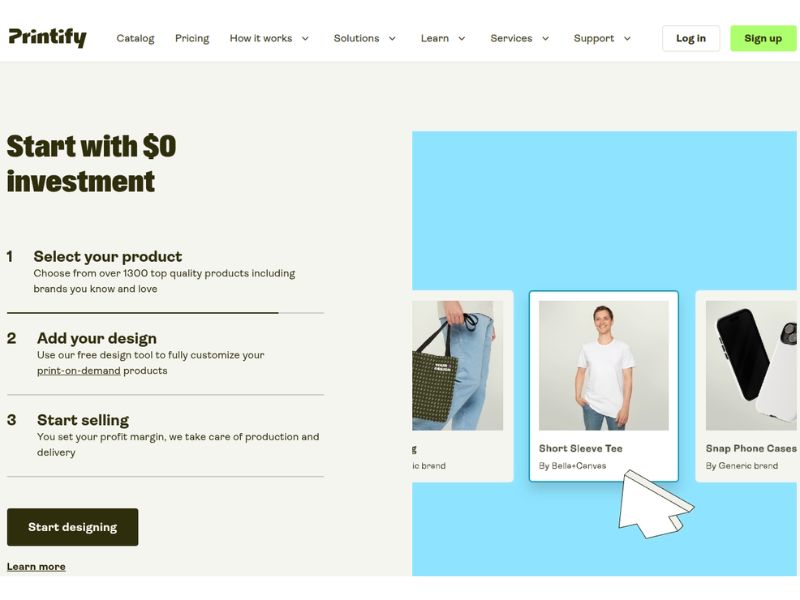
For those looking for a solution to both optimize costs and expand their product catalog, Printify is a name that cannot be missed. This platform operates as a huge network connecting you with over 90 print providers located in many different regions around the world.
Printify’s product catalog includes over 1,300 diverse items, ranging from clothing, accessories to unique niches like scented candles, yoga mats, or tech gadgets. The operation process here is very intuitive: you just need to choose your desired product, then actively select a suitable provider within the system. As soon as an order comes in, the chosen partner will be responsible for printing and shipping it directly to your customer.
The biggest advantage is that the base price is usually lower than the market average. At the same time, having a multi-national network of printers allows you to flexibly choose a provider close to your target market to minimize shipping time.
Additionally, Printify supports strong integrations with major e-commerce platforms and marketplaces like Shopify, Etsy, or WooCommerce.
However, because there are too many printing partners in the system, product quality may not be consistent across different providers. Therefore, the safest solution is to actively order samples to test the quality before officially selling.
Comparison table: Printify vs Teespring
| Criteria | Printify | Teespring |
| Model | Third-party printer network | In-house full service |
| Products | Over 1,300 items (diverse niches) | More limited (clothing, digital, tickets) |
| Base Price | Lower | Higher |
| Shipping | Flexibly choose printers near customers | Fixed according to Spring’s system |
| Integration | Shopify, Etsy, WooCommerce | YouTube, TikTok, Instagram, Twitch |
| Quality | Not consistent (need to test samples) | More consistent and stable |
Read: Printify Alternatives: 11 Powerful Options for Sellers in 2026
2. Merchize
Merchize is a breakthrough choice for sellers who want to expand beyond traditional printed products. At its core, Merchize perfectly combines in-house manufacturing capabilities with a global fulfillment network. The highlight of this platform is that it builds its entire system to serve the goal of professional commercialization and business scaling, turning custom ideas into high-profit goods.
Currently, Merchize offers a rich catalog of nearly 1,000 quality products. Besides familiar apparel, accessories, and home decor items, this platform is especially strong in highly challenging, unique custom product lines such as custom-shaped window hangings, personalized night lights, or exclusive decorations.
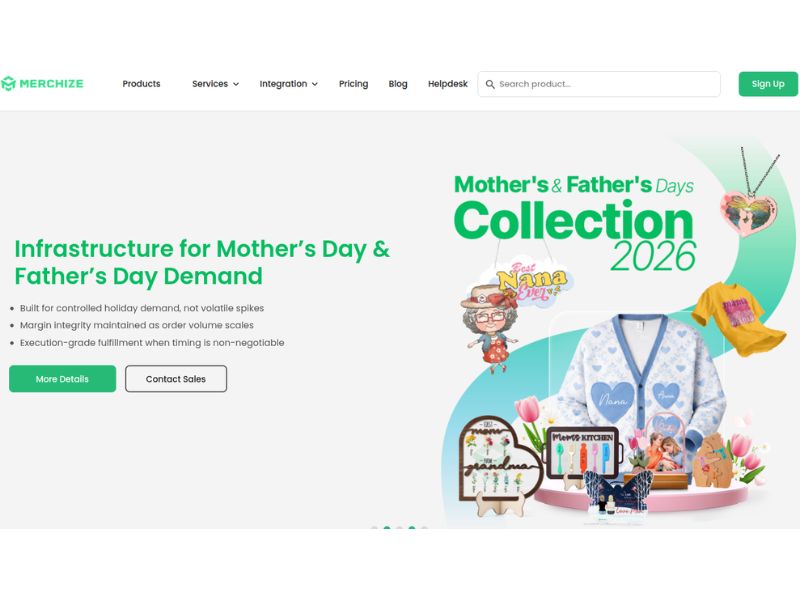
A solid support system for sellers choosing Merchize is its outstanding production capacity, featuring a modern factory system in Vietnam combined with fulfillment centers spread across the US, EU, UK, Australia, and China. Thanks to a powerful capacity of over 100,000 products per day and an extremely fast order processing time starting from just 1 working day, Merchize ensures maximum stability in both production time and shipping costs, even during peak seasons.
Merchize’s competitive advantage also lies in its high-tech processing techniques, including UV printing, DTG, embroidery, engraving, sublimation, and precise laser cutting. This opens up great opportunities for sellers to develop exclusive, deeply personalized product lines to stand out in the market.
Furthermore, to help sellers diversify their sales channels, Merchize allows smooth integration with a series of giants from Shopify, Etsy, and WooCommerce to Amazon, eBay, TikTok Shop, and Walmart. Accompanying this is a comprehensive supporting ecosystem, including private storefront services, Amazon FBA-compliant packaging support, and corporate gift production (SWAG), ready to accompany the long-term growth of your business.
Quick comparison: Merchize vs Teespring
| Criteria | Merchize | Teespring |
| Model | In-house manufacturing + Global fulfillment | In-house full service |
| Products | Nearly 1,000 items | More limited (clothing, digital, tickets) |
| Printing Tech | UV, laser cutting, embroidery, engraving, DTG | mostly DTG and standard printing |
| Fulfillment | Processing from 1 day (Warehouses in US, EU, VN, China) | Dependent on Spring’s own logistics system |
| Integration | Shopify, Etsy, Amazon, eBay, TikTok Shop… | YouTube, TikTok, Instagram, Twitch |
| Services | Storefront, FBA support, SWAG production | Direct sales through social media |
3. Gelato
If your biggest challenges are long shipping times and high international shipping costs, Gelato is the perfect solution. Operating as a middleman, Gelato partners with over 140 third-party manufacturers across more than 30 countries, including the US, UK, Europe, and Australia.
When an order is placed, the system automatically routes it to the printing facility closest to the customer. This process ensures super-fast delivery, minimizes shipping fees, improves customer satisfaction, and lowers carbon emissions through localized production.
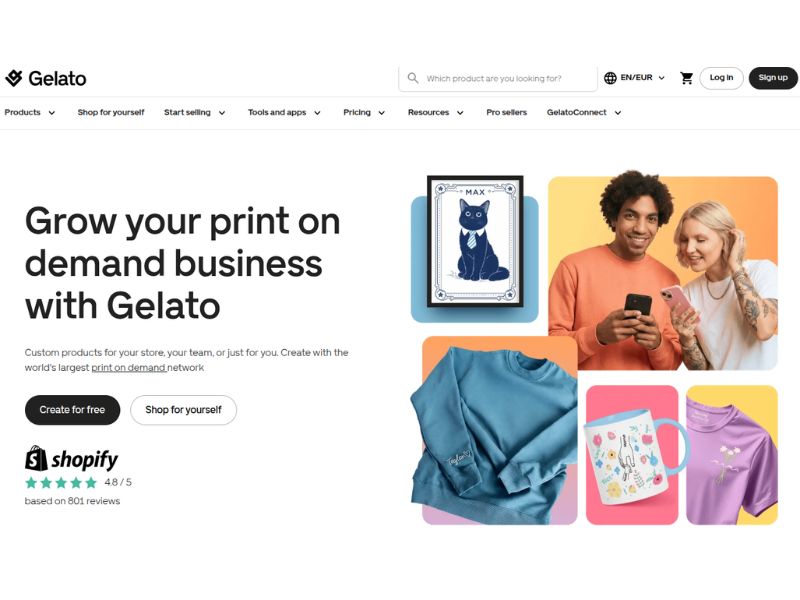
While Gelato offers standard items like apparel and mugs, its core strength lies in paper-based products such as posters, canvas prints, framed art, and calendars. The platform uses advanced printing methods like DTG, DTF, and premium embroidery. However, a major downside is that the base cost for posters remains high, even with a paid monthly membership. Additionally, the initial prices shown do not include shipping fees.
Another drawback is that because Gelato relies on a network of third-party printers, it lacks direct quality control, which can lead to inconsistent product quality between facilities. On the bright side, setting up a store is easy, as Gelato seamlessly integrates with popular e-commerce platforms like Shopify, Etsy, WooCommerce, Wix, Squarespace, and BigCommerce.
Comparison table: Gelato vs Teespring
| Criteria | Gelato | Teespring |
| Model | Localized printer network | Centralized in-house manufacturing |
| Strongest Products | Paper prints (Posters, canvas, calendars) | Fashion, digital, tickets |
| Shipping | Super fast, low cost | Fixed according to Spring’s logistics |
| Environment | Friendly | Traditional manufacturing process |
| Disadvantages | High poster prices, quality varies by printer | High general base price, no built-in traffic |
| Integration | Shopify, Etsy, WooCommerce, Wix… | YouTube, TikTok, Instagram, Twitch |
4. Printful
If you put consistent quality and brand experience first, Printful is the heaviest contender. Printful has currently an incredibly impressive connection capability with over 20 large and small e-commerce platforms, including Shopify, Etsy, WooCommerce, Amazon, BigCommerce, Wix, Squarespace, and many more.
Printful runs its own in-house manufacturing facilities across many regions of the world, helping strictly control the quality of every single product. This is the perfect solution for sellers aiming for professional brand positioning, allowing you to fully customize everything from embroidered logos and printed inside-neck labels to personalized packaging. Not stopping there, the system has updated its features to support bulk printing for warehousing, while also providing ready-made design packaging templates and eco-friendly reusable packaging options to keep up with green consumer trends.
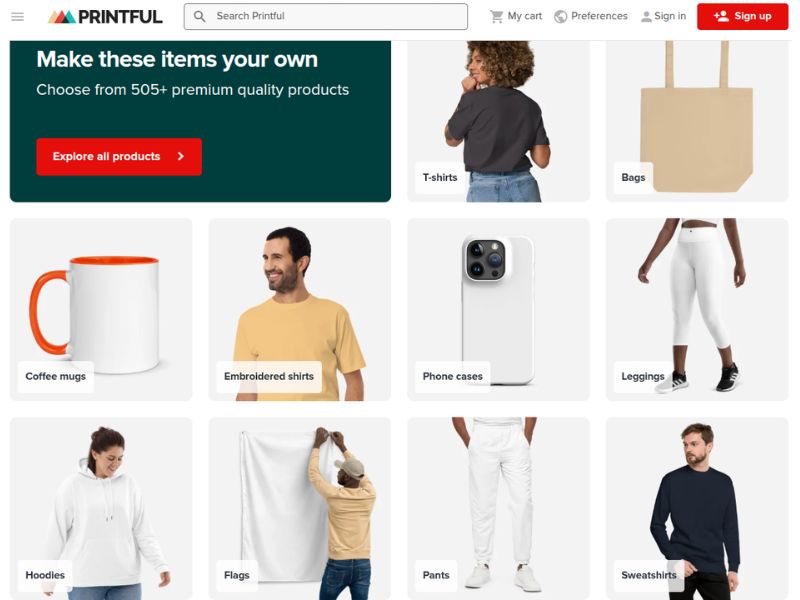
In terms of catalog, Printful’s products focus heavily on popular and high-demand groups such as fashion apparel, hats, wall art, and home decor, accompanied by a sharp and realistic mockup image system. However, a small downside is that the number of items here is somewhat limited, with only about 505 products, and it offers fewer niche items compared to some other custom printing partners on the market.
Quick comparison: Printful vs Teespring
| Criteria | Printful | Teespring |
| Model | Runs its own in-house facilities globally | Centralized in-house manufacturing |
| Products | Around 505 items (focuses on core goods) | Limited (clothing, digital, tickets) |
| Branding | Very strong | Basic, difficult to create personal identity |
| Warehousing | Supports bulk printing and warehousing | Only prints when ordered (pure POD) |
| Quality | Very high and consistent across facilities | Stable at a basic level |
| Integration | Over 20 e-commerce platforms (Shopify, Etsy…) | Mainly connects to social media |
Read: 12 Cheap Printful Alternatives to Maximize Your Profits in 2026
5. Redbubble
Unlike the platforms above, Redbubble operates as a traditional e-commerce marketplace, allowing designers to tap into a massive amount of built-in organic traffic. The process is super simple: you just upload your designs, set your price, and the system handles the rest.
Currently, Redbubble connects over 700,000 global creators with millions of buyers, offering more than 70 product types, with cheap and popular items like stickers leading in sales. When an order is placed, a third-party printer closest to the customer automatically prints and ships the item.
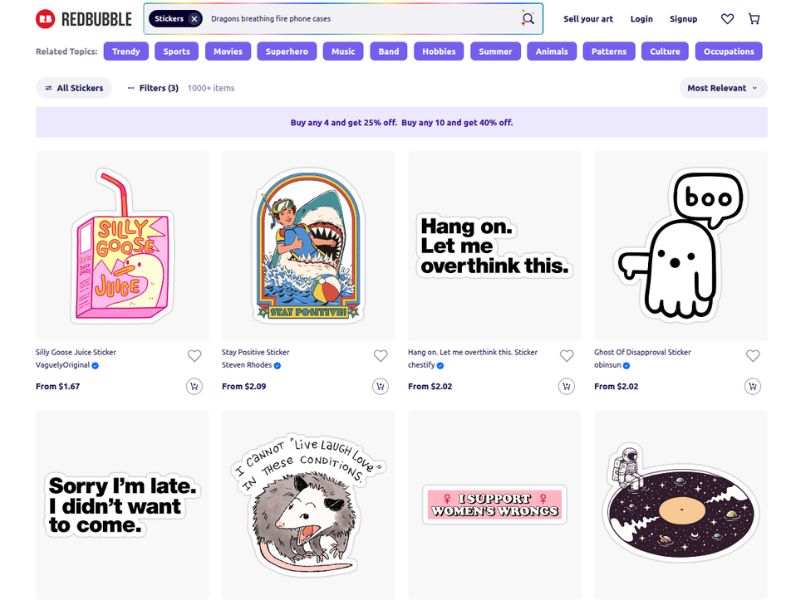
However, this hands-off model has big downsides. Because production relies entirely on small, individual orders through third parties, base costs are high and product quality can be inconsistent. Additionally, Redbubble is a completely closed ecosystem that does not integrate with independent stores like Shopify or Etsy. Instead of a fixed monthly membership, the platform also charges account fees by taking a percentage of your earnings based on your account tier.
In addition, you have to face the total loss of control. You cannot access customer data, build a personal brand, or manage the checkout experience, making you 100% dependent on the platform’s traffic algorithm. Realistically, you are selling on someone else’s “land," meaning your sales can drop drastically if the algorithm shifts. Furthermore, your profit margins will be very low since Redbubble sets high base costs, leaving you with only a modest royalty percentage per sale.
Quick comparison: Redbubble vs Teespring
| Criteria | Redbubble | Teespring |
| Model | E-commerce Marketplace | All-in-one sales platform |
| Traffic | Huge built-in organic traffic available | Sellers must drive traffic themselves or through social media |
| Integration | Not supported | Strong integration with YouTube, TikTok, Instagram |
| Branding | Customers only remember Redbubble | Supports building a separate storefront for sellers |
| Profit Margin | Very low | Higher |
| Account Fee | Deducts a percentage of earnings based on account tier | Free to create a store, only charged when an order is made |
Read: Redbubble Alternatives: Which You Should Switch to in 2026?
6. Spreadshirt
If you are looking for a solution that balances both the traffic advantages of a marketplace and the ability to build your own brand, Spreadshirt is a highly potential candidate. This versatile platform offers sellers 2 flexible options:
- You can list your products on the Spreadshirt Marketplace to tap into a huge amount of daily built-in traffic
- You can launch an independent Spreadshop to fully control your brand identity.
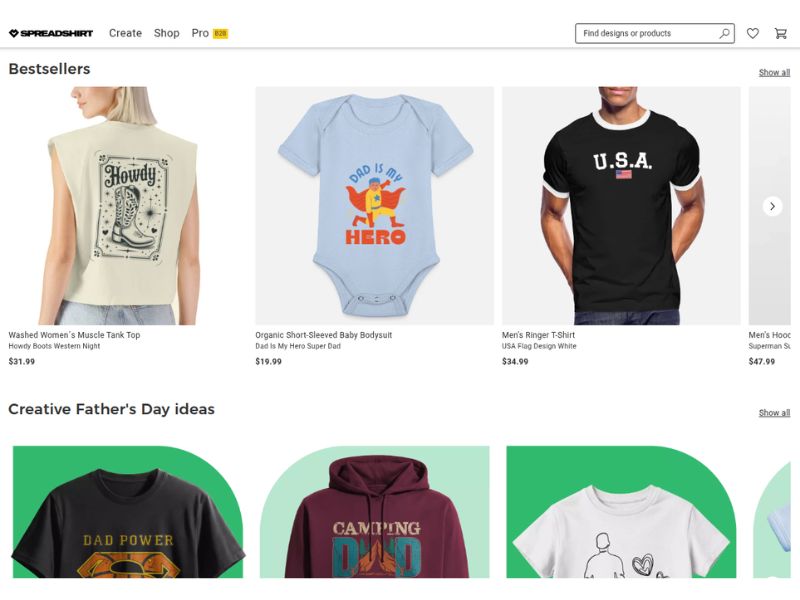
In addition, Spreadshirt’s cost and commission policy is also a huge plus:
-
With the Spreadshop model: You spend absolutely nothing on monthly maintenance fees ($0/month). Sellers have the right to set their own retail prices and keep the entire profit margin after subtracting the base cost. In particular, if your store reaches high sales volume, Spreadshirt applies a volume bonus policy with discounts up to 40% off the product’s base price, driving your profit margins very high.
-
With the Marketplace model: You also do not have to pay any fees. Every time a customer buys your design on Spreadshirt’s marketplace, you will receive a fixed design commission for each order successfully shipped out.
Regarding the product catalog, Spreadshirt focuses on optimizing core product groups with stable demand that are easy to scale, such as T-shirts, hoodies, hats, and ceramic mugs. The entire logistics process is guaranteed because Spreadshirt directly manages production at five modern factories globally, ready to provide fulfillment and shipping services to over 150 countries with consistent quality.
Quick comparison: Spreadshirt vs Teespring
| Criteria | Spreadshirt | Teespring |
| Flexible Model | Allows combining both Marketplace and separate Shop | Only focuses on building its own Storefront |
| Organic Traffic | Stable built-in traffic available from the Marketplace | Sellers must rely entirely on their own traffic |
| Factory System | Manages 5 production factories globally | Centralized manufacturing under Teespring’s system |
| Bonus Policy | Volume bonus up to 40% off base price for Shops | No volume bonus policy like this |
| International Payment | Well-optimized with support for 10 currencies | Mainly processes transactions in common currencies |
| Products | Focuses on core lines (T-shirts, hoodies, hats) | More diverse (includes digital products and event tickets) |
7. Zazzle
Operating on an e-commerce marketplace model combined with print-on-demand, Zazzle is an ideal playground for designers who want to simplify their business operations. When joining this ecosystem, you only need to focus on creating and uploading your artwork, then setting your desired royalty rate. Zazzle will handle the entire complex logistics process behind the scenes.
The most competitive advantage of Zazzle lies in its maximum customization feature for the end-user. The system allows buyers to directly modify the design before hitting the order button, such as changing names, anniversary dates, or adjusting text to their own liking.
Although it has a massive product catalog ranging from apparel and sportswear to furniture, Zazzle positions its brand incredibly well in the premium paper products and stationery niche, such as wedding invitations, greeting cards, wrapping paper, and life-event decorations like birthdays or baby showers.
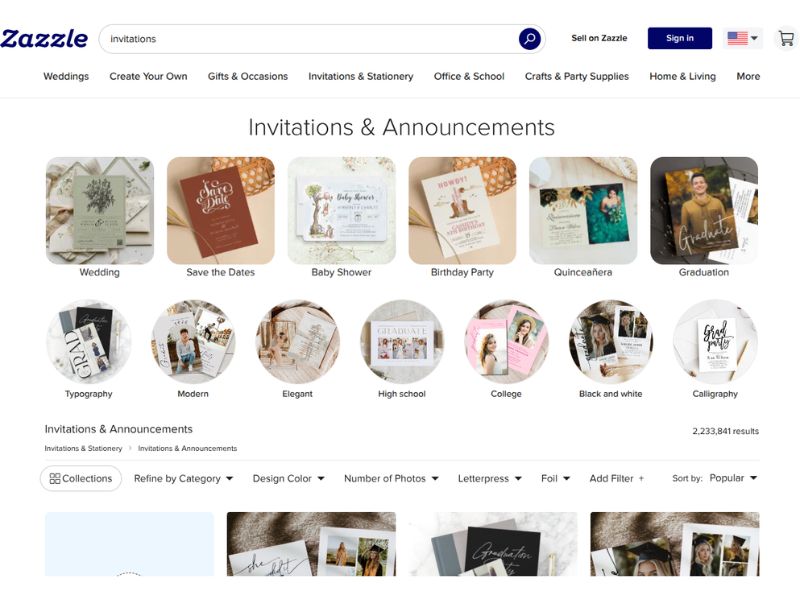
Zazzle’s profit-sharing mechanism also gives sellers great control based on a flexible royalty model:
-
For physical items: You are free to set your profit margin anywhere from 5% to 50%.
-
For digital products: You can even push your profit margin up to 99%.
-
Pricing formula: The entire retail price shown on the website will be automatically calculated using the formula: Base Product Price + % Royalty chosen by you.
However, because everyone does business on the exact same Zazzle storefront interface, unique brand identity is extremely challenging. You will have to face direct competition with thousands of other designers right on the same search results page. This can accidentally drag your actual profit margins lower than expected if you do not have truly breakthrough design ideas.
Quick comparison: Zazzle vs Teespring
| Criteria | Zazzle | Teespring |
| Model | E-commerce Marketplace | All-in-one sales platform |
| Core Feature | Allows customers to edit designs themselves | Customers buy fixed designs from the seller |
| Strongest Products | Stationery, wedding invitations, paper prints | Fashion, digital, event tickets |
| Profit Mechanism | Earns custom Royalty (5% – 50%, or 99% for digital) | Earns the difference (Retail Price – Base Price) |
| Branding | Hard to create a unique identity due to shared interface | Easy to customize and own a separate Storefront |
| Competition | Very high | Lower |
8. Teechip
Teechip (operating as Chip for sellers) is a unique hybrid POD platform that combines campaign-based selling with a complete e-commerce store builder. It offers maximum flexibility, allowing you to sell on their Marketplace, set up an independent store with a custom domain, or combine both models. The platform includes free marketing and conversion tools, such as SEO optimization, tracking Pixels, automated email marketing, and AI-driven promotion management, making it an ideal infrastructure-free choice for testing new products quickly.
In terms of products, Teechip provides standard print-on-demand items with competitive fixed base prices (typically $17.95 to $22.95 for T-shirts). It supports product personalization for over 90 different items and uniquely allows direct integration with AliExpress for dropshipping, helping sellers diversify beyond traditional POD inventory.
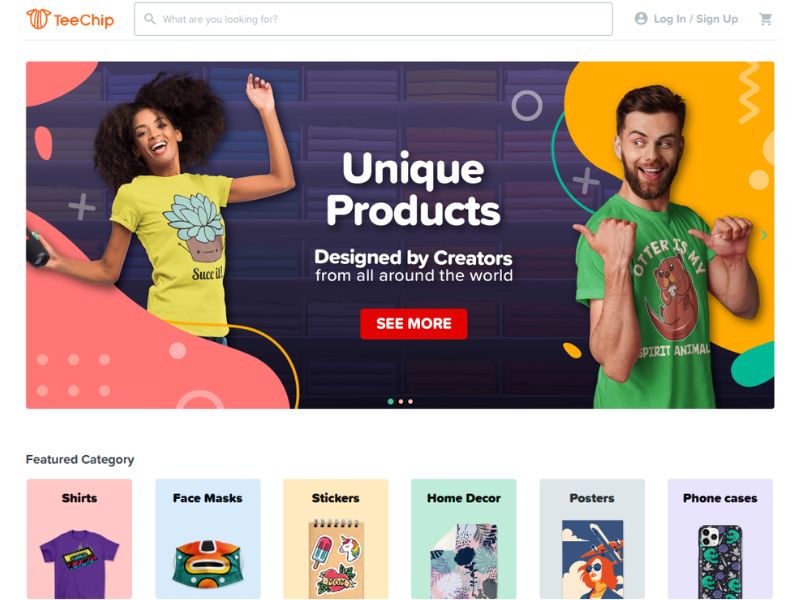
For cost-conscious sellers, the platform is completely free to use with no monthly fees, charging only a 7% processing fee on your actual profits to cover customer service, fraud protection, and payment processing.
However, there has inconsistent printing quality. Furthermore, because it utilizes a shared Marketplace alongside a system that recommends similar items, popular products are highly vulnerable. If you happen to have a high-selling campaign, it is very easy for competing sellers to clone your exact design and list it at a lower price on the same platform to steal your customers.
Quick comparison: Teechip vs Teespring
| Criteria | Teechip | Teespring |
| Model | Campaign selling + AliExpress Dropshipping | Campaign selling + All-in-one POD |
| AI Features | Integrated AI to automatically manage promotions | No such AI tools integrated |
| Platform Fee | Free, only charges 7% on actual profit | Free, charges are built directly into the base price |
| Marketing Integration | Built-in Pixels, Email marketing, and SEO | Focuses on integrating checkout tools on social media |
| Personalization | Allows customers to edit designs on over 90 items | Only applies to a few templates with fixed designs |
| Domain Name | Allows setting up a store with a custom domain | Supports creating Storefronts (subdomain or custom domain) |
9. Apliiq
If your business direction aims straight at the premium segment, Apliiq is the ultimate perfect launchpad. Instead of following the beaten path of other POD platforms, Apliiq puts “brand identity" above everything else.
This platform focuses on helping sellers build a real, professional private label according to the standards of streetwear brands or premium boutique labels. The biggest difference lies in a series of exclusive customization options, such as adding woven labels, satin labels, custom patches, or sewing unique artistic liners inside hoodie hoods – subtle details that usually only appear in famous fashion houses.
The platform’s catalog features over 1,200 styles of premium blank apparel from world-famous blank brands like Bella + Canvas, Comfort Colors, and even sports giants like Nike and Adidas. To meet strict retail standards, Apliiq provides a wide variety of specialized garment techniques, including high-quality embroidered logos (supporting 3D puff embroidery), advanced digital printing (DTG/DTF), bulk screen printing, and upgraded cut-and-sew techniques like adding custom patterned pockets to T-shirts.
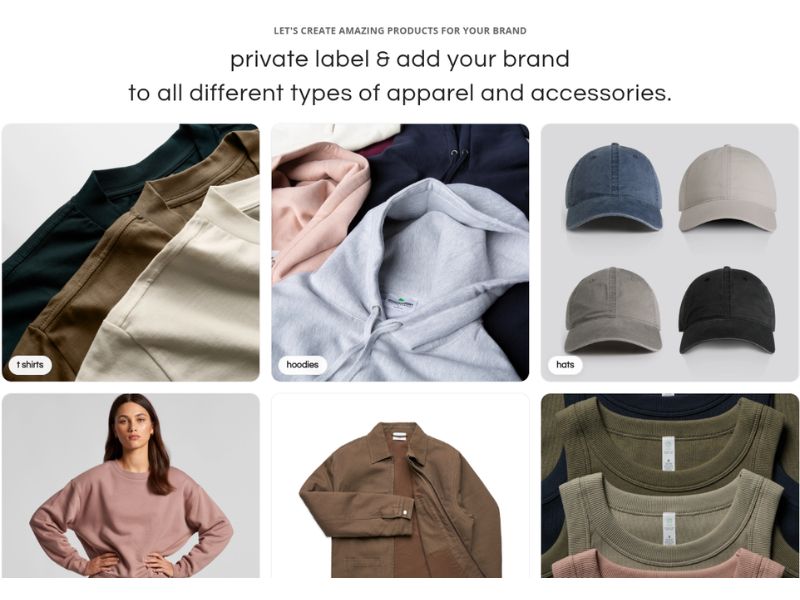
In terms of technology, Apliiq supports smooth integration with Shopify, WooCommerce, and a few major marketplaces, making it easy to sync and run an automated store.
However, in exchange for this premium quality, sellers need to prepare a larger budget because the cost of blanks and detailed customization at Apliiq is significantly more expensive than the market average. At the same time, the product ecosystem here is visibly limited as it focuses solely on fashion apparel and fabric accessories (T-shirts, hoodies, hats, joggers, tote bags); there are absolutely no common consumer goods or gift items like mugs, phone cases, or wall art.
Quick comparison: Apliiq vs Teespring
| Criteria | Apliiq | Teespring |
| Market Segment | Streetwear & Premium brands | Casual fashion, gifts & Creators |
| Brand Positioning | Extremely strong | Basic |
| Blank Quality | Premium (Over 1,200 styles from Nike, Adidas, Comfort Colors) | Stable at a basic standard level |
| Processing Tech | Highly diverse (DTG/DTF printing, 3D embroidery, laser cutting, sewing labels) | Mainly standard digital printing |
| Product Ecosystem | Only focuses on clothing and fabric accessories | Broader |
| Input Cost | Very high | Moderate |
10. Bonfire
Bonfire stands out by uniquely combining print-on-demand with a crowdfunding model. The platform provides a free set of tools designed to help non-profit organizations, schools, artists, and individuals easily raise funds by selling custom merchandise.
The operation process revolves around campaigns: you simply create a design, set a target number of orders, and share the link. Once the campaign ends, Bonfire completely handles payment processing, manufacturing, shipping, and customer service.
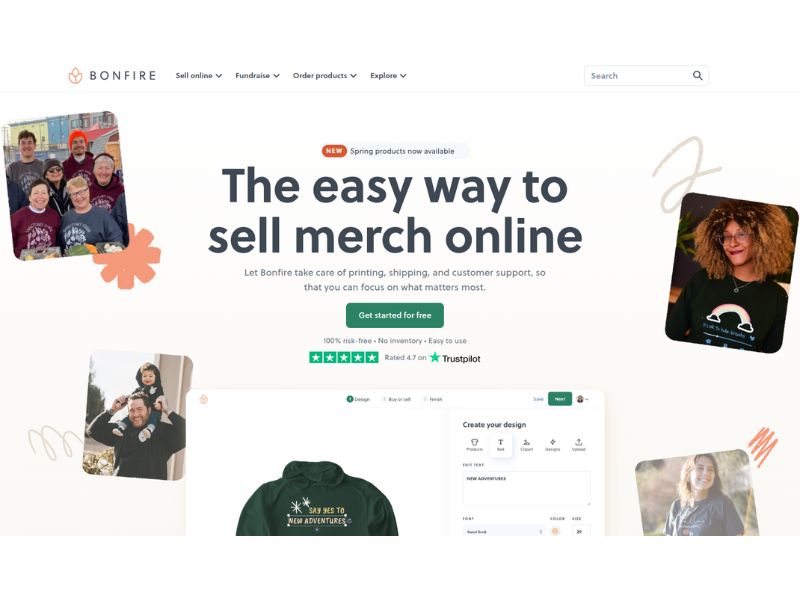
The product catalog focuses heavily on popular, easy-to-sell items like classic T-shirts, hoodies, sweatshirts, kids’ clothing, tote bags, hats, and mugs. A major advantage of Bonfire is its inclusion of premium and eco-friendly blank lines (such as Comfort Colors and sustainable fabrics) which help build trust for your campaign. Additionally, the platform is highly flexible, allowing you to either run online fundraising campaigns to earn profit margins or purchase items in bulk at base prices with no MOQ for personal or group use.
However, because it is specifically designed for community connection and short-term fundraising, Bonfire will not be suitable for sellers who want to build a long-term fashion brand. The system here does not provide deep customization solutions for labels.
At the same time, Bonfire’s niche product catalog is still quite thin, and the platform lacks automated API integration ports with popular third parties like Shopify or WooCommerce, making the syncing and automation of the supply chain more challenging.
Quick comparison: Bonfire vs Teespring
| Criteria | Bonfire | Teespring |
| Core Goal | Crowdfunding and social connection | Commercializing designs and optimizing revenue |
| Sales Format | Short-term campaigns or bulk ordering at base price | Campaigns or continuous Storefront maintenance |
| Key Feature | Integrated donation tools, displays fund progress bars | Powerful social commerce integrations (TikTok, YouTube…) |
| Green Products | Eco-friendly blank options are available | Mainly standard and common blank lines |
| E-commerce Integration | Quite limited | Full support and better ecosystem connection |
| Branding | Dependent on Bonfire’s campaign interface | Supports more professional Storefront customization |
11. Gooten
Gooten is perfect for sellers looking to expand beyond T-shirts into deep niche markets. Its biggest selling point is its advanced processing methods, such as computer embroidery, foil printing, laser engraving, and weaving, allowing you to create unique products other platforms can’t offer.
Gooten automates everything from technical processing to logistics by connecting with a large network of manufacturers across the US, UK, Canada, and Australia. Its catalog includes around 525 product lines, from basic apparel to specialized home decor.
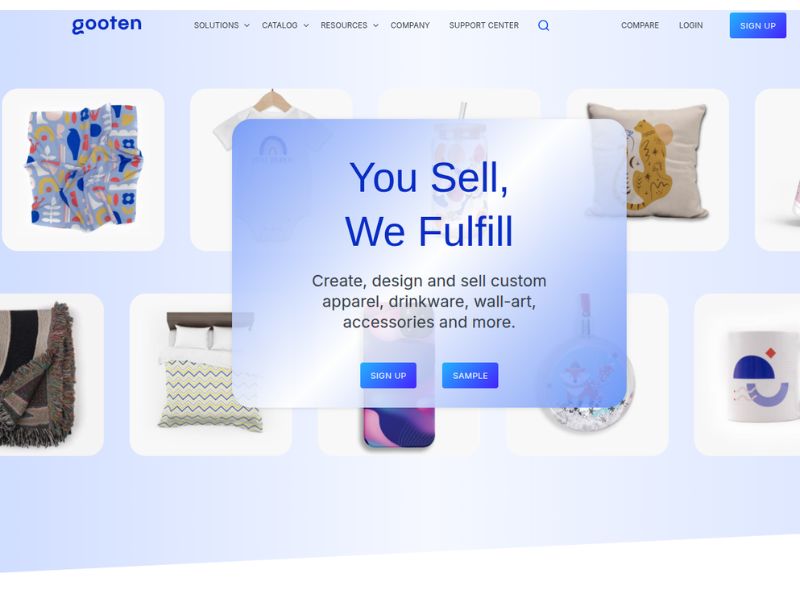
A standout feature is its direct pairing with the Customily app, which lets buyers easily personalize designs right on your store by adding text, changing patterns, or using AI to remove backgrounds. This makes it incredibly easy to catch the personalized product trend.
However, because Gooten relies on a third-party network, product quality can sometimes vary between facilities. Additionally, it lacks direct integrations with major marketplaces like Amazon or eBay, and the Customily tool only works at its best on Shopify or Etsy.
Quick comparison: Gooten vs Teespring
| Criteria | Gooten | Teespring |
| Model | Global manufacturing partner network | Centralized in-house manufacturing |
| Printing Tech | Highly diverse | Basic |
| Personalization | Very strong thanks to deep integration with Customily | Limited, mostly sells fixed designs |
| Niche Products | Rich | Focuses on T-shirts, digital products, and tickets |
| Quality | Risk of variation due to third-party involvement | More consistent and stable |
| Marketplace Integration | Limited | Connects directly with Social channels |
12. TeePublic
If you do not like complex store setups or expensive advertising, TeePublic is the ideal answer.
TeePublic operates as a vibrant e-commerce marketplace. They focus heavily on pop culture, fandoms, and trending internet topics like movies, video games, or anime. This platform possesses a very rich source of built-in potential customers who actively search for unique designs based on specific interests. Therefore, sellers can instantly tap into this strong internal traffic to get orders.
The process is quite simple: you just need to register an Artist account, upload your design files, and the system will automatically apply the design template. The platform’s product inventory is massive, ranging from apparel and accessories to home goods. Notably, TeePublic’s standard T-shirt lines are highly rated by customers thanks to their outstanding blank quality.
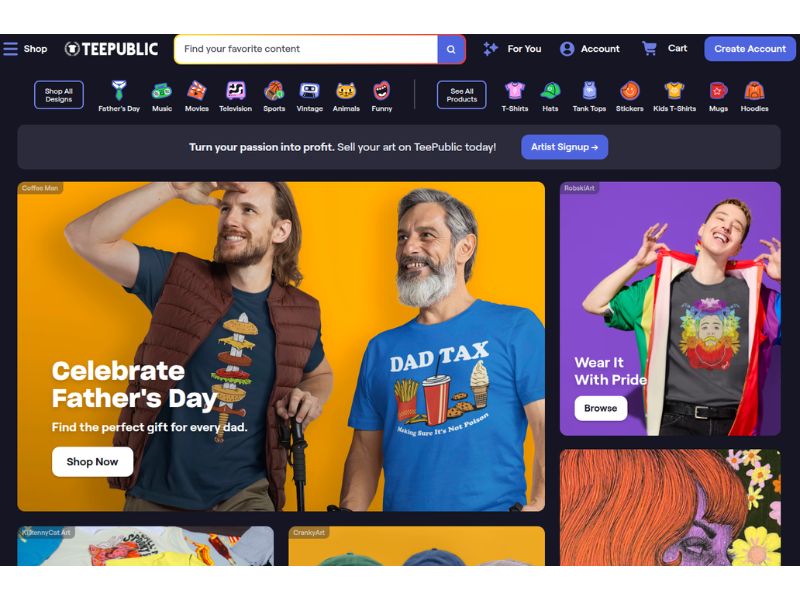
In addition, you can easily reach customers in dozens of major countries, from the US, Canada, and Europe to Southeast Asian regions like Thailand, Singapore, and Malaysia.
However, TeePublic is a completely closed e-commerce marketplace. You will sell directly on their “playground" and earn a fixed income (Royalty) on each product sold. The system also does not support API connections with external tools like Shopify or Etsy.
Quick comparison: TeePublic vs Teespring
| Criteria | TeePublic | Teespring |
| Model | E-commerce Marketplace | All-in-one sales platform |
| Organic Traffic | Strong built-in buyer community available | Sellers must rely entirely on their own traffic |
| Template Application | Automatically applies designs to 100% of products | Sellers manually choose and set up each product line |
| Special Integration | Allows bulk importing of designs from Redbubble | Strongly integrates with social media |
| Service Commitment | 100% free returns and exchanges for guests (GuaranTee) | Applies standard company return policies |
| Income Level | Fixed income (Royalty) per product | Earns the difference |
Teespring competitors comparison chart
Factors to consider when choosing the right Teespring alternatives
To find the perfect Teespring alternative, you shouldn’t just look at which platform is the most popular. Instead, you need to look inward at your current resources and strengths.
1. What is your Traffic Source?
Evaluate where your buyers will come from and your marketing budget. If you are an influencer with a large following or have money for ads, independent platforms like Printify, Printful, or Spreadshirt offer the highest profit margins. However, if you are starting from zero with no ad budget, it is best to piggyback on the free, massive organic traffic of marketplaces like Redbubble or TeePublic to get your first sales.
2. What is your growth phase?
Decide if you want quick, hands-off passive income or a long-term fashion brand. If you just want to upload designs and let someone else handle everything, the marketplace or campaign models of Zazzle or Bonfire will save you time, though you lose business control. But if you want to own your customer data, manage checkouts, and build a unique brand, setting up your own Shopify or Etsy store linked to networks like Merchize or Gelato is the way to grow.
3. What is your target niche?
Every POD platform has its own product focus, so you must match your design style with their manufacturing strengths. If your ideas focus on funny quotes, jokes, or pop-culture memes, cheap and popular items like stickers and standard T-shirts on TeePublic or Redbubble sell the fastest. But if you are targeting premium niches that require 3D embroidery, laser engraving, or custom home decor, you need advanced partners like Apliiq or Gooten.
4. What is your tech capability?
Be honest about your technical skills and how much daily time you can invest. Building an independent store, setting up payment gateways, and connecting tracking pixels on platforms like Teechip or Shopify requires significant time and tech learning at the start. If you are busy and just treat POD as a side hustle, stick to marketplaces with simple interfaces like Redbubble or Zazzle that automatically apply your designs with a single click.
Conclusion
IThere is no single “perfect" platform. The best choice doesn’t depend on which platform has the biggest name, but on which one truly understands your creative soul, fits your technical skills, and respects your business goals. Look closely at your own resources, listen to what your business needs right now, and choose the path that allows your brand to grow naturally and beautifully.