Contents
Many people still think that selling stickers is just a small side-hustle. However, in the 2026 creator economy, stickers have become a million-dollar industry, driven by the personalization culture of Gen Z and Gen Alpha.
Even so, the strategic step that separates a small hobbyist from a million-order local brand is the choice of distribution channels. Where are the best places to sell stickers that meet all three factors: high organic traffic, smooth international payment gateways, and optimal POD (print-on-demand) integration? Let’s look at the real data right below.
7 best places to sell sticker online this year
1. Etsy
If you type the keyword “sticker" into Etsy’s search bar, the algorithm will immediately show tens of thousands of results in all kinds of styles. This huge number is the best proof that this is the best place to sell stickers.
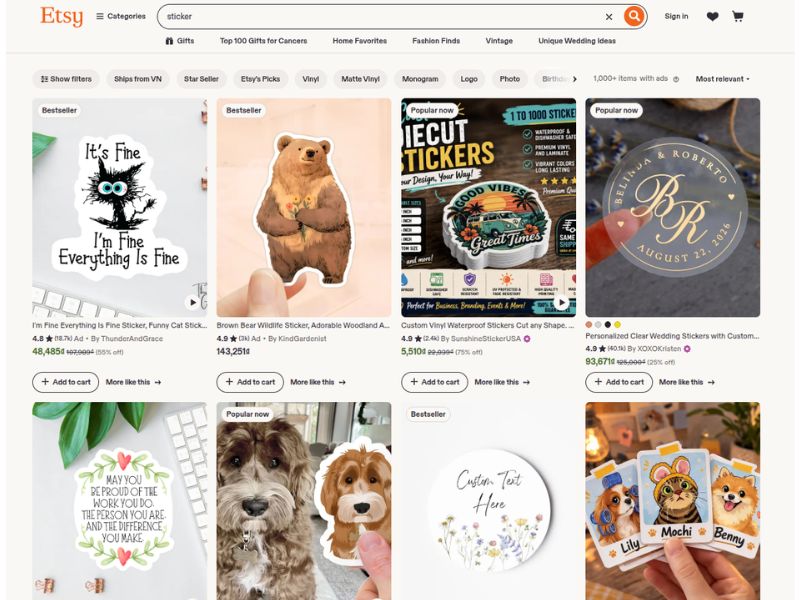
The biggest advantage of Etsy lies in customer behavior. People go to Etsy to search for “uniqueness" and artistry. They are willing to pay higher prices for sticker sets with Cottagecore or Y2K styles, or special sticker designs made for planners.
What does this mean? You don’t need a website with millions of subscribers. As long as you do good SEO and catch the right trends (aesthetic/trendy stickers), Etsy’s algorithm will automatically bring your designs to millions of users who already have their wallets ready.
Of course, standing on the shoulders of giants is never free. Etsy charges a listing fee for each product and a transaction fee for every successful order. In a highly competitive market, big shops have been established for a long time, this is not a place for lazy people who just copy ideas.
But looking at it objectively: In exchange for getting your first orders quickly without spending a single dollar on ads, Etsy is still the most perfect launchpad for you to test the market and measure customer tastes before thinking about bigger games.
2. Amazon
Next, if you type the keyword “sticker" on Amazon, the results show not just thousands, but millions of products from all over the world. Looking at this number, real business minds will see: The buying power here is endless.
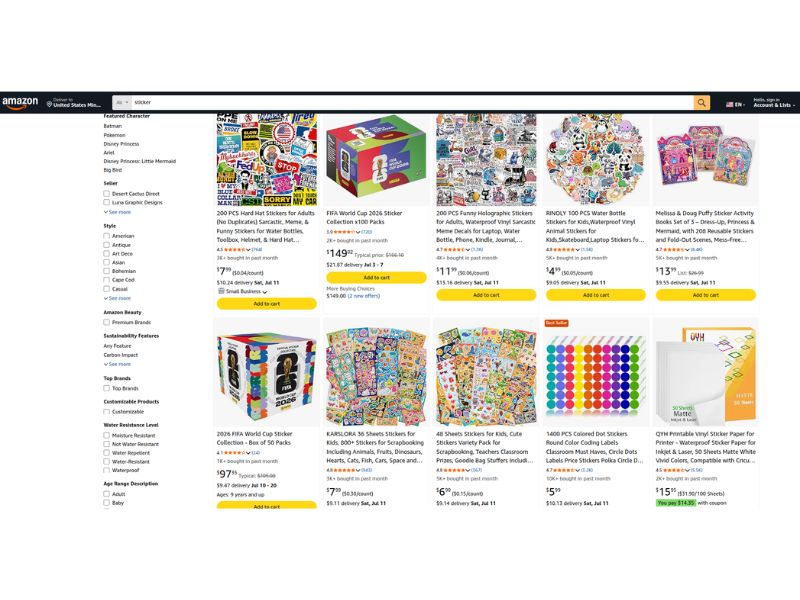
The majority of customers go to Amazon not to buy one or two single stickers. They come here to look for bulk combo packs of 50 to 100 stickers for different purposes.
However, Amazon does not run on unique artistic taste like Etsy; it runs on logistics and speed. You will face a fierce price war, along with strict policies about shipping time and customer service. In particular, Amazon’s fee system (especially if you choose FBA) and the cost of running internal ads to get your products displayed are not cheap at all.
In short, Amazon is a top battlefield for sellers who already have financial resources, the ability to produce/print in large quantities at optimized costs, and are ready to spend money to win the buy box. If you want to scale up your revenue from a few hundred dollars to tens of thousands of dollars a month, this is a place you must go.
3. Shopify
Completely different from Etsy or Amazon – where you have to “rent a house" and follow the rules of the platform owner – Shopify is like buying your own land and building your own empire. Here, you have full control: from the storefront interface experience and brand storytelling to product pricing, without worrying about a third-party algorithm cutting your reach or leading customers to a competitor’s shop.
The profit margin on Shopify is always a dream number for every sticker seller because you don’t have to share a high percentage of your revenue with e-commerce platforms. You own 100% of customer data (emails, phone numbers) – an invaluable asset for running remarketing campaigns.
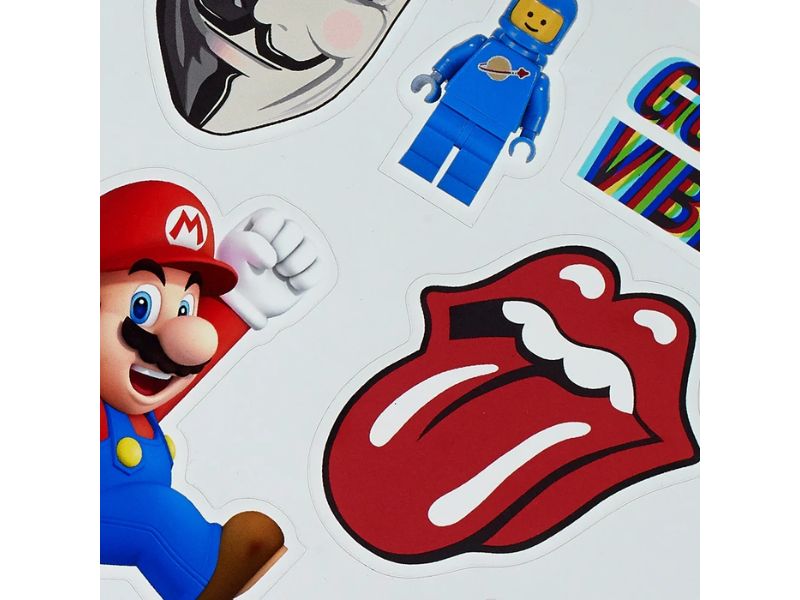
However, this freedom comes with a very big price. When you just open a Shopify store, your traffic is zero. No one will know about you if you don’t know how to “bring people" to your home through SEO, running Facebook/TikTok ads, or building a community on social networks.
Therefore, Shopify is not an ideal starting point for beginners with no resources. The smartest strategy is to use Etsy or Amazon to “test" which designs the market likes, and use the cash flow from those platforms to grow your fan base. When you already have best-selling products and a certain number of loyal customers, that is the perfect time to move to Shopify and build a real sticker brand.
4. Redbubble
If you are an artist or a designer who wants to focus 100% on creating and hates packaging, shipping, or handling customer complaints, then Redbubble is your “promised land." Although this is a marketplace with many different products, any experienced seller knows that stickers are the “king" of sales on Redbubble.
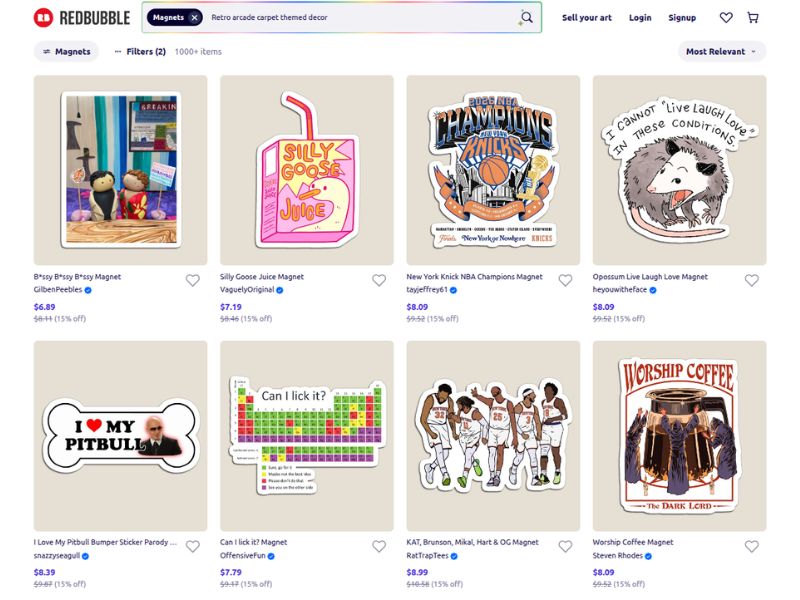
The magic of this platform lies in the POD model. You only need to upload your design file, write a title, add SEO tags, and choose the sticker format. When a customer buys it, Redbubble’s system will automatically send the print order to the partner factory closest to the customer’s location to produce and ship it. You don’t have to do anything.
Of course, the downside here is the profit margin. Because Redbubble has to pay for all production and operation costs, the money you receive per sticker is usually quite small, from just a few cents to over 1 USD. You also cannot customize the packaging or build your own customer list because your identity is completely hidden behind Redbubble’s logo.
But looking at it fairly, for beginners or artists who want to create a sustainable source of passive income from their simple doodles, this is still a stepping stone that you should not skip.
5. TikTok
Moving into 2026, TikTok is no longer just an entertainment app; it has evolved into a massive selling machine thanks to the perfect combination of short videos, livestreams, and TikTok Shop. For a product that is highly visual, cheap, and easy to buy on impulse like stickers, TikTok is a “heavy weapon" capable of creating unbelievable sales explosions.
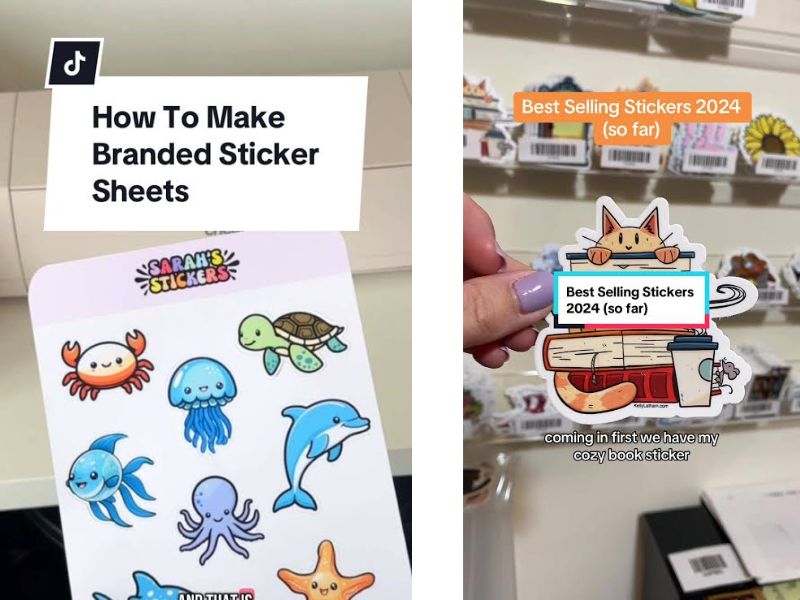
Sticker customers are mostly Gen Z and Gen Alpha – generations that “live" on TikTok. They don’t actively look for stickers to buy like on Etsy or Amazon; they buy because they are attracted when scrolling past a close-up video of you peeling a shiny holographic sticker, or a behind-the-scenes video of you carefully packing an order.
TikTok’s interest-based distribution algorithm can turn an account with 0 followers into a viral hit overnight. One trending video means hundreds or thousands of orders will pour in within just a few hours.
Despite these advantages, TikTok is also a very fierce battlefield that requires high perseverance. Here, you cannot just set up your shop and wait for orders. You must become a real content creator: constantly updating video ideas, catching trending music, or confidently going live to interact with viewers.
Competition on TikTok does not come from price, but from the speed of attracting viewers in the first 3 seconds. If you are a sharp seller who can produce content regularly and has a stock of stickers ready to ship immediately, this is the channel with the fastest growth rate at the moment.
6. Instagram
If your stickers have a unique, highly aesthetic art style or represent a specific lifestyle, Instagram is like a small cultural world. Unlike TikTok, which focuses on instant explosions, Instagram is the land of customer loyalty and long-term brand value.
The strength of Instagram lies in the deep connection between artists and fans through formats like Reels, Stories, and Broadcast Channels. Customers here buy because they love your creative journey and want to support your artistic mindset. By sharing unfinished sketches or opening a vote for a new design on your Story, you successfully bring customers into the production process.
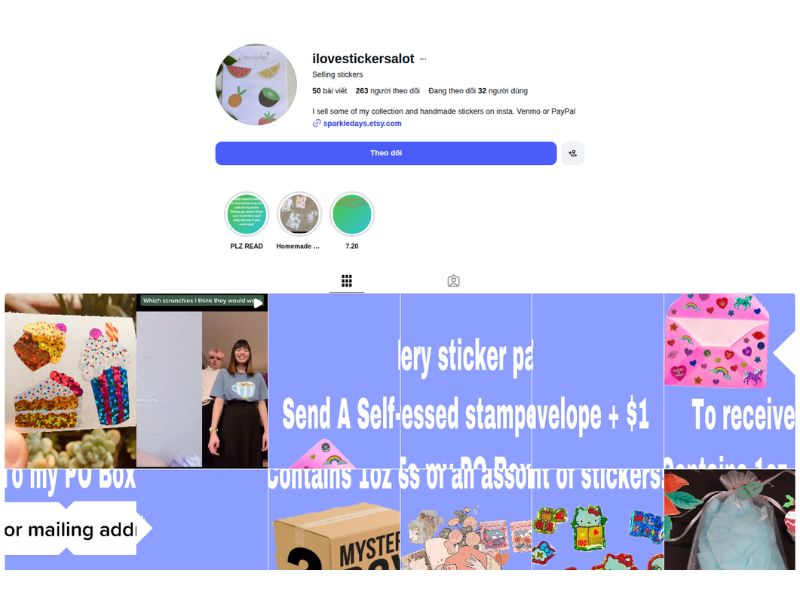
However, the platform’s algorithm requires a consistent content strategy, well-invested images, and a patient mindset, because organic growth is much slower than TikTok.
Advice from experts: Do not try to sell directly in a pushy way on Instagram. Turn your profile into a lively art lookbook, then guide this loyal fan base to your Shopify website through the link in your bio to maximize conversion rates.
7. WooCommerce
For those who love digital freedom and want to personally design every corner of their store without paying monthly maintenance fees, WooCommerce (an open-source platform running on WordPress) is the launchpad for you. This is where you break away from all templates to build a one-of-a-kind shopping experience.
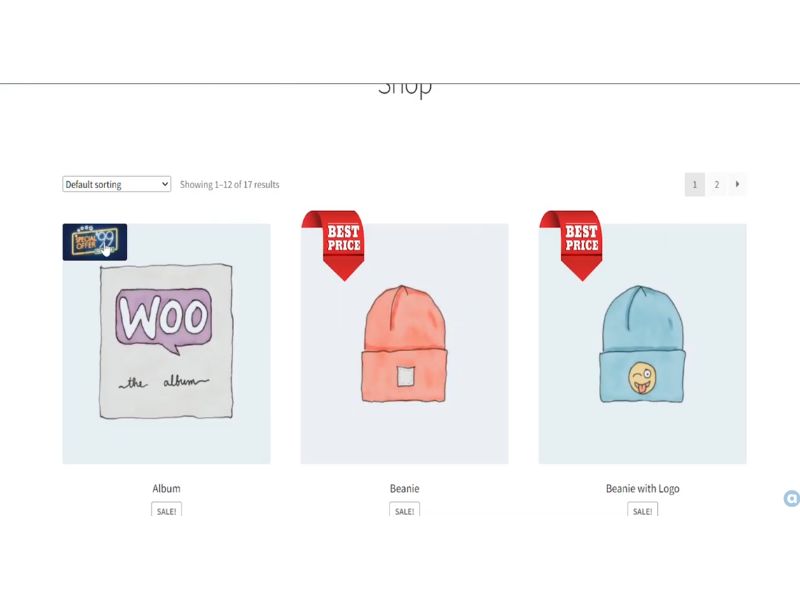
The advantage of WooCommerce is very low operating costs and endless customization options. You do not pay a fixed monthly platform fee and are not bound by any strict rules from big tech companies. With a huge plugin library, you can easily design unique features: from allowing customers to upload their own photos for custom sticker orders, creating mix-and-match sticker packs, to integrating 3D display effects for premium sticker lines like vinyl, gold-embossed, or reflective holographic stickers.
But let’s be realistic: WooCommerce is not for people who are “tech-blind." To master it, you need a certain amount of knowledge about website administration, from buying hosting and installing SSL security to fixing system errors during updates. You also have to handle everything yourself, from bringing in traffic to maintaining the store.