
You’d think picking a postcard size would be the easy part.
But get it wrong and you’re looking at a print run that costs twice as much to mail, text that gets sliced off at the edges, or a beautifully designed card that USPS simply refuses to process at the rate you planned for. Whether you’re planning a high-volume direct mail campaign, printing inserts for your online orders, or mailing event invitations that need to make an impression, the format you choose shapes everything that follows.
The good news? Once you understand how the rules work, the right choice becomes obvious. Here’s everything you need to know.
What Is the Standard Postcard Size?
The standard postcard size in the US is 4" × 6" — and for good reason. It’s the sweet spot between visibility and postage savings. Merchize is currently offering Greeting Card in size 4"x6".
Here’s what you need to know at a glance:
- Minimum size (USPS): 3.5" × 5"
- Maximum for postcard rate: 4.25" × 6"
- De facto standard: 4" × 6" — fits within the postcard-rate window and works for most print runs
- Thickness requirement: Between 0.007" and 0.016" to qualify for postcard postage
Anything outside that maximum — like a 5" × 7" — still ships fine, but it moves into first-class letter territory, which costs more.
The 4" × 6" format hits the postcard-rate window comfortably, prints economically, and is widely supported across virtually every print-on-demand and commercial print platform.
If you’re also working with greeting cards, invitations, or event mailers alongside postcards, our card size guide covers dimensions for thank-you cards, welcome cards, and small event cards in one place.
Common Postcard Sizes at a Glance
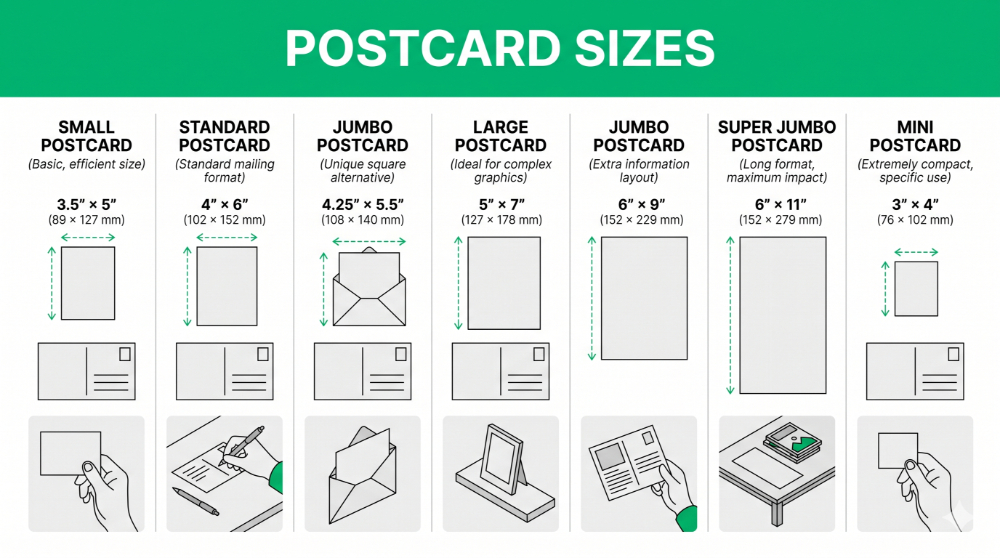
Every standard postcard size serves a different purpose — here’s the full breakdown in one place.
| Size | Inches | Millimeters | Pixels (300 DPI) | Postage Class | Best For |
| Small | 3.5" × 5" | 89 × 127 mm | 1050 × 1500 px | Postcard rate | Minimum USPS size; package inserts |
| Standard | 4" × 6" | 102 × 152 mm | 1200 × 1800 px | Postcard rate | Direct mail, promotions, most print runs |
| Jumbo | 4.25" × 5.5" | 108 × 140 mm | 1275 × 1650 px | Postcard rate | Coupons, event announcements |
| Large | 5" × 7" | 127 × 178 mm | 1500 × 2100 px | Letter rate | Invitations, premium mailers |
| Jumbo | 6" × 9" | 152 × 229 mm | 1800 × 2700 px | Letter rate | High-impact direct mail |
| Super Jumbo | 6" × 11" | 152 × 279 mm | 1800 × 3300 px | Flat rate | Maximum visibility campaigns |
| Mini | 3" × 4" | 76 × 102 mm | 900 × 1200 px | N/A (not mailable alone) | Package inserts, thank-you cards |
A few things worth noting:
- Postcard rate applies only to sizes within the USPS window (max 4.25" × 6")
- Letter rate kicks in for anything larger — expect to pay more per piece
- Flat rate applies to oversized pieces like 6" × 11"
- Mini postcards aren’t mailable on their own but work great as package inserts or handouts
Postcard Rate vs. Letter Rate: Why Size Determines What You Pay
Choosing the wrong postcard size doesn’t just affect how it looks — it can quietly inflate your mailing costs, especially at scale.
USPS splits mail into categories, and the category your postcard falls into depends almost entirely on its size.
USPS First-Class Postcard Requirements
To qualify for the cheaper postcard rate, your postcard must stay within these limits:
- Minimum size: 3.5" × 5"
- Maximum size: 4.25" × 6"
- Thickness: Between 0.007" and 0.016"
- Shape: Rectangular only
As of 2025, the USPS First-Class postcard rate sits at $0.56 per piece — noticeably cheaper than the standard letter rate.
The 4" × 6" standard size fits comfortably within all these requirements, which is exactly why it’s the most popular choice for direct mail campaigns.
What Happens When Your Postcard Is Too Big?
The moment your postcard exceeds 4.25" × 6", USPS reclassifies it as a letter or flat — and the price jumps accordingly.
- A 5" × 7" postcard mails at the First-Class letter rate: around $0.73 per piece
- A 6" × 9" or larger may be classified as a flat, pushing costs even higher
That difference might seem small. But if you’re sending 5,000 pieces, the gap between postcard rate and letter rate adds up to hundreds of dollars.
USPS Marketing Mail: When Size Doesn’t Change Postage
There’s one exception worth knowing: USPS Marketing Mail (formerly bulk mail).
With Marketing Mail, postage is calculated by weight and presort level — not strictly by whether your piece qualifies as a “postcard." This means a 6" × 9" mailer can sometimes cost less per piece than a First-Class stamp, even at larger sizes.
The catch? Marketing Mail requires a minimum of 200 pieces per mailing, plus a USPS permit. It’s ideal for large campaigns but not practical for small runs.
The bottom line: if you’re mailing fewer than 200 pieces, stick to 4" × 6" to keep postage at the postcard rate. If you’re running a large campaign and want a bigger format, Marketing Mail can make larger sizes cost-effective.
Different sizes solve different problems. Here’s how to match the right format to your goal.
Most Popular Postcard Sizes (And When to Use Each)
4" × 6" Postcards — The Cost-Efficient Standard
This is the workhorse of direct mail. Nearly every print platform supports it, it’s easy to design for, and it mails at the lowest postage rate available.
Best for:
- Promotional campaigns and sales announcements
- Loyalty offers and discount codes
- High-volume mailers where cost per piece matters
If you’re just getting started with postcards — or running a large campaign on a tight budget — 4" × 6" is the safest, most practical choice.
5" × 7" Postcards — More Space, Premium Feel
Step up to 5" × 7" and you immediately get more design room and a noticeably more substantial feel in hand. It stands out in a mailbox without going overboard on size.
Best for:
- Event invitations and announcements
- Product launches where you want a premium impression
- Real estate listings and showcase mailers
The trade-off is letter-rate postage, so factor that into your budget if you’re mailing at volume.
6" × 9" Postcards — High Impact for Direct Mail
This is the go-to size for serious direct mail campaigns. It’s large enough to dominate a mailbox stack and gives your design room to breathe — headlines, imagery, and a clear call to action without feeling cramped.
Best for:
- Direct mail campaigns targeting new customers
- Retail promotions and seasonal offers
- Service businesses (real estate, home services, healthcare)
Many marketers consider 6" × 9" the sweet spot between visibility and cost, especially when using USPS Marketing Mail for bulk sends.
6" × 11" Postcards — Maximum Attention, Flat Rate
This is the biggest standard postcard size you’ll commonly find at print shops. It’s hard to ignore and gives you near-magazine-cover levels of visual space.
Best for:
- Grand opening announcements
- High-stakes campaigns where standing out is the priority
- Brands with strong visual identity and bold creative
Use it selectively. The flat-rate postage and higher print cost make it better suited for targeted, high-value campaigns rather than broad volume sends.
Mini and Square Postcards — Novelty and Package Inserts
Mini postcards (around 3" × 4") aren’t designed for mailing on their own — but they shine in other contexts.
Best for:
- Package inserts — tuck a thank-you card or discount offer into every shipment
- In-store handouts — easy to display in racks or hand out at events
- Product cards — include care instructions, brand story, or a QR code
For POD sellers especially, mini postcards and small inserts are a low-cost way to add a branded touch to every order. Merchize’s brand packaging kit, which includes mini message cards, works well for exactly this — no minimum order required, and every piece ships on demand.
Design Specs: Bleed, Trim, and Safe Zones
Getting your postcard size right is only half the job. Set up your file wrong and you’ll end up with white edges, cropped text, or a rejected print file — even if your design looks perfect on screen.
Here’s what every postcard design file needs.
Bleed and Trim Explained
When a postcard is printed, it comes out on a larger sheet and gets cut down to size. That cut is never perfectly precise — there’s always a tiny margin of error.
Bleed accounts for that variance. It’s extra artwork that extends beyond the final trim edge, so if the cut runs slightly off, there’s no white border showing.
- Standard bleed: 0.125" (3mm) on all four sides
- Your design file should be set up larger than the final size to include bleed
- Any background color or full-bleed image must extend all the way to the bleed edge
For a 4" × 6" postcard, your working canvas should be 4.25" × 6.25" to include bleed on all sides.
Trim is simply the final cut line — the actual finished size of the postcard. Everything outside the trim gets removed.
Safe Zone and Address-Side Rules
The safe zone is the inverse of bleed — it’s the area inside the trim where your critical content must stay.
- Safe zone: Keep all text, logos, and important design elements at least 0.25" inside the trim edge
- Anything placed too close to the edge risks getting clipped in the cutting process
The address side has its own set of rules from USPS:
- The bottom 5/8" of the address side must be kept clear for barcode printing
- The right 4.5" of that bottom strip is reserved for postal barcodes
- Return address goes in the top left
- Postage area sits in the top right
Avoid placing decorative elements or copy in these zones — USPS automation equipment reads this area, and interference can cause delivery issues.
Resolution: What DPI and Pixel Dimensions to Use
Always design postcards at 300 DPI (dots per inch). Anything lower will print soft or pixelated, even if it looks sharp on your monitor.
Here are the exact pixel dimensions you need for each standard size at 300 DPI — including bleed:
| Size (Final) | With Bleed | Pixels at 300 DPI (with bleed) |
| 3.5" × 5" | 3.75" × 5.25" | 1125 × 1575 px |
| 4" × 6" | 4.25" × 6.25" | 1275 × 1875 px |
| 4.25" × 5.5" | 4.5" × 5.75" | 1350 × 1725 px |
| 5" × 7" | 5.25" × 7.25" | 1575 × 2175 px |
| 6" × 9" | 6.25" × 9.25" | 1875 × 2775 px |
| 6" × 11" | 6.25" × 11.25" | 1875 × 3375 px |
A few more technical notes worth keeping in mind:
- Color mode: Use CMYK, not RGB. RGB is built for screens; CMYK is what printing presses use. Colors can shift significantly if you submit an RGB file
- Fonts: Outline all text before exporting, or embed fonts in your PDF to avoid substitution issues
- File format: Most printers prefer PDF (print-ready) or TIFF. JPEGs are acceptable but avoid heavy compression
Set these specs up correctly from the start and you’ll avoid the most common — and most frustrating — print file rejections.
Size isn’t just a spec — it’s a strategic decision. The right choice depends on where your postcard is going, who’s receiving it, and what you need it to do.
Mass Direct Mail — Prioritize Postage Savings
When you’re mailing hundreds or thousands of pieces, postage cost per unit matters more than almost anything else.
Go with 4" × 6". It qualifies for the lowest postage rate, prints economically, and works with virtually every direct mail workflow. If your campaign lives or dies by cost efficiency, this is your size.
Only step up to a larger format if your offer or creative genuinely needs the extra space — not just because it looks impressive.
Event Invitations and Announcements — Prioritize Perceived Value
A postcard that feels substantial in hand sets expectations before the recipient even reads a word.
5" × 7" is the sweet spot here. It’s noticeably larger than a standard mailer, has a premium feel, and gives your design room for a strong visual — without tipping into oversized territory.
For high-end events or launches where first impressions carry real weight, the extra postage cost is usually worth it.
In-Store Handouts and Rack Display
Postcards that live in a display rack or get handed out at a counter have different requirements than mailers. Nobody’s paying postage, so size becomes purely a creative and practical decision.
- 4" × 6" fits standard rack displays and feels familiar
- 5" × 7" stands out in a rack without being awkward to hold
- Avoid going too large — anything bigger than 5" × 7" can feel unwieldy as a handout
Keep the design clean and the call to action obvious. People pick these up quickly and decide just as fast whether to keep them.
Package Inserts — Smaller Sizes That Fit Shipments
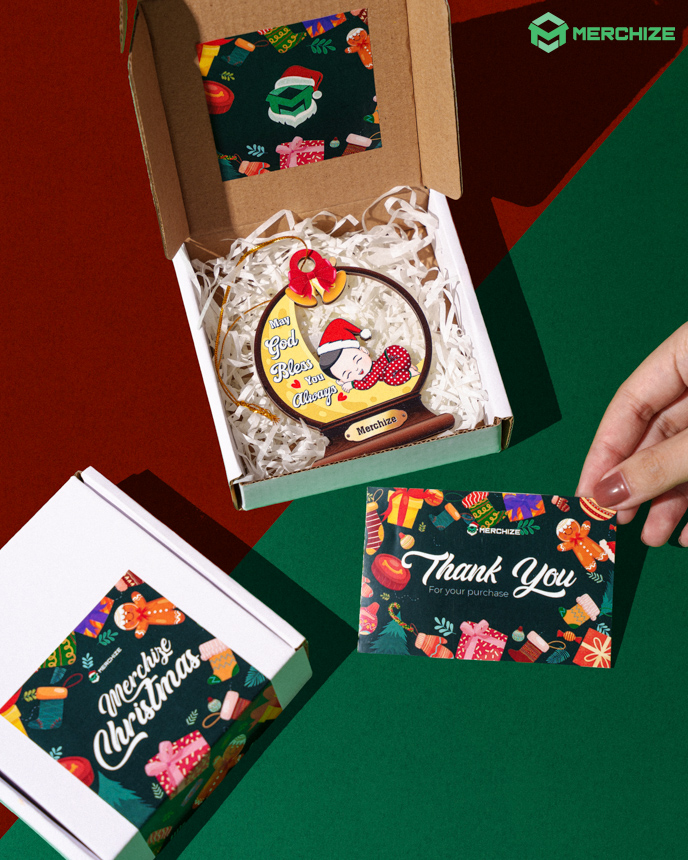
For POD sellers, package inserts are one of the most underused touchpoints in the customer journey. A small card tucked into every order can drive reviews, repeat purchases, or social follows — without adding meaningful cost. Pairing inserts with a custom brand packaging kit takes the unboxing experience even further, turning a simple shipment into a memorable brand moment.
3" × 4" or 4" × 6" both work well here. The key considerations:
- Will it fit flat inside your standard packaging?
- Is there enough space for your message without feeling cramped?
- Does it feel intentional, or like an afterthought?
A well-designed insert at this size punches above its weight. Merchize’s greeting cards and branded inserts ship on demand with no minimum order, making it easy to include a polished printed touch across your entire product lineup without committing to a large print run.
Choosing Based on Budget and Print Run Size
When in doubt, map your size to your volume:
| Print Run | Recommended Size | Reason |
| Under 200 pieces | 4" × 6" | Postcard rate postage, low print cost |
| 200–1,000 pieces | 4" × 6" or 5" × 7" | Balance visibility with per-unit cost |
| 1,000+ pieces (bulk mail) | 6" × 9" or larger | Marketing Mail offsets higher print cost |
| Package inserts (any volume) | 3" × 4" or 4" × 6" | Compact, cost-effective, fits most packaging |
The best postcard size is the one that fits your goal without unnecessary cost. Start with the use case, then work backwards to the format — not the other way around.
Choosing the Right Postcard Size for Your Goal
Size isn’t just a spec — it’s a strategic decision. The right choice depends on where your postcard is going, who’s receiving it, and what you need it to do.
Mass Direct Mail — Prioritize Postage Savings
When you’re mailing hundreds or thousands of pieces, postage cost per unit matters more than almost anything else.
Go with 4" × 6". It qualifies for the lowest postage rate, prints economically, and works with virtually every direct mail workflow. If your campaign lives or dies by cost efficiency, this is your size.
Only step up to a larger format if your offer or creative genuinely needs the extra space — not just because it looks impressive.
Event Invitations and Announcements — Prioritize Perceived Value
A postcard that feels substantial in hand sets expectations before the recipient even reads a word.
5" × 7" is the sweet spot here. It’s noticeably larger than a standard mailer, has a premium feel, and gives your design room for a strong visual — without tipping into oversized territory.
For high-end events or launches where first impressions carry real weight, the extra postage cost is usually worth it.
In-Store Handouts and Rack Display
Postcards that live in a display rack or get handed out at a counter have different requirements than mailers. Nobody’s paying postage, so size becomes purely a creative and practical decision.
- 4" × 6" fits standard rack displays and feels familiar
- 5" × 7" stands out in a rack without being awkward to hold
- Avoid going too large — anything bigger than 5" × 7" can feel unwieldy as a handout
Keep the design clean and the call to action obvious. People pick these up quickly and decide just as fast whether to keep them.
Package Inserts — Smaller Sizes That Fit Shipments
For POD sellers, package inserts are one of the most underused touchpoints in the customer journey. A small card tucked into every order can drive reviews, repeat purchases, or social follows — without adding meaningful cost.
3" × 4" or 4" × 6" both work well here. The key considerations:
- Will it fit flat inside your standard packaging?
- Is there enough space for your message without feeling cramped?
- Does it feel intentional, or like an afterthought?
A well-designed insert at this size punches above its weight. Merchize supports postcard and insert printing with no minimum order, making it easy to include branded inserts across your product lineup without committing to a large print run.
Choosing Based on Budget and Print Run Size
When in doubt, map your size to your volume:
| Print Run | Recommended Size | Reason |
| Under 200 pieces | 4" × 6" | Postcard rate postage, low print cost |
| 200–1,000 pieces | 4" × 6" or 5" × 7" | Balance visibility with per-unit cost |
| 1,000+ pieces (bulk mail) | 6" × 9" or larger | Marketing Mail offsets higher print cost |
| Package inserts (any volume) | 3" × 4" or 4" × 6" | Compact, cost-effective, fits most packaging |
The best postcard size is the one that fits your goal without unnecessary cost. Start with the use case, then work backwards to the format — not the other way around.
International Postcard Sizes (Canada Post and Beyond)
If you’re mailing outside the US, size requirements shift — and so do the consequences of getting it wrong.
Canada Post
Canada Post has its own postcard rate window, and it’s tighter than USPS:
- Minimum size: 90 × 140mm (roughly 3.5" × 5.5")
- Maximum size for postcard rate: 105 × 148mm (roughly 4.1" × 5.8")
- Thickness: Between 0.18mm and 0.69mm
The closest US equivalent is a standard 4" × 6" — but double-check your exact dimensions before printing, since even a few millimeters over the maximum pushes your piece into letter territory.
European and International Standards
Europe runs on ISO paper sizes, which means the naming conventions and dimensions look different from what US-based sellers are used to.
The most common postcard formats used across Europe:
| Format | Dimensions | Closest US Equivalent |
| A6 | 105 × 148mm (4.1" × 5.8") | Standard postcard |
| A5 | 148 × 210mm (5.8" × 8.3") | Large/oversized mailer |
| DL | 99 × 210mm (3.9" × 8.3") | Slim mailer / envelope insert |
A6 is the de facto standard postcard size across most of Europe — it maps closely to the US 4" × 6" in terms of use case and is widely supported by European print platforms.
If you’re designing for an international audience, A6 at 300 DPI works out to 1240 × 1748px — slightly different from the US 4" × 6" pixel dimensions, so keep separate files if you’re printing for multiple markets.
Common Postcard Size Mistakes to Avoid
Even experienced designers and sellers run into these. Most are easy to avoid once you know what to watch for.
- Locking in your design before deciding on postage class
This is the most expensive mistake on the list. Designing a beautiful 5" × 7" postcard and then discovering it won’t qualify for postcard-rate postage — after your print run is done — hurts. Decide your size based on mailing strategy first, then brief your designer.
- Skipping bleed and safe zones
Designing right to the trim edge is a guaranteed way to end up with clipped text or white borders. Always set up your canvas with 0.125" bleed on all sides and keep critical content 0.25" inside the trim. No exceptions.
- Choosing size for aesthetics alone
A bigger postcard looks more impressive — but if it bumps you into letter rate or flat rate postage, the cost difference across a large campaign can be significant. Let your goal and budget drive the size decision, not just how it looks in a mockup.
- Ignoring USPS compliance on thickness and shape
Non-rectangular postcards — anything with rounded corners beyond standard tolerances, or die-cut shapes — may not qualify for postcard rate regardless of their dimensions. Same goes for stock that’s too thin or too thick. Always verify your paper stock against USPS thickness requirements before printing.
- Overloading small formats with too much content
A 3" × 4" insert or a 4" × 6" postcard has limited real estate. Trying to fit a headline, subhead, three bullet points, a QR code, and a logo on a small card usually results in a cluttered design that readers ignore. Pick one message, one visual, one call to action — and let the design breathe.
FAQs About Postcard Sizes
What is the standard postcard size in the US?
The standard postcard size is 4" × 6". It’s the most widely used format across both personal and commercial printing.
Which postcard size qualifies for the postcard postage rate?
Any rectangular postcard that falls within 3.5" × 5" (minimum) and 4.25" × 6" (maximum) — with a thickness between 0.007" and 0.016" — qualifies for USPS postcard rate postage.
Can I mail a 5" × 7" postcard at the postcard rate?
No. A 5" × 7" postcard exceeds the USPS maximum for postcard rate and will be charged at the First-Class letter rate instead.
What is the best postcard size for direct mail marketing?
4" × 6" for budget-conscious campaigns. 6" × 9" if you need more visual impact and are mailing in bulk via USPS Marketing Mail.
Do square postcards cost more to mail?
Yes. Square postcards don’t meet USPS rectangular requirements for postcard rate and are typically charged at the letter rate — sometimes with an additional non-machinable surcharge.
What’s the minimum postcard size USPS accepts?
3.5" × 5" is the smallest size USPS will process. Anything smaller won’t be accepted for mailing.
How thick does a postcard need to be?
Between 0.007" and 0.016" to qualify for postcard rate. Most standard postcard cardstock falls within this range — but it’s worth confirming with your printer if you’re using an unusual stock.
What resolution should I use when designing a postcard?
Always design at 300 DPI. For a standard 4" × 6" postcard with bleed, that means a canvas of 1275 × 1875px. Check the design specs section above for pixel dimensions across all common sizes.
Conclusion
Choosing the right postcard size doesn’t have to be complicated. Start with your goal, factor in your budget, and let your mailing strategy guide the format — not the other way around.
For most people, 4" × 6" is the smart default: affordable to print, cheap to mail, and supported everywhere. Need more visual impact? Step up to 5" × 7" or 6" × 9". Sending package inserts? A compact 3" × 4" gets the job done beautifully.
The hardest part is simply getting started. Pick your size, set up your file with the right specs, and get your design in front of the people who need to see it. If you’re a POD seller looking to fulfill postcards, inserts, or custom greeting cards without managing inventory, Merchize’s print-on-demand fulfillment service handles production and shipping from a single platform — no minimum orders, no upfront stock.