Contents
When exploring Print-on-Demand (POD), sellers usually deal with familiar challenges like optimizing capital, managing inventory, or finding design solutions for beginners. However, one issue that is rarely analyzed in detail is: Can you run a POD business without building your own website?
The cost of maintaining a platform, the technical skills needed to run a website, and the struggle to get initial traffic often drain a lot of resources before sellers can even test if their products work. In reality, having an independent website is not a mandatory requirement to launch a successful POD business.
This article will analyze in detail how to start print on demand business without a website, helping sellers build a lean business model right from the beginning.
Key Takeaways
-
If you lack capital and operating experience, start with POD Marketplaces to keep costs low.
-
Always keep a backup fund of $100 – $300 to pay printing costs to suppliers upfront, as e-commerce marketplaces usually hold money for 7–14 days for new stores.
-
The fastest way to get sales for a new store is combining 2–3 interests into a single product.
-
Never use keywords related to famous brands, public figures, or copyrighted art styles in your Title and Tags.
-
Use e-commerce marketplaces as a “test lab" to find winning designs at the lowest cost before thinking about building your own website.
Can you start a POD business without a website?
Of course you can. You can completely start and run a successful print-on-demand business without building your own website. This method works by using the ecosystems of e-commerce marketplaces or integrated selling platforms. Here, all infrastructure from hosting and traffic to production and shipping is already optimized.

The viability and efficiency of this model are shown in:
- Fast setup and no technical barrier: Instead of spending weeks designing the look, buying domain names, and setting up payment systems, sellers can finish opening a store and uploading designs in just a few minutes.
- Ability to react fast to market trends: Large selling platforms always have real-time market data. You only need to follow top-selling rankings or news reports from these platforms to catch popular product lines.
- Taking advantage of huge organic traffic: This means you get existing buyers right away. E-commerce marketplaces attract millions of visits every month. Because of this, you only need to focus on optimizing keywords and product images to rank high in internal search bars.
- Automated production and shipping system: Current e-commerce marketplaces keep close links with a network of trusted global print suppliers. When an order happens, the whole process from printing, quality check, and packaging to delivery is handled automatically by third parties. This helps sellers focus completely on market research and design development.
8 no-website selling platforms today
To start a pod business without building your own website, the first and most important step is choosing a selling platform that fits your resources and business direction. Below is a detailed analysis of 7 top platforms:
Etsy
Etsy is at the top of the list if your goal is to sell POD products at high prices and get big profits. With 93 million active people, buyers go to Etsy mainly to hunt for handmade items, unique designs, or personalized gifts (like printing names or anniversary dates).
Etsy works as a connecting e-commerce marketplace. Etsy itself does not do the printing. Sellers open a store, list products, and silently connect via API to third-party POD suppliers (like Printify, Gelato, or Merchize). When an order comes in on Etsy, the data is automatically sent to the print supplier to produce and ship directly to the customer.
In addition, Etsy charges a listing fee of $0.2 for each product (every 4 months), along with a 6.5% transaction fee and payment processing fees. Although the costs are not cheap, Etsy’s customer base is willing to accept high prices, making it easy for you to balance costs and keep good profit margins.
It is true that the Etsy marketplace is very competitive and strictly controls copyright policies. However, this is still the most ideal starting point for small and medium brands that want to build a loyal customer base.
Merch by Amazon
If Etsy requires you to manage suppliers yourself, Merch by Amazon puts you in a completely hands-free process. You can fully use the huge organic shopping traffic of Amazon (Amazon had 635 million users on its e-commerce app) without spending a single cent on operating or advertising costs.
All you need to do is design and upload files to Amazon’s system, then select the product lines to apply them to (t-shirts, hoodies, mugs, phone cases…). When users find and order them, Amazon handles printing, packing, shipping through the Prime network, and taking care of customer service.
This is also a model where you do not need to put up upfront capital for production. For each successful order, Amazon pays you a fixed royalty depending on the retail price you set.
Note: Selling on Merch by Amazon is completely free and has low risk. But the account registration step is very hard to pass, and the Tier system limits the number of designs you can post when starting out.
Redbubble
Redbubble is a pure POD marketplace that is extremely famous among freelance artists and illustrators. With over 70 product categories from fashion to home decor, Redbubble handles more than one million products every month sent to global buyers.
The main advantage is that you upload a design once and apply it to dozens of products at the same time. Printing and shipping are fully taken care of by Redbubble.
In addition, Redbubble allows you to flexibly set the profit percentage (Artist Margin) added to the base price. However, this platform currently applies an account tier policy (Standard, Premium, Pro), where Standard accounts will have an account management fee deducted based on sales.
This platform is very suitable for designers who like to draw fan art, memes, pop culture themes (you still need to carefully avoid copyright issues), or unique graphic concepts.
See more: Redbubble Alternatives: Which You Should Switch to in 2026?
TeePublic
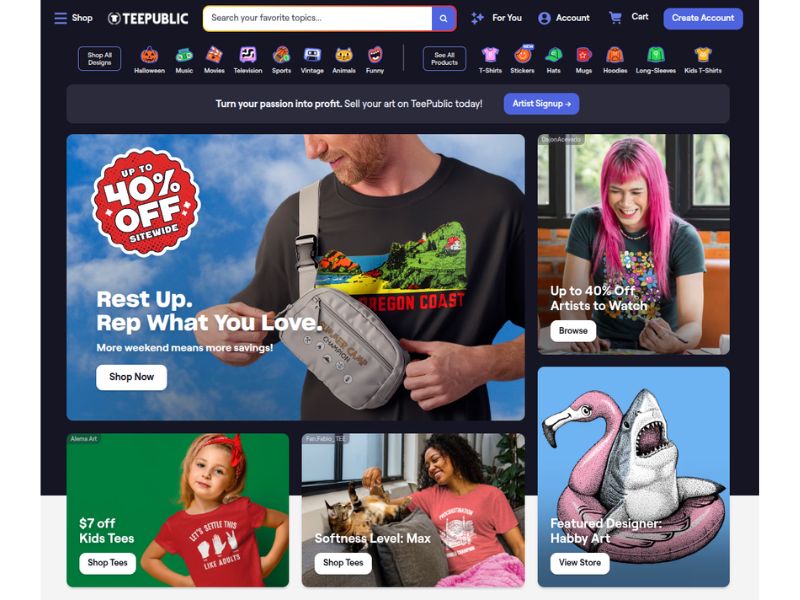
Also owned by Redbubble, TeePublic offers a completely different operating experience: simple, fast, and very well optimized for graphic t-shirts, stickers, and phone cases.
TeePublic applies a fixed royalty rate for each product. When a product is included in a platform sale (which happens very often), you receive a slightly lower commission, but in return, order volume increases sharply thanks to marketing campaigns run by the platform itself.
In addition, TeePublic’s upload tool is among the smoothest today, helping you post dozens of design files in just a few minutes. The downside is that you cannot change or set the selling price yourself.
Zazzle
Founded in 2002, Zazzle is a veteran in the POD industry with a unique strength: tools that allow customers to edit designs directly on the platform.
Why choose Zazzle? Customers come to Zazzle mainly to find event products such as wedding invitations, class shirts, corporate gifts, or birthday accessories. They can type in names, change dates, or insert personal photos into design templates provided by you.
- Cost model: Free to register and sell, Zazzle collects a management/transaction fee of around 30% per order.
- Challenges: Zazzle’s dashboard is relatively complex and takes more time to learn than other platforms. However, once you master the customization tools, you will have a very stable income stream.
- eBay
eBay is not a dedicated POD marketplace, but it is an extremely effective POD sales channel for sellers who already have e-commerce experience with 136 million active buyers
Like Etsy, you must connect your eBay store yourself to suppliers like Printify or Merchize. You set your own prices, optimize title SEO yourself, and handle customer service issues on your own.
Note that eBay allows you to list your first 250 products for free every month (after that, it costs $0.35 per listing), along with a Final Value Fee based on the total order value. Selling POD on eBay requires you to choose a print supplier with very fast production and shipping times. If tracking numbers are late, your eBay account can easily get flagged or restricted.
Facebook Marketplace
Facebook Marketplace has reached over one billion consumers and completely removes technical barriers for new sellers. This channel is an ideal testing ground if you want to validate POD designs within local or domestic markets without paying platform maintenance fees.
You can quickly publish listings, directly leverage existing community traffic, and use organic post engagement to see which graphic concepts catch interest. However, the operational workflow remains largely manual. Since there is no native API integration with POD suppliers, sellers must actively handle buyer messages, negotiate payment methods, manage customer service queries when a sale occurs.
TikTok Shop
TikTok Shop stands out as a powerful social commerce driver, reaching approximately 1.54 billion global users who actively discover products through short-form video content and live streams. Unlike traditional search-based marketplaces, TikTok’s algorithm pushes creative product videos directly onto the For You pages of users interested in specific niches.
Furthermore, sellers can seamlessly connect POD fulfillment applications directly to their TikTok Shop account, enabling automated order routing, automated tracking updates, and hassle-free production as soon as an order is placed. The platform also offers access to an extensive affiliate network, allowing you to collaborate with content creators to scale your reach without advertising costs.
Additional potential channel: Pop-Up storefronts
Or if you feel traditional e-commerce marketplaces are too competitive and strict, yet you still want to avoid the technical and fixed costs of building a full Shopify website, you can consider Pop-Up Storefronts.
This model gives you a simplified store (or single product landing page) completely free in just a few minutes. The platform gives you a direct shoppable link. You just need to put this link in your TikTok, Instagram, or YouTube bio, or share it in online communities.
Key advantages:
- No hosting/domain fees: You do not have to pay monthly fixed costs or worry about complex technical issues.
- Built-in fulfillment: Platforms like this (such as Fourthwall, Spring/TeeSpring, or Spreadshop) usually have built-in print suppliers. When customers click the link to buy, the system automatically prints, ships, deducts base costs, and sends you the profit margin.
- Optimized for Creators & KOLs: Very suitable if you already have a social media following and want to sell custom merchandise immediately without losing buyers to competitors like on traditional marketplaces.
How to start a print-on-demand business without a website
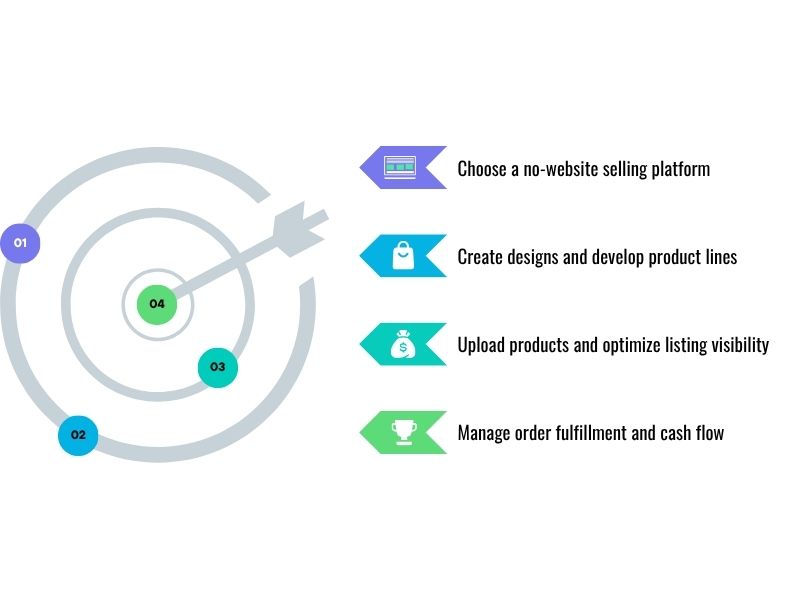
Step 1: Choose a no-website selling platform
Before creating designs or finding suppliers, you need to decide where your POD products will be sold. Without your own website, the selling platform becomes the place where you reach customers, list products, and receive orders.
However, not all platforms work on the same model. Some platforms have built-in POD systems and handle the entire production, shipping, and customer service process themselves. Meanwhile, marketplaces like Etsy or eBay require you to connect with a third-party POD supplier to fulfill orders.
Therefore, before making a choice, consider 4 main factors:
- Traffic source: Does the platform have an existing customer base that fits your niche?
- Level of automation: Do you want to handle fulfillment and customer service yourself, or do you prefer a hands-off model?
- Costs and profit margins: Listing fees, transaction fees, royalties, and fulfillment costs will directly affect your profits.
- Fit for your selling model: Some platforms are suitable for artists and designers, while others fit sellers who want to build a brand or sell personalized products.
Step 2: Create designs and develop product lines
This stage requires sellers to focus on researching real market demand. Researching niche markets can be done directly through the search bar on Pinterest or Etsy to discover topics, quotes, and graphic styles that buyers are actively searching for.
After identifying potential niches, you proceed to create design templates using intuitive, easy-to-use graphic tools like Canva or Kittl. These designs are then applied to high-margin product lines with good conversion rates, such as t-shirts, ceramic mugs, hoodies, or tote bags.
Step 3: Upload products and optimize listing visibility
Once you have high-quality design files in PNG format, upload them directly to the product catalog of your chosen selling platform. To reach the right potential customers, product titles, tags, and descriptions need to be written carefully, naturally weaving in popular search keywords.
In addition to content, product mockup images play a decisive role in click-through rates. Using professional mockup images from Placeit or your print supplier helps products look realistic and more attractive. After finishing images and content, set your desired profit margin or royalty rate according to each platform’s rules.
Step 4: Manage order fulfillment and cash flow
After listing your products, operating and financial workflows need to be set up properly to ensure your store runs smoothly. Sellers need to connect trusted international payment gateways such as Payoneer, PayPal, or PingPong to receive revenue and withdraw funds to local bank accounts.
For models connected to third-party suppliers, you need to actively monitor production progress, order completion rates, and tracking codes to ensure on-time delivery. At the same time, managing cash flow rotation between upfront costs paid to print suppliers and pending revenue payouts from marketplaces is key to keeping business operations continuous.
FAQs
1. Which e-commerce platform gives sellers the highest profit?
There is no fixed answer to which platform brings the highest profit, as it depends entirely on your operating model and pricing strategy. E-commerce marketplaces like Etsy or eBay usually allow you to set your own retail prices and negotiate base costs with suppliers, bringing higher profit margins.
On the other hand, POD marketplaces like Redbubble, TeePublic, or Merch by Amazon yield lower profit per item because they charge full service fees for printing and shipping, but in return, they help streamline operations and make it easy to reach high order volume thanks to existing organic traffic.
2. Is there a risk of account suspension when selling POD on marketplaces without a website?
The risk of policy violations and store suspension is real, and even quite common if sellers do not understand the rules clearly. Main causes usually come from trademark infringement, uploading banned images or keywords, or failing to maintain on-time order fulfillment metrics on platforms that require manual tracking updates.
3. When should a seller transition from selling on marketplaces to building their own website?
When you achieve stable sales on marketplaces and start needing to build long-term brand identity. Owning a website allows you to completely control customer data, run retargeting ad campaigns, and maximize profit margins.
4. How can newly listed POD products compete with long-established stores?
Target micro-niches. Combining two or more interests into a single design (for example: combining “cat lovers" with “yoga enthusiasts") makes your product far less competitive.
5. Can you run paid ads when selling POD on marketplaces without a website?
You can run ads directly within internal marketplace ad platforms to boost products to top positions. However, running ads from outside platforms like Facebook Ads or Google Ads directly to a marketplace store often makes tracking ad effectiveness difficult to measure accurately.