Contents
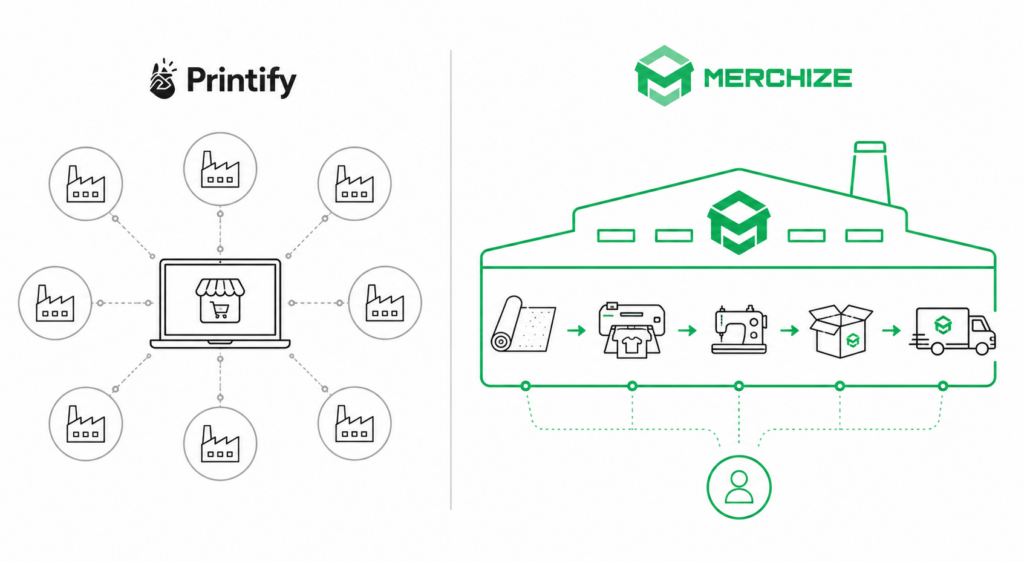
Printify and Merchize take opposite approaches to fulfillment. Printify is a marketplace connecting you to 80+ independent print providers. Merchize is the factory itself, owning production from fabric to finished package. That one structural difference shapes almost everything else: pricing, quality, speed, and support.
This guide breaks both platforms down side by side: pricing and real cost breakdowns (including the Gildan 5000 and AOP tees), product quality, catalog depth, shipping speed, branding, and customer support. By the end, you’ll know which one fits your store or whether using both makes more sense.
Key Takeaways:
- Different models: Printify is a marketplace of 80+ independent print providers; Merchize owns its own factory in Vietnam, plus fulfillment sites in the US, EU, UK, Australia, and China.
- Pricing: Merchize has no subscription fee and often costs less overall — even beating Printify Premium ($39/mo) on a basic Gildan 5000, with an even bigger edge on AOP apparel.
- Quality & consistency: Printify’s quality varies by provider, since orders route to different businesses. Merchize’s quality is more consistent, since one factory handles every order.
- Catalog & reach: Printify has the bigger catalog (1,300+ products) and connects to more sales channels. Merchize is smaller (800+) but specializes in AOP apparel, custom décor, and offers Walmart/FBA support.
- Printify suits sellers who want breadth and flexibility. Merchize suits sellers focused on margins, apparel quality, and hands-on support.
What Is Printify?
Printify isn’t technically a print-on-demand supplier. It’s more like a platform that connects you to 80–90+ independent print providers around the world.
Here’s how Printify works: you design a product, and Printify routes the order to one of its partner printers. That printer makes it, packs it, and ships it out under your brand.
This model allows Printify to expand their fulfillment network and broaden their catalog. However, on the other hand, it also means that the quality, turnaround time, and pricing all depend on which provider handles your order, not on Printify itself. Printify doesn’t have full control over the production process. .
What you get with Printify:
- A catalog of 1,300+ products (and growing — the exact count shifts often)
- The freedom to pick a provider by price, location, or rating
- “Printify Choice," which auto-selects a provider for you if you don’t want to decide
Printify tends to work best for a few kinds of sellers:
- Beginners, thanks to its free plan, built-in pop-up store, and huge library of tutorials
- Sellers who want the widest possible product range and provider options
- EU/UK-based sellers, since Printify has strong, well-documented provider coverage in Germany, Czech Republic, Poland, and the UK
Once you understand that Printify’s whole model runs on this marketplace structure, the rest of its strengths and trade-offs start to make a lot more sense.
What Is Merchize?
Merchize takes the opposite approach from Printify. Instead of connecting you to outside printers, Merchize is the printer.
Merchize runs its own 70,000+ sq ft production facility in Vietnam, plus fulfillment sites in the US. Besides, Merchize also has printing partners in the EU, UK, Australia, and China. Depending on your needs, you can select to send orders to Merchize’s owned fulfillment facility or other printing partners.
That’s the core difference between the two platforms. Printify spreads your orders across dozens of independent providers. Merchize keeps production mostly in-house, from printing to packing to shipping.
What Merchize is built around:
- In-house DTG, cut-and-sew, and sublimation printing
- A catalog of 800+ products (Merchize’s catalog is consistently growing with new products added regularly)
- A strong focus on all-over-print (AOP) apparel, plus niche items like custom wood and acrylic home décor
Since every order runs through the same factory, there’s no provider-shopping and no guessing which partner you’ll get this time. One pipeline, one set of standards.
Owning the whole production line also allows Merchize to have better control over how each product is made and what product to develop.
Merchize tends to be the better fit for:
- Margin-focused sellers who want predictable costs
- AOP apparel and home-décor niche sellers
- Sellers who’d rather have one steady fulfillment process than juggle multiple providers
- US-focused sellers, since Merchize leans into US fulfillment along with FBA, Walmart, and TikTok Shop services
So here’s the quick version: Printify gives you breadth through outside providers. Merchize gives you depth through its own factory. That one structural difference is what shapes almost every other comparison between Merchize and Printify.
Merchize vs Printify — Head-to-Head
Platform Fees & Plans
Let’s talk numbers, because this is where the two platforms really start to look different.
Printify’s pricing:
- Free plan: $0/month, up to 5 stores
- Premium plan: $39/month (raised from $29 back on February 17, 2026 — about a 34% jump)
- Annual plan: $299/year, which works out to roughly $24.99/month
- Enterprise: custom pricing for larger sellers
The Premium plan gets you better product discounts. But you’re paying that $39 every month whether you sell one product or one thousand.
Merchize’s pricing:
- Fulfillment service: free, pay only per order — no subscription, no minimum order quantity
That’s the entry point for actually fulfilling orders. But Merchize also has a separate Storefront Plan, for sellers who want Merchize to help build and run a full online store. That comes in two paid tiers: Platinum at $79/month and Diamond at $299/month. You don’t need the Storefront Plan to fulfill orders. It’s optional, built for a different need.
For a new seller just starting out, the practical difference comes down to this:
- With Printify, you either accept lower discounts on the Free plan or commit to $39/month to unlock better pricing
- With Merchize, you can start fulfilling orders at $0/month, no subscription commitment either way
If you’re testing a new store or still validating your product line, that difference matters. A $39/month subscription only starts paying for itself once you’re doing enough monthly volume. With Merchize, you can unlock tier pricing as your volume grows, regardless of what plan you opt for.
Product Quality & Printing Method
Quality works differently depending on which platform you use — and it comes down to how each one is structured.
How Printify handles quality:
Printify routes orders to different providers, so print quality depends on which one handles your order. Some providers may be more consistent than others, even when using the same printing method.
This isn’t a one-off concern. Reports of quality inconsistency have come up across multiple years, and in some cases, a single order split across providers has come back with visibly different results between items.
That’s a known trade-off of the marketplace model: more provider choice, but less of a single standard to rely on.
How Merchize handles quality:
Merchize prints in-house, using its own DTG, dye-sublimation, and cut-and-sew setup. Every order runs through the same facility and process.
Available reviews — a smaller sample than Printify’s — lean positive on print and fabric quality, particularly for AOP (all-over-print) items. It’s worth being clear-eyed here: this is a limited data set, not a large-scale independent benchmark.
So “more consistent" is a reasonable expectation based on how the model is set up — one facility, one process — rather than a confirmed outcome backed by extensive third-party testing.
The simple way to think about it:
- Printify: quality can vary by provider, since multiple businesses fulfill orders
- Merchize: quality depends on one facility, since a single operation handles production
Each approach has a different risk profile. A marketplace spreads production across many providers, which means more variability but also more options if one provider doesn’t work out. An in-house model centralizes production, which can mean more consistency, but also means you’re relying on a single point of production with less flexibility to switch if something isn’t a fit.
Neither structure guarantees quality on its own. How each platform’s catalog reflects this — breadth versus specialty — is where the comparison goes next.
Product Catalog & Specialty Categories
Catalog size tells you a lot about how each platform is built — and here, the difference is pretty clear-cut.
Printify’s catalog:
Printify’s catalog sits at 1,300+ products, and it keeps growing. That range comes from pulling in dozens of providers, each contributing their own product lines.
This makes Printify a strong fit for sellers who want broad selection — think mugs, apparel, phone cases, wall art, and everything in between, all in one place. If you’re testing lots of product ideas or want to cover many niches at once, that breadth is genuinely useful.
Merchize’s catalog:
Merchize’s catalog is smaller, sitting around 800+ products, with new trendy items added on an ongoing basis. But the size isn’t really the point — the specialty is.
Merchize has built out a real strength in all-over-print (AOP) apparel and custom décor items like wood and acrylic pieces. These are harder to produce well, and harder for competitors to copy at the same quality. That specialization tends to appeal to sellers focused on Etsy and apparel niches, where product uniqueness and print quality matter more than sheer catalog size.
Who fits where:
- Printify suits sellers who want maximum variety and are comfortable testing across many product types and providers
- Merchize suits sellers focused on apparel and décor niches, especially on platforms like Etsy where distinctive, well-made products stand out
Printify wins on raw count. Merchize wins on hard-to-copy products, particularly AOP cut-and-sew apparel and laser-cut décor. One approach is about having options; the other is about depth in a specific lane.
Which platform makes more sense here depends on your niche — and that same question carries into how each platform prices its products, which is where the real margin math begins.
Pricing & Profit Margins
Base cost is only part of the story. Shipping, fees, and print method all shift where your actual profit lands.
Gildan 5000 breakdown (standard cotton tee)
| Printify (Free plan) | Printify (Premium, $39/mo) | Merchize | |
| Base cost | $9.68 | $7.40 | $5.25 |
| US shipping (1st item) | $4.49 | $4.49 | $5.00 |
| Extra fees | None (pay-per-order) | $39/mo subscription | None |
| Landed cost (approx.) | $14.17 | $11.89 (+ subscription) | $10.25 |
On this basic tee, Merchize’s Gildan 5000 comes out cheapest overall. Its landed cost beats even Printify Premium, and there’s no subscription fee to offset.
All-over print (AOP) t-shirt breakdown
This is where the price gap really opens up.
- Printify’s AOP apparel runs roughly $17 (Printify Premium) –$24 (Free plan) plus shipping fee of around $6. The total cost can go up to $30 a shirt. Since sublimating a design onto fabric before cutting and sewing it is a more involved process, most suppliers, including Printify’s print providers, would charge a premium for it.
- Merchize’s AOP T-shirt base cost starts at around $12, which already includes shipping, since Merchize’s own Vietnam factory handles cutting, sewing, and sublimation in-house rather than outsourcing to a third party. Plus, Merchize can optimize labor costs overseas, since production stays in-house from fabric to finished garment.
Even though Merchize’s shipping runs a little higher than Printify’s, the base cost savings are usually large enough to outweigh it.
Printify makes sense when:
- You’re selling flat DTG basics where speed-to-market and catalog breadth matter more than shaving a dollar off unit cost.
- You’re already on Premium for other catalog-wide benefits.
- You want the widest range of blanks and providers to test quickly.
Merchize wins when:
- You want the lowest landed cost on basics like the Gildan 5000 — no volume threshold or subscription needed to get there.
- You’re selling cut-and-sew or AOP apparel (hoodies, leggings, all-over tees), where factory-direct production gives a much bigger pricing edge.
- You’re a low-volume or single-order seller who doesn’t want a subscription cutting into thin margins.
Shipping & Fulfillment Speed
Printify doesn’t own any factories. It’s a marketplace that connects you to a network of independent print providers scattered across the US, Canada, Europe, and Australia. When someone orders from your store, Printify (or its Order Routing and Geo Routing tools) picks a provider to fulfill based on price, stock, and location.
That setup has a real upside: you can hand-pick a provider close to your customers to cut delivery time. But it also means speed isn’t consistent — one provider might ship in 2–3 days, another in a week, because you’re not really dealing with Printify, you’re dealing with whichever partner factory gets the order.
- Production time: roughly 2–5 business days, depending on the provider and product
- Standard shipping: 3–5 business days domestically
- Express options exist, but cost extra and still depend on which provider handles it
Merchize takes the opposite approach. Instead of routing orders to outside partners, it runs its own facilities — a large factory in Vietnam, plus owned fulfillment centers in the US, EU, UK, Australia, and China. Because Merchize controls the whole chain from printing to packing to shipping, the process is more predictable from order to order.
- Production time: about 1–6 business days, with simple items like tees and posters closer to 2 days
- US shipping: typically 3–5 business days once it leaves a US or EU facility
So the real difference isn’t just “who’s faster" — it’s predictability. With Printify, your speed depends on which provider you choose and how well you manage that choice. With Merchize, you get a more uniform experience because one company owns the entire fulfillment pipeline, from print to doorstep.
That consistency matters even more once international orders enter the picture — which is exactly what the next section digs into.
Ecommerce Integrations & Marketplace Support
Fulfillment speed only matters if the platform can actually connect to where you’re selling — and here, Printify casts the wider net.
Printify plugs into nearly every major sales channel: Shopify, Etsy, TikTok Shop, Amazon, eBay, WooCommerce, Wix, BigCommerce, Squarespace, and PrestaShop, plus an open API for custom builds. If you’re running stores across several platforms at once, that breadth makes life easier — one POD backend, many storefronts.
Merchize covers the essentials too — Shopify, Etsy, Amazon, eBay, WooCommerce, Google Shopping, and TikTok Shop (US-only for now) — along with its own API and a built-in storefront you can use without a separate ecommerce platform.
- Printify: Shopify, Etsy, TikTok Shop, Amazon, eBay, WooCommerce, Wix, BigCommerce, Squarespace, PrestaShop, API
- Merchize: Shopify, Etsy, Amazon, eBay, WooCommerce, Google Shopping, TikTok Shop (US), API, built-in storefront
Merchize offers Walmart and FBA (Fulfillment by Amazon) services, something Printify doesn’t lead with. If you’re building toward Walmart Marketplace or want your POD products prepped for Amazon’s own warehouses, that’s a meaningful edge most sellers won’t find elsewhere in the POD space.
Design & Mockup Tools
Good design tools save you hours — and this is one area where the two platforms take noticeably different approaches.
Printify’s Product Creator is the more polished option. It comes with a built-in AI image generator and direct access to Shutterstock’s stock photo library, so you can go from blank product to finished mockup without leaving the editor.
Merchize keeps things simpler on the surface — a free mockup generator covers most everyday needs — but adds two things worth knowing about. Its 3D Design Preview is live on selected products (and expanding), letting you and your customers see a more realistic render before printing. And for sellers doing all-over-print (AOP) work, Merchize supports a PSD-file workflow that gives you pixel-level control over placement and print precision.
- Printify: Product Creator, AI image generator, Shutterstock integration
- Merchize: free mockup generator, 3D Design Preview (select products), PSD-file workflow for AOP
Honestly, Printify’s editor feels more polished for general day-to-day design work. But if you’re deep into all-over-print products where exact placement matters, Merchize’s PSD workflow gives AOP sellers a level of precision that a drag-and-drop editor alone can’t match.
That trade-off — polish versus precision — is worth keeping in mind as we move into product catalog and print quality next.
Branding & Custom Packaging
Branding turns a generic order into a package that looks like it came from your store, not a factory. Here’s how these two platforms stack up.
Printify’s branding options
Printify’s branding depends heavily on which print provider fulfills your order, since the company itself doesn’t run the factories.
Printify lets you add neck labels to the inside of around 30 of its bestselling clothing items. All Printify products ship in white-label mailers and boxes, but you can’t add your own branding to that outer packaging.
Where Printify does deliver is inserts:
- Printify offers on-demand packaging inserts with no minimum order requirements and no storage fees.
- Branded inserts are available through six print providers, priced at $0.15 per insert. Currently, only Dimona Tee, Monster Digital, SwiftPOD, Print Clever, and Duplium support branding inserts.
This setup works best for sellers who are okay mixing and matching providers, and who mainly want a small branded touch (an insert or inner label) rather than a fully branded unboxing moment.
Merchize’s branding options
Merchize offers a full branding kit, plus brand tags, labels, inserts, and custom packaging. The branding kit has no minimum quantity, so it works even for single-order branding — a big plus for sellers who are just starting out or who sell low-volume, made-to-order items. Other packaging options may require a minimum quantity, which suits sellers with steadier order volume.
This setup is a good fit for sellers who want their packaging to feel consistent across their whole catalog, not just on select items from select providers.
The core difference comes down to control. Printify spreads branding across many providers, so what you get depends on which one fulfills your order. Merchize centralizes production, which makes it easier to offer full packaging branding, not just inserts and labels.
Customer Support & Guarantees
Support quality can make or break a POD business. When a product arrives damaged or an order gets stuck, how fast (and how well) your supplier responds matters as much as the product itself.
How Printify’s support works
Printify runs support through live chat and email, plus a help center for self-service. Support is the most divisive part of the experience, with reviews split hard.
Pros:
- Support is available 24/7 through chat, even if response quality varies.
- Simple issues (order status, basic questions) tend to get resolved fine.
Cons:
- Sellers describe copy-paste replies that miss the actual issue.
- No phone line, so urgent problems can sit in a queue.
- Because fulfillment is split across many print providers, support experience is inconsistent from one order to the next.
How Merchize’s support works
Merchize assigns sellers a dedicated account manager rather than routing everyone through a general queue. Many sellers reach their rep directly through WhatsApp or chat.
- Account managers review design files, flag issues before production starts, and follow orders through to delivery.
- Because Merchize runs its own factory, support isn’t split across third-party providers the way Printify’s is.
Pros:
- Smaller sellers report not feeling ignored or treated like a low-volume account.
- One point of contact who knows your account, rather than a new agent each time.
- Issues tend to get caught proactively, before an order ships.
Cons:
- Some sellers report a learning curve with the platform itself, which requires support from Merchize.
Printify’s support is a mixed bag: fine for simple questions, but sellers report frustration when something actually goes wrong, especially around refunds and lost orders. Merchize leans on dedicated account managers, which shows up in more consistently positive seller feedback, though a few sellers note occasional language and onboarding friction.
Which Should You Choose?
There’s no universal winner here. The right platform depends on what you sell, how much you sell, and how hands-on you want fulfillment to be.
Choose Printify if:
- You want the widest product catalog to test many niches at once.
- You sell across multiple sales channels and want one backend for all of them.
- You’re comfortable managing quality and speed differences across providers.
- You’re a beginner who wants a free plan, a built-in store, and lots of tutorials to lean on.
- You’re based in the EU or UK, where Printify’s provider network is especially strong.
Choose Merchize if:
- You sell AOP apparel or specialty décor, where factory-direct production gives you a real pricing and quality edge.
- You want predictable costs, without needing volume or a subscription to get good pricing.
- You’d rather have one steady production process than manage multiple providers.
- You’re a low-volume or single-order seller who wants no-minimum branding.
- You want hands-on support from a dedicated account manager.
- You’re building toward Walmart or FBA, where Merchize offers services Printify doesn’t.
A simple way to decide: if breadth and flexibility matter most to you, Printify’s marketplace model gives you more room to experiment. If margin, consistency, and apparel quality matter more, Merchize’s factory-direct model does more of the heavy lifting for you.
And you don’t have to pick just one. Many sellers run both — Printify for catalog breadth and fast testing, Merchize for AOP margins and factory-level quality. Multi-sourcing isn’t a compromise; it’s how a lot of experienced POD sellers actually operate.
Still unsure? Start small. Order samples from both, test a few products in your actual niche, and let real production quality and turnaround times make the decision for you.
FAQs
Is Merchize cheaper than Printify?
At the entry level, yes. Merchize has no monthly fee and their base costs are generally lower. At higher volumes, it depends on comparing Merchize’s tier discounts against Printify’s 20% discount, based on your own break-even order volume.
Does Merchize have as many products as Printify?
No. Printify offers 1,300+ products, while Merchize has 700+. Merchize trades product breadth for deeper AOP (all-over-print) and specialty item options.
Can I use both together?
Yes. Many sellers use multiple POD suppliers at once. It’s a common, professional approach to optimize print on demand businesses. A typical split: Printify for speed and product breadth, Merchize for better margins and unique product offers.
Which is better for Etsy sellers?
Both print on demand suppliers offer Etsy integration. However, if you consider factors like product fit and market fit offers, Merchize makes a better choice. Merchize’s catalog is more diverse with unique apparel and decoration items developed specifically for the Etsy market. At Merchize, you can find plenty of products for thriving niches on Etsy like Wedding, Back-To-School, Memorial, Home Decoration, Embroidery, and more.
Does Merchize require a monthly subscription like Printify Premium?
No. Fulfillment itself is free, and you only pay per order. The $79 and $299 tiers are optional storefront plans, not a requirement to use Merchize’s fulfillment service.